
REVIEW · LEIPZIG
Music in Leipzig – Bach, Wagner and the Thomanerchor
Leipzig sings before you even reach the churches. This 90-minute walk turns the city into a living music lesson, with Leipzig Music Trail stops and sound bites that make the composers feel local.
What I like most is how the tour keeps the facts flowing without turning into a spreadsheet, and how it connects big names to specific places, not just titles.
The other standout for me is the St. Nicholas Church visit, where you can point to Bach’s 1723 milestone and understand why that moment mattered. One thing to consider: this is not a long concert, so you get musical examples and street sound scenes rather than hours of performance, and church access can vary.
In This Review
- Key Highlights You’ll Notice on the Walk
- Leipzig Music Trail in 90 Minutes, With Bach and Wagner as Your Map
- Starting at Markt 1, and How the Route Reads Like a Story
- Following the Trail With 18th-Century Street Sound Scenes
- St. Nicholas Church and Bach’s 1723 First Performance as Cantor
- Bach and Wagner in Leipzig: Same City, Different Musical Missions
- Thomanerchor and Leipzig’s Choral Identity, Explained in Plain Terms
- Gewandhaus and the Conservatory: Where Leipzig’s Music Becomes Public
- How Much Music You Get, and What Kind
- Price and Value for $188 per Group Up to 25
- Who Should Book This Tour?
- Should You Book Music in Leipzig, Bach, Wagner and the Thomanerchor?
- FAQ
- How long is the tour?
- Where is the meeting point?
- Is this a private group tour?
- What languages is the live guide available in?
- What major sites are included?
- How much does it cost?
Key Highlights You’ll Notice on the Walk
- Leipzig Music Trail route that links composer stories to real streets
- 18th-century street noise and musical examples to set the mood
- St. Nicholas Church with Bach’s 1723 connection you can actually see
- Thomanerchor context and why the choir matters far beyond Leipzig
- Wagner, Bach, and the city’s institutions tied together in plain language
Other Saxon towns we have written up
- Leipzig: City History Canal Sightseeing Tour on a Motorboat★ 4.7 · 6,232 reviews
- Leipzig: 1.5-Hour Public Tour with Night Watchman Bremme★ 4.6 · 3,116 reviews
- Combo Tour in Leipzig: Guided City Tour & City Sightseeing★ 4.7 · 2,317 reviews
- Leipzig: 1.5-Hour Historical Walking Tour in German★ 4.7 · 2,217 reviews
Leipzig Music Trail in 90 Minutes, With Bach and Wagner as Your Map

Leipzig can look like a classic German trade and show city at first glance, the kind with busy squares and good public transport. But the moment you start moving, the music shows up everywhere. That is exactly what this tour is designed for. In a short window, you get a guided route that treats Leipzig like a soundtrack, not a museum piece.
The structure is simple: you follow the trail on foot, you stop at key locations, and you get short explanations that connect the place to the composer and the period. Instead of drowning you in dates, the guide focuses on the relationships, the themes, and what Leipzig’s music life was doing at the time. It is the kind of storytelling that helps you remember the city, not just the facts.
This is also a private group tour, so the guide can keep an eye on your pace and answer questions as they come up. If your group likes to ask why something happened, or you want clarity on a choir or a church role, this format is a good fit.
Starting at Markt 1, and How the Route Reads Like a Story
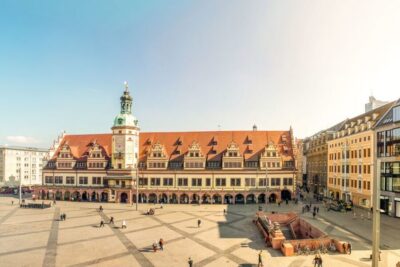
Your tour begins at Leipzig, Markt 1, Altes Rathaus (Old Town Hall), Museum Shop. That matters more than you might think. Market squares in Leipzig are not random waypoints. They set you in the center of everyday city life, so the music story starts in a place that still feels like where people actually lived and moved.
From there, the walk follows the Leipzig Music Trail, which is meant to be followed on foot. You are not just looking at plaques. You are moving through the city as it sounded and felt in earlier centuries, with the guide adding context as you go.
A small practical point: since this is a 90-minute tour, you will not feel rushed, but you also should expect a steady walking pace. Comfortable shoes are a must. Leipzig’s charm is partly in how the city opens up between stops.
Following the Trail With 18th-Century Street Sound Scenes
One of the most memorable ideas in this tour is that it does not only talk about music. It helps you imagine the soundscape around it.
You get 18th-century street noise and musical examples while you walk. The goal is not technical music theory. It is to make the surroundings feel right for what Bach, Wagner, and others were dealing with: everyday life close to performance, churches anchoring sound, and the constant mix of voices, movement, and sound that came through city streets.
I like tours that do this because it changes what you notice. After a short sound-and-context setup, you start paying attention to how space shapes music. You also start seeing how Leipzig could become a place where choral tradition, public concerts, and serious composition were not isolated bubbles. They were part of the same city rhythm.
This is also where your guide’s skill shows. A competent guide can give you just enough detail to make the idea click, without turning the walk into a lecture. And if you care about context, you will likely appreciate the pace and the way questions get handled.
St. Nicholas Church and Bach’s 1723 First Performance as Cantor

The biggest “stop and look” moment is the St. Nicholas Church, where you’ll note a bust of Bach connected to his first performance there in 1723.
Even if you already know Bach’s name, this kind of stop helps you shift from biography as a list of dates to biography as turning points in place. The guide frames why that 1723 event was a notable milestone in his career path, and why Leipzig mattered as a musical center that could shape a composer’s public work.
Standing at a specific point associated with that first performance gives you a physical reference. You can carry it forward after the tour, whether you’re visiting more churches on your own or reading a score and trying to picture what kind of setting it was created for.
Practical consideration: churches are not always guaranteed to be open at every moment. If access is limited, you can still benefit from the route and the guide’s explanation, but your experience will depend on conditions at the time you go.


Bach and Wagner in Leipzig: Same City, Different Musical Missions
Leipzig is one of those rare cities where you can feel the continuity of musical life even when styles and eras change. This tour leans into that.
You are guided through Leipzig’s connections to Johann Sebastian Bach, and you also get Richard Wagner’s Leipzig birth connection. The point is not to reduce them to headlines. It is to show that Leipzig’s music culture had multiple lanes: church music, public concert culture, and professional training all feeding into each other.
Bach represents a deep, structured approach to sacred music and performance tradition. Wagner represents a different kind of musical ambition, one that later became associated with large-scale dramatic writing. Seeing both names tied to Leipzig helps you understand something important: Leipzig was not only a place for one type of music. It was a system that produced and supported musicians in different directions.
If you like your composer stories connected to real geography, you’ll enjoy how this tour treats the city as the “why.” Leipzig’s streets and institutions explain the momentum behind the music, instead of leaving you with names and dates only.
Thomanerchor and Leipzig’s Choral Identity, Explained in Plain Terms
The tour also gives you context for the St. Thomas Church Choir (Thomanerchor), including that it has an 800-year history and that it is beloved well beyond Leipzig.
For many visitors, a choir name can sound like a label. Here, it turns into an idea you can picture: a long-running tradition where performance is not just one-off, it is institutional. The guide connects that choir culture with the broader Leipzig musical environment, where churches and public musical life reinforce each other.
What’s valuable is that you do not need to be a choir expert to get it. The explanation is framed so you can walk away understanding what makes that kind of long-standing tradition special: continuity, training, and public presence.
If you’re planning to see or listen to more in Leipzig after the tour, this choir context is a helpful lens. Even if you do not attend another performance that day, it changes how you interpret what you see around St. Thomas Church and the surrounding music institutions.
Gewandhaus and the Conservatory: Where Leipzig’s Music Becomes Public
Leipzig’s musical reputation is not only church-based. The tour also touches the Gewandhaus, the singers and choir tradition around St. Thomas Church, and the role of the conservatory.
This is a key part of the experience because it explains how Leipzig functions as a music city with both private and public sides. Churches create a certain kind of discipline and tradition. Concert institutions create another kind of visibility and audience interaction. Conservatories add training, professional standards, and continuity for future musicians.
The tour keeps these ideas connected to what you are walking past. That is important. When you tie the institution to the street and the building, Leipzig stops being a “famous music city” slogan and becomes something you can actually trace.
If you like learning by seeing, this section is likely to feel useful. You’ll have a clearer idea of why Leipzig has stayed important across centuries, not just because of famous names but because of how the city organized musical life.
How Much Music You Get, and What Kind
Let’s set expectations up front. This is called a music trail tour, but it is not a full concert experience.
You can expect:
- Musical examples as part of the walking storytelling
- Street sound scenes to recreate the feel of an older city
- Explanations tied to where the music would have happened and why
So if your goal is to hear long performances, expect something shorter and more interpretive. If your goal is to understand Leipzig as a music city, and to get your bearings before a concert or a church visit, this format works well.
I also appreciate that the tour does not overdo numbers. It gives plenty of facts, but the emphasis stays on meaning and connection. That makes it easier to enjoy the walk, not just endure it.
Price and Value for $188 per Group Up to 25
The price is $188 per group, up to 25 people, for a 90-minute city tour. That can be great value if you’re traveling with family or friends because the cost is per group rather than per person.
The practical value question is: what do you get for that money? You get a guided walk that focuses on major Leipzig music pillars:
- the Leipzig Music Trail
- the Bach milestone at St. Nicholas Church
- context around the Thomanerchor
- the city’s connections to Bach and Wagner
If you were to do all of that yourself, you could piece it together with guidebooks and reading. The real advantage here is the pacing and the guide’s ability to connect the dots quickly on foot.
If you’re traveling solo or as a couple, the price might still be reasonable depending on how much you value guided interpretation. It is best when you want a guided route and a strong “orientation to Leipzig music culture,” rather than just a list of sites.
Who Should Book This Tour?
This tour fits best if you:
- Want a guided way to understand Leipzig’s music connections in a short time
- Like choral tradition and want a clearer sense of the Thomanerchor’s importance
- Prefer storytelling that links composers to specific places
- Enjoy walking through a city while learning, without needing deep theory
It may be less ideal if you:
- Are strictly hunting for a concert-length music experience
- Need guaranteed church interior access at every stop
Should You Book Music in Leipzig, Bach, Wagner and the Thomanerchor?
I think you should book it if you want Leipzig to make sense fast. The tour is short, city-centered, and focused on connections that help you interpret what you see later. The St. Nicholas Church Bach milestone and the Thomanerchor context are strong anchor points, and the guide’s approach seems built for people who want facts without a heavy lecture tone.
Skip it only if you’re expecting long performances or you’re mainly looking for quiet time in a single church. This is a guided walk that uses music examples and sound scenes as a teaching tool, and that’s a different kind of experience.
If you’re in Leipzig for a limited time, this tour is a smart way to start. You leave with a map in your head, not just photos on your phone.
FAQ
How long is the tour?
The tour lasts 90 minutes.
Where is the meeting point?
You meet in Leipzig, Markt 1, Altes Rathaus (Old Town Hall), Museum Shop.
Is this a private group tour?
Yes. It is listed as a private group.
What languages is the live guide available in?
The live guide is available in Spanish, English, French, German, Italian, and Russian.
What major sites are included?
The experience focuses on the Leipzig Music Trail, includes St. Nicholas Church (with the Bach bust tied to his first performance as cantor in 1723), and provides context about the Thomanerchor.
How much does it cost?
The price is $188 per group, up to 25 people.
Saxony Beyond Dresden
Everything else we filed on Leipzig
- Leipzig exclusive : Guided bike tour for a private group
★ 5.0 · 11 reviews - Mulled wine ride in the Leipzig New Zealand
★ 4.6 · 12 reviews - Wittenberg Private Walking Tour With A Professional Guide
★ 5.0 · 12 reviews - City tour on foot, by S-Bahn and tram
★ 4.5 · 12 reviews - The classic – experience Leipzig’s city centre
★ 5.0 · 13 reviews - Corpses, Leprosy, Lucifer 75-minute Tour at the Old Cemetery
★ 5.0 · 16 reviews
Leipzig and Saxony Tours, side by side.
 ★ 4.7Leipzig: City History Canal Sightseeing Tour on a MotorboatFrom $186,232 reviews
 ★ 4.6Leipzig: 1.5-Hour Public Tour with Night Watchman BremmeFrom $173,116 reviews
 ★ 4.5Dresden: Elbe River Cruise to Pillnitz CastleFrom $372,411 reviews
 ★ 4.7Combo Tour in Leipzig: Guided City Tour & City SightseeingFrom $252,317 reviews
 ★ 4.7Leipzig: 1.5-Hour Historical Walking Tour in GermanFrom $172,217 reviews
 ★ 4.8Leipzig: 2-Hour Guided Walking Tour in GermanFrom $181,612 reviews
 ★ 4.6Leipzig: 13-Stop Hop-on/Hop-off Bus TicketFrom $281,468 reviews
 ★ 4.5Gruseltour Leipzig: A Haunted Guided TourFrom $211,385 reviews
Other lists this tour is on