
REVIEW · NUREMBERG
Get to know Nuremberg. Highlights in the old town
Nuremberg teaches you fast. This 90-minute, expert-guided walk turns the old town into a clear story, starting at the Henkerhaus and ending back where you began. I love how the route covers both big-name sights and the quieter bits, and I also like that it stays an easy walking pace while still feeling like you learned a lot.
One thing to weigh: this is a German-speaking tour, so if you do not read or speak German, you might have to rely on the visuals and your own pace of understanding. Also, it is a walking tour, so comfortable shoes matter even if the stops are spread out in short chunks.
In This Review
- Key highlights worth showing up for
- A 90-minute Pegnitz walk that gives you bearings fast
- Henkerhaus Museum: the executioner’s house over the Pegnitz
- Der Schöne Brunnen: medieval figures, real water use
- St. Sebaldus Church: Romanesque structure and a saint you can still visit
- Weißgerbergasse: how a crafts street survived the air raids
- Kettensteg chain bridge: early engineering you can actually see
- The route logic: from main market power to craft backstreets
- Value check: what you get for $16.20 and why it feels fair
- What to do before and after: small choices that make the walk better
- Who this tour is best for
- Should you book Nuremberg Highlights in the old town?
- FAQ
- How long is the Nuremberg old town highlights walk?
- Where does the tour start?
- What time does the tour begin?
- What is the price per person?
- What kind of ticket do I receive?
- Is the tour guided in German?
- Which stops are included during the walk?
- Are there admission fees at the stops?
- How many people are in a group?
- What is the cancellation policy?
Key highlights worth showing up for
- Henkerhaus Museum inside a 500-year-old executioner’s house built over the Pegnitz
- Beautiful Fountain (Der Schöne Brunnen) with 40 brightly painted figures and a medieval water setup
- St. Sebaldus Church with late Romanesque features dating to around 1230 and the saint’s grave still inside
- Weißgerbergasse where late-medieval craft life survived World War II largely unscathed
- Kettensteg chain bridge from 1824, described as the oldest surviving all-metal suspension bridge in the German-speaking world
- A compact route that gives you photo-ready moments without turning into a marathon
More of Nuremberg inside the walls
- Nuremberg: Old Town Guided Walking Tour★ 4.6 · 2,416 reviews
- Nuremberg: Tunnels and Secret Passages in the City Wall Tour★ 4.8 · 2,334 reviews
- Nuremberg: Medieval Dungeons Guided Tour★ 4.8 · 1,726 reviews
- Nuremberg: Walking Tour of Former Nazi Party Rally Grounds★ 4.7 · 1,665 reviews
A 90-minute Pegnitz walk that gives you bearings fast
Nuremberg can feel like two cities at once. Yes, you have the famous Christmas-market energy, but the old town also has a serious spine, built along the Pegnitz River and organized around markets, churches, and civic power. This tour is built for that “first real look” feeling, so you leave with a mental map and a reason to care about what you see.
The biggest value is that you get the why, not just the what. You’ll walk from the Hangman’s House area along the Pegnitz, reach the central market zone with the Frauenkirche and the Beautiful Fountain, then continue through the main historic monuments, and finally loop back through Weißgerbergasse and over the Maxbrücke. It is a tight route, but it covers the main ideas of medieval Nuremberg.
Henkerhaus Museum: the executioner’s house over the Pegnitz
Your tour starts at the Henkerhaus Museum at Trödelmarkt 58, right in the heart of the old town. The building is about 500 years old and sits directly over the Pegnitz, which already tells you something about medieval construction and how close daily life was to the river. For centuries, it served as the official residence of the Nuremberg executioners and their families.
What I like about starting here is the perspective shift. Most old towns tell heroic stories, but Nuremberg also has a legal and criminal past, and this exhibition on legal and criminal history makes the subject feel grounded and human. Even if you usually skip “dark history” stops, this one works because it is tied to a real building with a real location.
A practical note: you’re there for about 10 minutes. That is long enough to absorb what you can, but short enough that the tour does not slow down or drag.
Der Schöne Brunnen: medieval figures, real water use
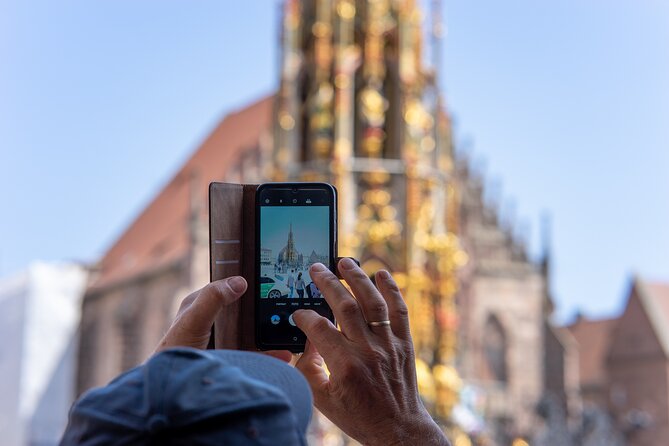
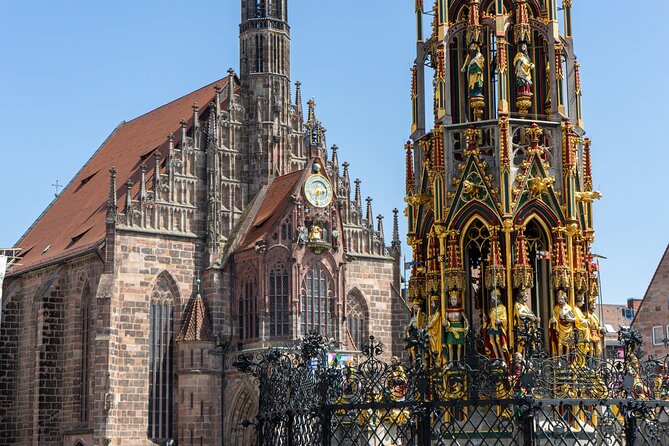
Next comes the Beautiful Fountain, Der Schöne Brunnen, roughly 19 meters high and built between 1385 and 1396. The fountain is decorated with 40 painted figures representing people and themes from history, politics, church, and education, all reflecting the medieval worldview. It is the kind of monument that looks like a postcard, but it is more interesting when you know what you’re looking at.
Here is the extra detail that makes the stop worth your time. In the Middle Ages, fountains like this were not just decoration, they were part of the water supply system. The tube well was supplied with fresh water through a specially installed water pipe, the Schönbrunn pipe, so the fountain sits at the intersection of art and everyday infrastructure.
This stop is also about 10 minutes. If you want a photo, take it when you get your first clear angle, because the group keeps moving and you do not want to spend the whole time hunting for the perfect shot.
St. Sebaldus Church: Romanesque structure and a saint you can still visit
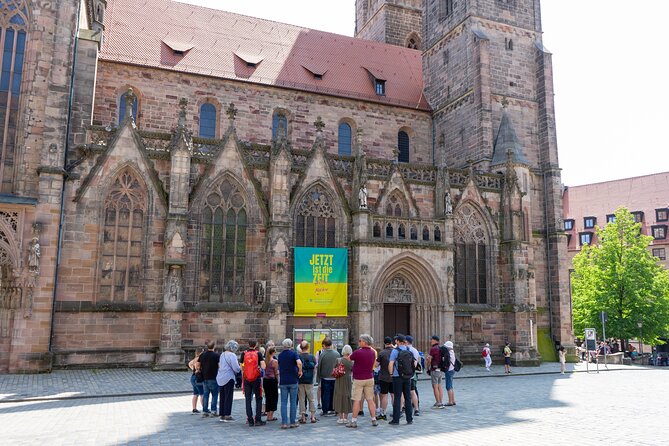
St. Sebaldus Church is one of those places where the architecture and the traditions reinforce each other. The church is described as the oldest parish church in Nuremberg, built around 1230 as a late Romanesque pillar basilica. It is dedicated to Saint Sebald, and his grave is still in the church today.
What you’ll appreciate on this stop is how the church ties to local belief. The saint is associated with blessings and legends, and the guide’s explanations help turn the building from a big stone landmark into something people once visited with real hopes and rituals. Even if you are not religious, you’ll get how community life worked around the church.
Another plus: admission here is free. You can spend your time looking at the structure and absorbing the story without feeling like you’re paying extra for every step forward.
Weißgerbergasse: how a crafts street survived the air raids
From the major monuments, the route turns toward a street that feels more intimate. Weißgerbergasse is the craft lane portion of the walk, and the key point is survival. The houses here largely avoided damage in the World War II air raids, so you can still experience part of the late-medieval character that shaped how Nurembergians lived and worked.
The name points to the people and work that once filled the street. It was home to white tanners, who made fine leather from wild, lamb, and goat skins. You are not just looking at old façades, you’re seeing the physical footprint of a craft economy that mattered to the city.
This is also about 10 minutes. It is a great pace for keeping the tour lively, but if you love street-level details, you might want a quick extra minute when the group finishes, so you can study doorways, wall textures, and the general rhythm of the street.
Kettensteg chain bridge: early engineering you can actually see
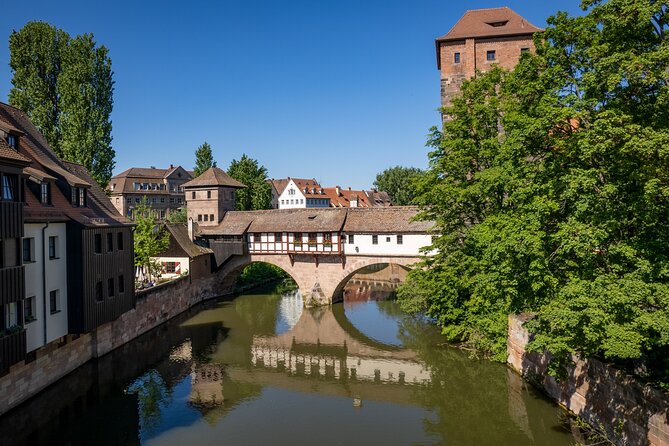
Then the tour shifts to the technical side of Nuremberg. The Kettensteg chain bridge, made in 1824 by the Nuremberg mechanic Georg Kuppler, is presented as a technical marvel of the early industrial age. Today, it is described as the oldest surviving suspension bridge made entirely of metal in the German-speaking world.
This stop works well because it changes your viewpoint. You go from stone, churches, and civic buildings into something that looks modern even though it is old. And since it is a bridge, the guide can help you connect it to how people moved between parts of the old town.
Even though you only get about 10 minutes, it is enough time to understand what you are looking at. If bridges are your thing, you’ll probably enjoy this more than you expected.
The route logic: from main market power to craft backstreets
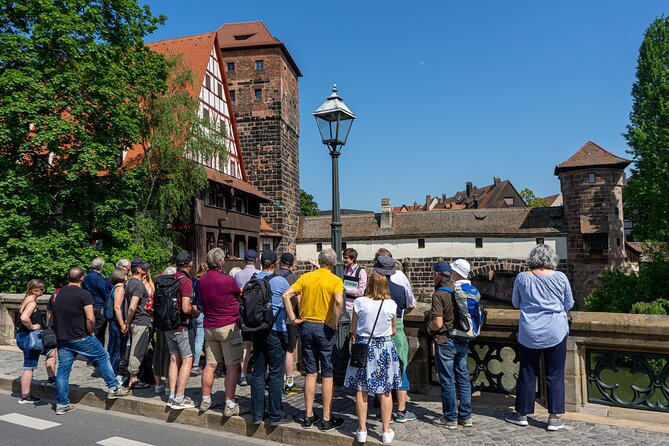
One of the smartest things about the tour is the way it sequences the sights. It flows from the Henkerhaus along the Pegnitz to the main market area, where you encounter the Frauenkirche and the Beautiful Fountain. Then you move into the civic and religious center, with the historic town hall and St. Sebaldus Church, before coming back through Weißgerbergasse and crossing back over the Maxbrücke.
That order matters because it builds a story arc. Market and civic power are not separate from daily life, and the guide’s explanation helps you connect professions, city function, and the buildings that supported them. You also get plenty of real photo spots along the way, with the walk giving you angles rather than just one frontal view.
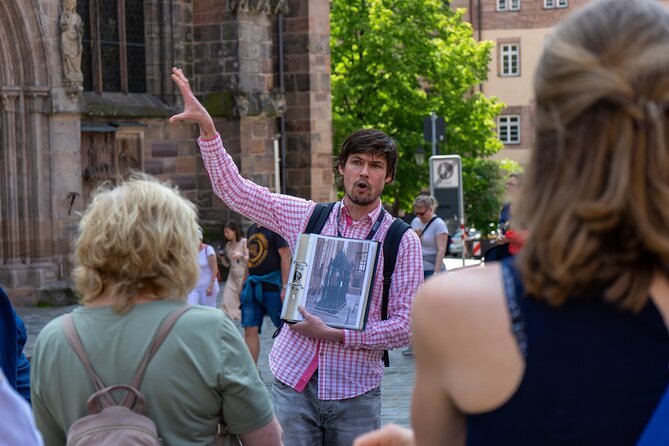
If you like asking questions, this tour style tends to support that. It’s designed as a guided walk, so you can usually get follow-ups in the natural gaps between stops rather than having to wait until the end.
Value check: what you get for $16.20 and why it feels fair
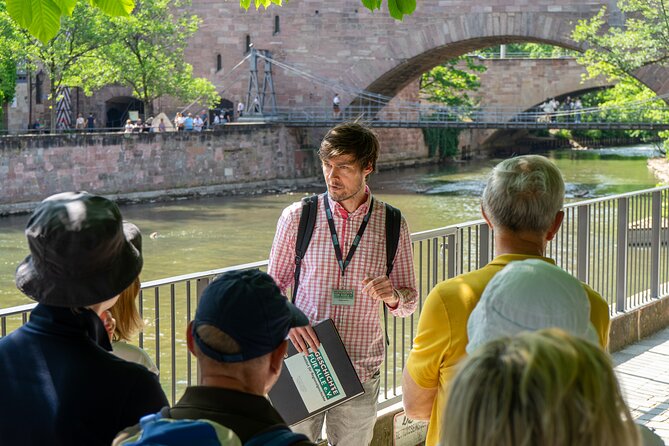
At $16.20 per person for about 1 hour 30 minutes, this is priced like a compact city intro, not a long museum day. The group limit is up to 25 people, which usually keeps things from feeling chaotic. You also get a mobile ticket, which is convenient on a travel day.
Money-wise, the structure is good. The Henkerhaus Museum admission is included, and the other highlighted stops are free, including Der Schöne Brunnen, St. Sebaldus Church, Weißgerbergasse, and Kettensteg. So your fee is largely paying for the guide, the route planning, and the explanation layer that helps you make sense of what might otherwise feel like a list of monuments.
Scheduling matters too. This starts at 2:00 pm, which is a nice middle-of-the-day option when you want something solid but not an all-day commitment. And because it ends back at the meeting point, it’s easy to plug into the rest of your afternoon plans.
What to do before and after: small choices that make the walk better
For a 90-minute old-town walk, your best prep is simple. Wear shoes you can trust on cobblestones and bring a light layer if the weather is changeable, since you’ll be outside for much of the route. If you rely on photos, consider charging your phone fully before you go, since these stops are designed for angles and detail shots.
After the tour, use what you learned to aim your free time. With the story of Pegnitz, water supply, craft life in Weißgerbergasse, and the civic focus around the market area, you’ll notice more on your own. Even if you only have an hour more, you can choose which buildings or streets to revisit with purpose.
Who this tour is best for
This walk makes sense if you want a fast, organized introduction to Nuremberg’s old town. It is especially good if you know the big headline facts, like bratwurst and the Christmas market, but you want the city’s structure and working life explained in plain language.
It also suits first-time visitors. In a short amount of time, you’ll see the major monuments plus the craft street and the bridge, which gives you a well-rounded feel for the city. And because it is described as for most travelers and allows service animals, it tends to be straightforward to join as long as you can handle a compact walking route.
Should you book Nuremberg Highlights in the old town?
I’d book this if you want a guided, walkable orientation that connects monuments to how people actually lived. The standout value for me is the combination of included Henkerhaus entry plus several free stops, with a route that covers market power, church life, craft streets, and an engineering highlight.
Skip it or at least adjust expectations if you only want museums that are fully independent, because this is built around a German-speaking guide and short stop visits. Also, if you do not enjoy walking, 1 hour 30 minutes may feel like too much time on your feet, even if it is paced.
If you fit the sweet spot, this is a smart way to see Nuremberg with fewer wrong turns and more “I get it now” moments.
FAQ
How long is the Nuremberg old town highlights walk?
It is about 1 hour 30 minutes.
Where does the tour start?
The tour starts at Henkerhaus Museum, Trödelmarkt 58, 90403 Nürnberg, Germany.
What time does the tour begin?
The listed start time is 2:00 pm.
What is the price per person?
The price is $16.20 per person.
What kind of ticket do I receive?
You get a mobile ticket.
Is the tour guided in German?
Yes. This tour is German-speaking.
Which stops are included during the walk?
The highlighted stops are Henkerhaus, Der Schöne Brunnen, St. Sebaldus Church, Weißgerbergasse, and Kettensteg, plus the route passes key central sights like the Frauenkirche and the historic town hall.
Are there admission fees at the stops?
Henkerhaus includes an admission ticket, while Der Schöne Brunnen, St. Sebaldus Church, Weißgerbergasse, and Kettensteg are listed as free.
How many people are in a group?
The tour has a maximum of 25 travelers.
What is the cancellation policy?
You can cancel for a full refund up to 24 hours before the experience’s start time. If you cancel less than 24 hours before, the amount you paid is not refunded.
Nuremberg Within the Walls
Everything else we filed on Nuremberg
- Private transfer from Nuremberg to Munich with 2h for sightseeing
★ 5.0 · 4 reviews - Nuremberg Culinary Walking Tour
★ 4.0 · 4 reviews - Nuremberg: World War 2 History Tour with Beer Tasting
★ 5.0 · 4 reviews - PRIVATE – Nuremberg Combo Tour WWII + Old Town
★ 5.0 · 4 reviews - Get to know Nuremberg. Highlights in the old town
★ 5.0 · 4 reviews - Nuremberg Old Town Highlights Private Walking Tour
★ 5.0 · 5 reviews
Nuremberg Old Town and Castle Tours, side by side.
 ★ 4.4Nuremberg: City Tour with the Bimmelbahn TrainFrom $122,475 reviews
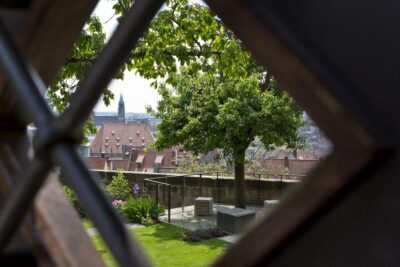 ★ 4.6Nuremberg: Old Town Guided Walking TourFrom $182,416 reviews
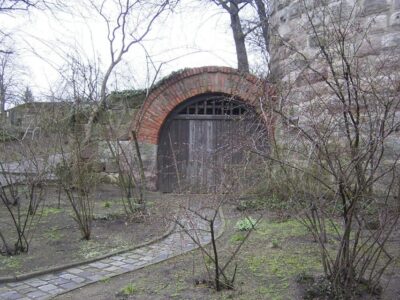 ★ 4.8Nuremberg: Tunnels and Secret Passages in the City Wall TourFrom $142,334 reviews
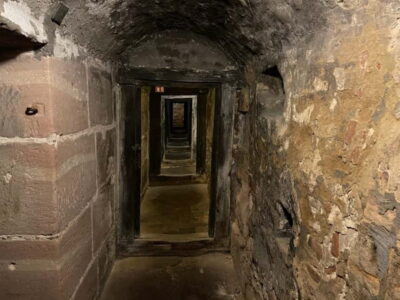 ★ 4.8Nuremberg: Medieval Dungeons Guided TourFrom $111,726 reviews
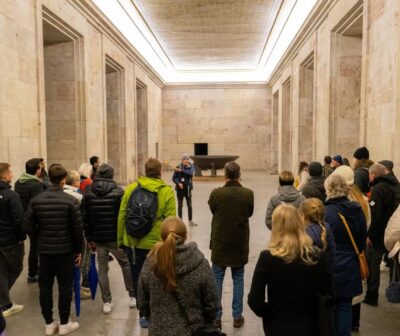 ★ 4.7Nuremberg: Walking Tour of Former Nazi Party Rally GroundsFrom $151,665 reviews
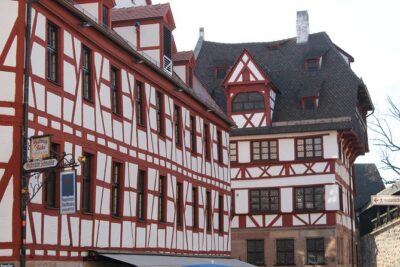 ★ 5.0Medieval Tour in Nuremberg in SpanishFrom $191,374 reviews
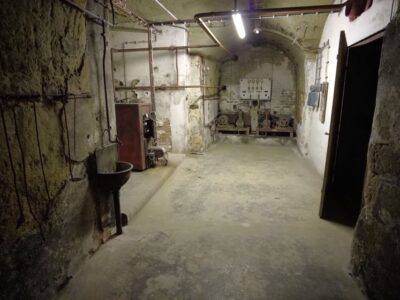 ★ 4.8Nuremberg: Historischer Kunstbunker WWII Art Bunker TourFrom $14921 reviews
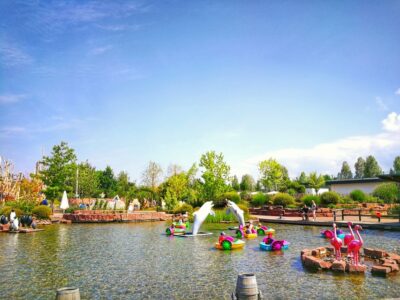 ★ 4.7Nuremberg: PLAYMOBIL®- FunParkFrom $29863 reviews
Other lists this tour is on