

REVIEW · LEIPZIG
Leipzig City Tour 2.0: entertaining on the go mobile projections
Leipzig’s past shows up right on the street. Leipzig City Tour 2.0 pairs a guided walk with mobile projections that make key moments feel visible, not just explained. I also like the modern headsets, because they help you hear the story clearly while still turning to take photos. One drawback to plan for: this is a tech-forward tour, so if you prefer purely traditional sightseeing, the visuals will matter to the experience.
You’re looking at about 90 minutes, and the route stays focused on the city center rather than long museum detours. The group stays small, with a maximum of 30 people, so you can keep up without feeling rushed or swallowed by crowds. The starting point is Richard-Wagner-Straße 13, and you finish back there, making it easy to roll into dinner afterward.
The guiding style feels warm and practical, too. Mario Jung, the owner and guide (and a person who’s been noted for helping with Segway questions), is part of what makes the tour feel like more than a slideshow on a stick. At $18.97 per person, it’s a straightforward way to get meaning out of Leipzig’s landmarks without turning your day into logistics.
In This Review
- Key things I’d circle on your map
- How the City Tour 2.0 projections work while you walk Leipzig
- Richard-Wagner-Straße start, then straight to rail and city passages
- 1989 origin stop, with no church stop planned
- Explaining the column, Leipzig’s first skyscraper, and a GDR-era sculpture
- Augustusplatz to Marktplatz: largest inner-city square and the Leipzig Passenger System
- Stock market stories, hidden marketplace details, and old foundations
- Price, pace, and whether this is worth your time in Leipzig
- Should you book the Leipzig City Tour 2.0
- FAQ
- How long is the Leipzig City Tour 2.0?
- How much does the tour cost?
- Where does the tour start and end?
- Is there a mobile ticket?
- What kind of equipment do you use during the tour?
- Does the tour include a church visit?
- What is the group size limit?
- Can I bring a service animal?
- Is it easy to cancel?
Key things I’d circle on your map
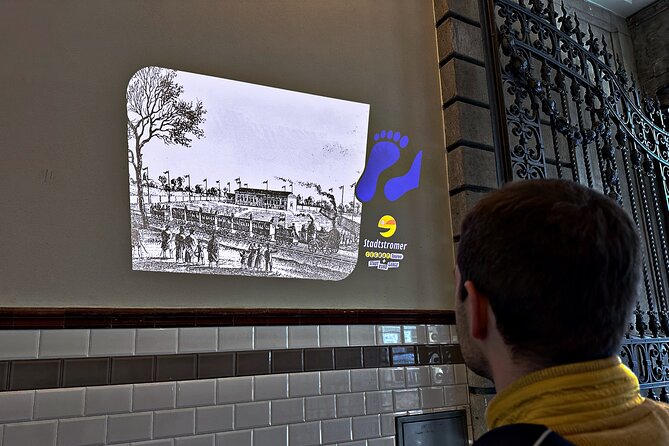
- Mobile projections timed to real locations so history shows up where it happened.
- Modern headsets that let you listen clearly while you look around for photos.
- A route that moves from rail and commerce to 1989 without lingering in church interiors.
- Quick explanations for odd landmarks like why a specific column is there.
- Big city squares, passages, and courtyards you might otherwise walk past.
- Small-group pacing (max 30) for a calmer, more human-feeling tour.
Other Saxon towns we have written up
- Leipzig: City History Canal Sightseeing Tour on a Motorboat★ 4.7 · 6,232 reviews
- Leipzig: 1.5-Hour Public Tour with Night Watchman Bremme★ 4.6 · 3,116 reviews
- Combo Tour in Leipzig: Guided City Tour & City Sightseeing★ 4.7 · 2,317 reviews
- Leipzig: 1.5-Hour Historical Walking Tour in German★ 4.7 · 2,217 reviews
How the City Tour 2.0 projections work while you walk Leipzig
The big idea behind Leipzig City Tour 2.0 is simple: the guide tells you what you’re seeing, and the mobile projections add the missing layer. Instead of standing in front of a plaque and guessing what changed over time, you get visuals that help you connect the dots between old events and today’s streets.
I like how the pace stays walking-friendly. The projections are meant to support what’s around you, not force you into one spot for long minutes. That matters in Leipzig, where courtyards, passages, and building fronts can look similar at a glance. With the guide’s cues, you’re less likely to miss the story hiding in plain sight.
The headsets are part of the value here. You can keep your eyes up, scan facades, and still catch every bit of narration. It also makes it easier to avoid the classic problem of tour audio being swallowed by street noise, wind, or people talking around you.
Finally, the “tech” doesn’t feel like a goal by itself. It’s used as a storytelling tool, especially when the stops get specific, like explaining the origin of the peaceful revolution in 1989 or why certain structures were built when they were.
Richard-Wagner-Straße start, then straight to rail and city passages
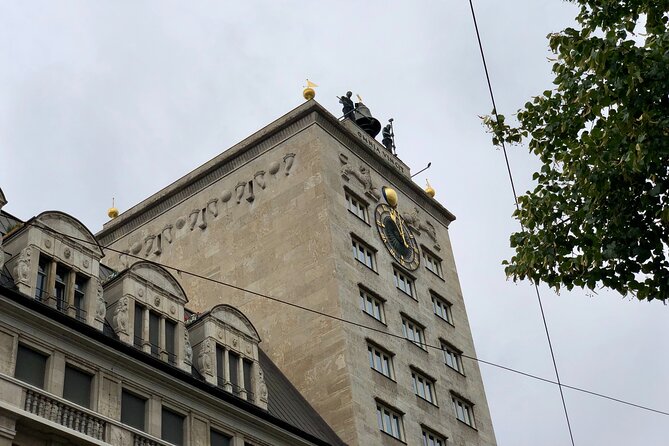
You begin at Richard-Wagner-Straße 13, and the tour’s early moments are about getting your bearings fast. First you get shown the city in a unique way, which sets the tone: Leipzig is not only about one famous sight, it’s about connections. You’re quickly oriented for the rest of the walk.
Then the story turns to the origin of the first German long-distance railway. This is the kind of topic that can sound dry on paper, but the way it’s framed helps you understand why Leipzig mattered for travel and trade. Even if you only know a little German rail history, you’ll walk away with a clearer sense of Leipzig as a hub, not a backwater.
From there, you move into the city’s passages and courtyards, those semi-hidden connectors that shape the cityscape. If you’ve ever wandered through older European centers and felt like you were just bumping from street to street, passages are where you finally feel the rhythm. The guide helps you read them like a map, not a maze.
One thing I appreciate about this segment is that it doesn’t rely on you already knowing what to look for. You’re given context for what you’re seeing, which is ideal if Leipzig is a first visit or if your day is short. It’s also why this tour works well even if you don’t love museums: the city itself becomes the exhibition.
1989 origin stop, with no church stop planned
A major highlight in the route is the origin of the peaceful revolution in 1989. This part of the tour is valuable because it connects politics and everyday city life. Leipzig was not just a distant headline, it was a real place where ideas turned into action.
What I like is the straightforward approach: you’re not pulled into church interiors for the story. The tour explicitly keeps that element out, so you’re not stuck waiting outside while you figure out where you’re allowed to go. Instead, you stay focused on the surrounding setting and what it meant at that time.
This is also where the projections can help, because modern streets can make past events feel far away. When the narration ties the moment to the physical space, it’s easier to hold onto the significance. You’re not just learning dates. You’re learning how a city’s layout, gathering points, and public life can shape history.
If you’re sensitive to crowds and long indoor stops, this “no church” choice is a plus. It keeps the flow moving and respects the fact that not everyone wants to trade one type of structure for another.
Explaining the column, Leipzig’s first skyscraper, and a GDR-era sculpture
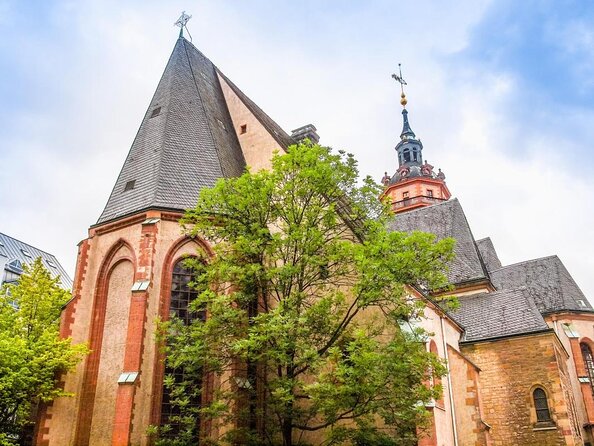
After the 1989 context, the tour turns to the kinds of details that most people walk past. You get a stop where the guide clarifies why a column is there. That sort of explanation sounds small, until you realize columns and monuments often reflect decisions, symbolism, and power, not just architecture. You start noticing how meaning gets built into the city.
Next comes the city’s first skyscraper, which still offers something special today. This stop helps you contrast different eras in a single glance. You’ll see how Leipzig has kept modern ambition in its skyline while older layers remain present nearby.
Then the route surprises you again with a sculpture that is astonishing for the time of the GDR, and you get the explanation behind why it could be erected. That’s the kind of story that gives you momentum. You walk away thinking about what was allowed, what was possible, and how art could carry messages even under pressure.
The common thread across these stops is interpretation. Instead of treating landmarks like screenshots, you learn what questions to ask. Why here? Why then? Why this form? That’s what makes a tech-assisted city tour feel like more than a gimmick.
And because the headset audio keeps you on track, you can enjoy the details without having to sprint to catch up with the group.
The wider Leipzig sightseeing pile



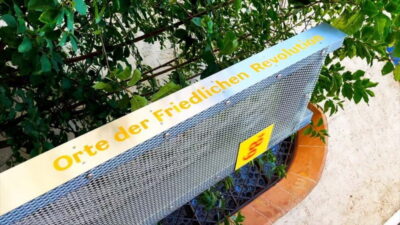
Augustusplatz to Marktplatz: largest inner-city square and the Leipzig Passenger System
The tour gives you a sense of Leipzig at multiple speeds. One segment focuses on more than just a connection between Augustusplatz and Marktplatz. The guide frames it as a lived corridor, not a line on a map, which makes the space feel purposeful.
You also hit what’s described as the largest inner city square in Germany. A square like this is usually where you see big, open space, and that can feel generic unless someone tells you why it matters. Here, the guide’s narration gives you a reason to stand still, even if just for a few minutes.
Another standout is the Leipzig Passenger System today connecting to Hansa-Hof. This is where the tour feels grounded in daily movement. You learn that city systems are layered, and that today’s convenience often has older roots. If you like practical urban history, this part hits.
And along the way, there’s room for the small human details, like pointing out a spot where you can still enjoy a snack even today. Those little cues are useful because they help you keep planning your own time. You’re not just learning, you’re also getting a sense of where to pause later.
If you’re a photo person, this section is built for it. You have open views across major squares, plus tighter angles near passages and connections. With the headsets, you can stop and frame shots without losing the narration.
Stock market stories, hidden marketplace details, and old foundations
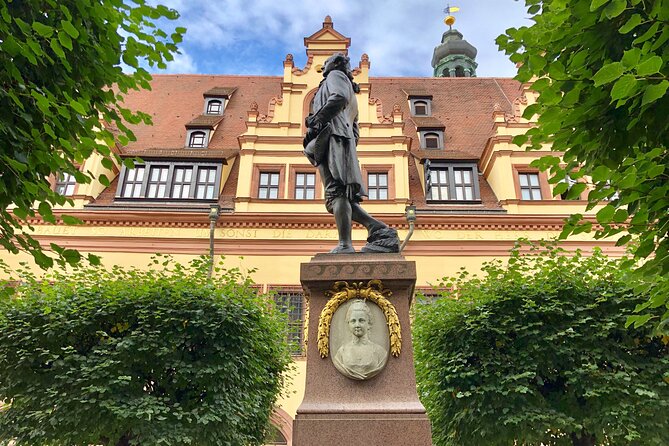
The tour leans into commerce as a thread through Leipzig. In a city of commerce, the stock market was irreplaceable, and you’re given the reasoning behind why. This isn’t just a trivia stop. It helps you understand how money, networks, and communication power shaped what got built where.
Then you stand at the Old Town Hall area and learn that the marketplace has hidden a lot. That phrasing matters because it pushes you to look past what’s obvious. Market squares can feel like they’re only there for shopping and events, but the guide encourages you to spot what the space has quietly absorbed over time.
One of my favorite types of city tours is where the guide points out that a building is on old foundations. Here, you’re shown that you can see it, and the story connects the present structure to what came before. That helps you read Leipzig as layered, not reset every few decades.
The route also includes a stop that connects the market square with what’s called the tin can. Even if you only remember the nickname, you’ll appreciate the guide’s attention to how places connect. Cities are not collections of isolated sights. They are systems of movement, commerce, and public life.
Finally, you get back to the start and finish, which makes the tour feel self-contained. You can plan your rest of the day without guessing how far you’ll end up from Richard-Wagner-Straße 13.
Price, pace, and whether this is worth your time in Leipzig
At $18.97 per person for about 90 minutes, you’re paying for three things: a guided route, headsets, and the mobile projection layer that adds context at specific stops. The value is strongest if you want Leipzig’s story stitched together, rather than hopping between sights with guesswork.
The pace is also part of the bargain. This is not a half-day slog, and the route sounds designed to keep you moving while still stopping enough times to make the explanations land. With a maximum of 30 travelers, you also avoid that “standing behind strangers” problem that can happen on popular walks.
Who this suits best:
- First-time visitors who want a clean overview of Leipzig’s key ideas fast
- Travelers who like tech-supported storytelling but still want a real walking route
- People who prefer outdoor history explanations over long indoor museum time
Who might feel less thrilled:
- If you hate any form of projection or want zero gadget involvement, this will probably feel more structured than you like
- If you’re hoping to spend a lot of time in church interiors or museums, this tour intentionally does not go there
One more practical point: the tour is near public transportation, which helps if you’re juggling a busy itinerary. Service animals are allowed, and confirmation comes at booking, so you’re not left guessing.
Should you book the Leipzig City Tour 2.0
I’d book it if you want a guided Leipzig walk that makes you understand the city, not just see it. The combination of mobile projections, headsets, and a route that moves through rail beginnings, 1989, and commerce-focused landmarks is a smart way to get multiple layers in a short time.
Skip it only if you know you dislike tech-assisted storytelling or you want a classic, low-structure walking tour with no projection moments. Otherwise, this is a strong value pick when you want your time in Leipzig to feel meaningful and your photos to come with context.
FAQ
How long is the Leipzig City Tour 2.0?
It’s approximately 1 hour 30 minutes.
How much does the tour cost?
The price is $18.97 per person.
Where does the tour start and end?
The tour starts at Richard-Wagner-Straße 13, 04109 Leipzig, Germany, and it ends back at the meeting point.
Is there a mobile ticket?
Yes, this experience uses a mobile ticket.
What kind of equipment do you use during the tour?
You’ll have modern headsets so you can listen while looking around and taking photos without missing the narration.
Does the tour include a church visit?
No, the tour does not go to a church.
What is the group size limit?
The tour has a maximum of 30 travelers.
Can I bring a service animal?
Yes, service animals are allowed, and most travelers can participate.
Is it easy to cancel?
Free cancellation is available up to 24 hours in advance for a full refund.
Seeing Leipzig in One Go
Saxony Beyond Dresden
Everything else we filed on Leipzig
- Leipzig exclusive : Guided bike tour for a private group
★ 5.0 · 11 reviews - Mulled wine ride in the Leipzig New Zealand
★ 4.6 · 12 reviews - Wittenberg Private Walking Tour With A Professional Guide
★ 5.0 · 12 reviews - City tour on foot, by S-Bahn and tram
★ 4.5 · 12 reviews - The classic – experience Leipzig’s city centre
★ 5.0 · 13 reviews - Corpses, Leprosy, Lucifer 75-minute Tour at the Old Cemetery
★ 5.0 · 16 reviews
Leipzig and Saxony Tours, side by side.
 ★ 4.7Leipzig: City History Canal Sightseeing Tour on a MotorboatFrom $186,232 reviews
 ★ 4.6Leipzig: 1.5-Hour Public Tour with Night Watchman BremmeFrom $173,116 reviews
 ★ 4.5Dresden: Elbe River Cruise to Pillnitz CastleFrom $372,411 reviews
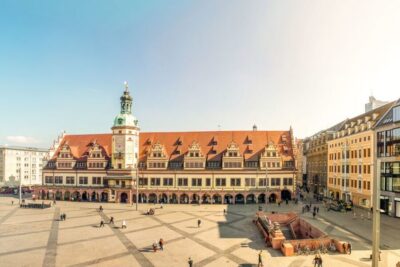 ★ 4.7Combo Tour in Leipzig: Guided City Tour & City SightseeingFrom $252,317 reviews
 ★ 4.7Leipzig: 1.5-Hour Historical Walking Tour in GermanFrom $172,217 reviews
 ★ 4.8Leipzig: 2-Hour Guided Walking Tour in GermanFrom $181,612 reviews
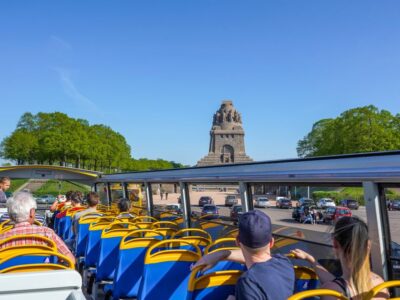 ★ 4.6Leipzig: 13-Stop Hop-on/Hop-off Bus TicketFrom $281,468 reviews
 ★ 4.5Gruseltour Leipzig: A Haunted Guided TourFrom $211,385 reviews
Other lists this tour is on