
REVIEW · E-BIKES
Best of Munich Electric Bike Tour
Munich can feel huge on foot. This electric bike tour keeps you moving while a live guide points out what you should notice, from Neo-Classic fountains to beer garden rituals.
What I like most is the e-bike assist, which makes the ride comfortable even if you are not trying to train for the Olympics. I also like how the stops mix major sights with small, specific details, so you get the why behind the buildings, not just the what.
The one thing to consider is the pace. Many stops are quick look-and-snap moments rather than long museum time, and with a group that can run up to 20, you may feel the flow is more guided than wander-y.
In This Review
- Quick takeaways before you book
- Why an e-bike tour is the smart way to see Munich’s center
- The 4-hour rhythm, what the ride actually feels like
- Start at Wittelsbacherbrunnen, where the city’s story begins with water
- Karolinenplatz and Königsplatz, a lesson in Bavarian style and power
- The Führerbau stands today, and that matters
- Art on two extremes: Old Masters to modern design
- Siegestor and Odeonsplatz, victory and rupture in the same skyline
- Residenz and Hofgarten, royal splendor plus a real breathing break
- Bayerische Staatskanzlei and the modern layers over older military space
- The English Garden at speed, and why it still lands
- Chinesischen Turm beer garden, where Hofbräu is part of the vibe
- Eisbachwelle, the surfing wave in a city river
- Friedensengel and Maximilians Park, a peace monument with a view
- Maximilianeum and the Deutsches Museum, civic life meets big science
- Viktualienmarkt for the food mood, then Ohel Jakob for modern faith
- Guide style, pace, and safety: why the name on the tour matters
- Price and value, is $71.90 worth it?
- Who should choose this Munich electric bike tour
- Should you book the Best of Munich electric bike tour?
- FAQ
- How long is the Best of Munich electric bike tour?
- What is included in the price?
- Is the tour offered in English?
- Where do I meet for the tour?
- Are food and drinks included?
- What is the cancellation policy?
Quick takeaways before you book
- E-bike comfort helps you cover a lot without getting wiped out
- English-speaking live guide makes the city make sense fast
- Big-sight mix from the Residenz to the English Garden to the Deutsches Museum
- Beer culture included by option, with an extra-cost beer hall tasting
- Stop variety runs from major architecture to the Eisbachwelle surf wave
- Small group cap (20) keeps it personal, but you still ride in a pack
More handlebar time in Munich
- Munich 3-Hour Guided Bike Tour★ 4.5 · 1,731 reviews
- Classic Mike’s Bike Tour daily @ 11.30 incl Beer Garden & Surfers★ 5.0 · 1,246 reviews
- Neuschwanstein Castle by Bus Incl. Bike Ride or Hohenschwangau★ 5.0 · 607 reviews
- Munich: Classic Guided City Tour by Bike (English Tour Only)★ 4.7 · 534 reviews
Why an e-bike tour is the smart way to see Munich’s center
Munich has a reputation for being easy, but easy still adds up. A traditional walking tour can turn into constant stop, start, and battery-draining stairs. Here, the electric bike and helmet help you keep momentum, so the “best of” part feels like value instead of a workout you did not ask for.
The other big win is control. You get a guide-led route that helps you avoid the guesswork of where to go next, especially when the sights are scattered across major squares and museum areas. In a few hours, you can see how different eras shaped the city, from 19th-century classicism to WWII-era memory sites to modern civic buildings.
The 4-hour rhythm, what the ride actually feels like
This is an around-town loop based out of the Karlsplatz area, with the tour ending back at the starting point. Expect frequent stops to hop off, look around, and get a quick explanation before you move on.
A tour like this works best if you want an overview and context. If you want to read every plaque and linger in every gallery, you will probably still do that after, because this experience is built for getting your bearings fast, then sending you back to your favorites.
Also, Munich weather can be changeable. You should plan for rain the way you would for any city ride: surfaces can get slick, and your comfort matters more on a bike than on foot. One negative note that showed up in experiences is that plans do not always go perfectly when cancellations happen, so it is worth having a backup idea for the day if your schedule is tight.
Start at Wittelsbacherbrunnen, where the city’s story begins with water
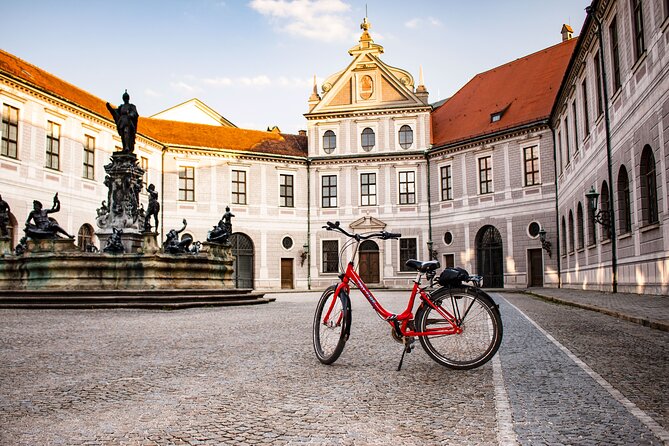
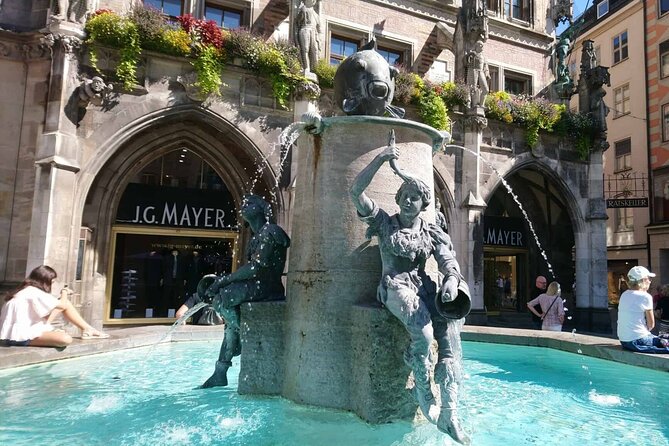
The tour opens at Wittelsbacherbrunnen, a monumental fountain at the transition between Lenbachplatz and Maximiliansplatz. It was built in the 1890s, between 1893 and 1895, designed by sculptor Adolf von Hildebrand in a Neo-Classicist style.
What I like about starting here is that it sets the tone. Munich often looks polished and “official,” and this fountain actually shows a design idea, not just a pretty backdrop. The fountain is described as an allegory for the primal forces of water, which is a great way to hear the city as more than postcards.
Karolinenplatz and Königsplatz, a lesson in Bavarian style and power
Next up is Karolinenplatz in the Maxvorstadt district. It is connected to the Strahlenplatz motif, and it also has a political meaning. The square symbolizes the relationship between Bavaria and France in the early 19th century, and it is named after Queen Caroline of Bavaria.
Then you roll into Königsplatz, also in the same broader museum quarter orbit. This is where the Neoclassical vibe becomes concrete. The space includes the Propyläen Gate, and opposite it you have the Glyptothek and the Staatliche Antikensammlungen. Nearby is Kunstareal, Munich’s gallery and museum quarter, which helps explain why this part of the city is so tightly packed with art institutions.
A quick reality check: at both Karolinenplatz and Königsplatz, your time on the ground is short. You get context, but you will not “do” the museums in this same window. Still, the payoff is that you leave knowing which buildings are which, so your later museum visit is way more efficient.
The Führerbau stands today, and that matters
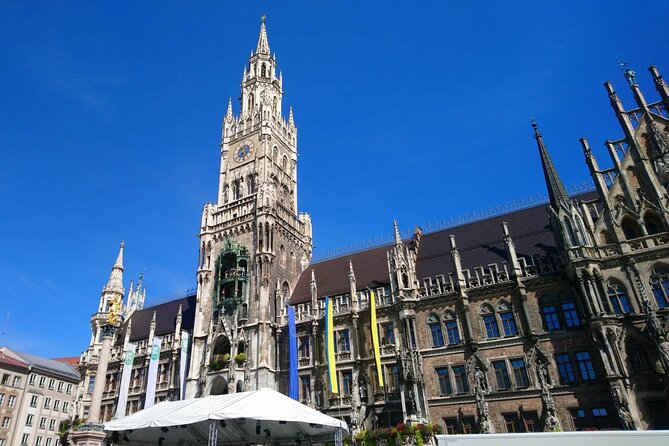
One stop that will stay with many people is the Führerbau at Arcisstrasse 12. The name is tied to its Nazi-era use. It was built between 1933 and 1937 and used extensively by Adolf Hitler.
Unlike many other Nazi-linked sites that no longer exist, this one still stands, and today it houses the University of Music and Performing Arts Munich. That contrast can feel uncomfortable, but it is also part of how cities deal with their past: you do not erase the buildings, you reframe them in time.
If you are sensitive to that kind of history, consider mentally preparing for it before you reach this stop. The upside is you get factual anchors, not vague hand-waving, and you can choose how much you want to reflect during the quick viewing moment.
Art on two extremes: Old Masters to modern design
The tour then swings toward art institutions with two very different identities.
First is Alte Pinakothek, the Old Pinakothek. It is described as one of the oldest galleries in the world and home to a major collection of Old Master paintings. Even if you do not step inside for a long look, the stop works because it tells you what kind of art house you are near, and why it matters historically.
Next is Pinakothek der Moderne, the modern-art and design-focused powerhouse that groups multiple collections in one building, including modern and contemporary art, works on paper, design and applied arts, and even a museum for architecture.
The practical value here is simple: after a ride like this, you can make a better decision about what to see next. If you are more into paintings, you know where to go. If you are into design, architecture, and modern art concepts, you know where to spend your time.
Siegestor and Odeonsplatz, victory and rupture in the same skyline
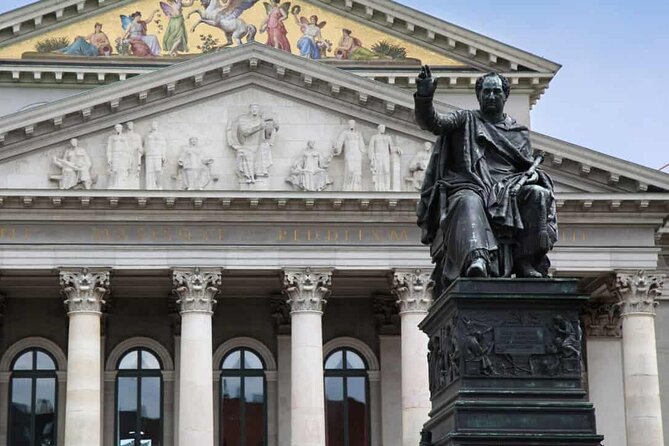
You move on to Siegestor, a three-arched memorial arch crowned with a statue of Bavaria with a lion-quadriga. Originally it celebrated the glory of the Bavarian army, but after restoration following World War II, it now stands as a reminder to peace.
Right after that is Odeonsplatz, a large central square developed in the early 19th century. It was shaped by Leo von Klenze and related urban development along Ludwigstraße. The square is tied to the Odeon concert hall, and it is also known for a fatal gun battle during the 1923 Beer Hall Putsch.
This part of the route gives you a real feeling for Munich’s layers. One moment is commemorative design, next is political violence and consequence. It is not just pretty stone. It is memory written into public space.
Residenz and Hofgarten, royal splendor plus a real breathing break
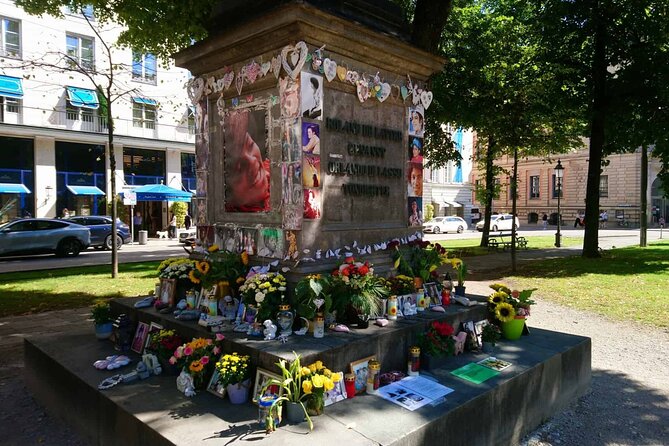
Then you reach the Residenz Munchen, the former royal palace of the Wittelsbach monarchs. The description calls it the largest city palace in Germany, open for visitors today with architecture, room decorations, and displays of former royal collections.
After that, you get a calmer stop: Hofgarten, built between 1613 and 1617 by Maximilian I. It is described as an Italian Renaissance garden style, with a pavilion for the goddess Diana built in 1615. If you have been riding and staring up at facades, this is a nice reset. Even a short stop in the garden helps your brain file the city as more than monuments.
One small consideration: because this is a bike tour, your time in these spaces may feel like a quick orientation rather than a deep visit. If palaces and gardens are your obsession, plan to come back later.
Bayerische Staatskanzlei and the modern layers over older military space
Your route also includes Bayerische Staatskanzlei, the building that houses Bavaria’s chancellery staff. It was erected from 1989 to 1993 around the central dome of the former Bavarian Army Museum, which had been built in 1905 at a site that was once Hofgartenkaserne barracks, then demolished in WWII.
I like this stop because it shows how cities reuse meaning instead of starting over. You are seeing a modern state building while standing on a site shaped by earlier military purpose and wartime loss. That is the kind of context that makes Munich feel like a living system, not a checklist.
The English Garden at speed, and why it still lands
One of the most famous pauses is Englischer Garten, one of the world’s largest urban public parks. It is described as 3.7 km² (370 hectares), and the name refers to its English garden form, an informal landscape style from the 18th to early 19th centuries.
Even on a bike, the park is a major “this city has room to breathe” moment. If you only know Munich as a beer-and-boats-from-the-bus type of place, this stop corrects that quickly.
Your drawback here is time. You will not “walk the whole park” on this tour. But you will leave understanding why locals go there for daily life, not just photos.
Chinesischen Turm beer garden, where Hofbräu is part of the vibe
The beer stop is at Biergarten am Chinesischen Turm. This is a classic outdoor Munich beer garden setup with shared tables under trees. Beer gardens started in Bavaria in the 19th century, and Munich is their home base.
The details here are excellent. There has been a beer garden run by Antje Schneider since 1974, and it has 7,000 seating places, described as the second largest in Munich after Hirschgarten. It sells Hofbräu beer and is one of the most famous tourist-friendly beer garden scenes in the city.
If you are a beer person, this is the practical win: you can take a break without turning your day into a long sit-down meal. Just remember that food and drinks are not included, so you should treat this as a choose-your-own-adventure moment.
And separate from this garden, the tour also offers a traditional beer sample at a legendary beer hall for an extra expense. If you care about classic beer hall culture, it is worth factoring in that add-on cost.
Eisbachwelle, the surfing wave in a city river
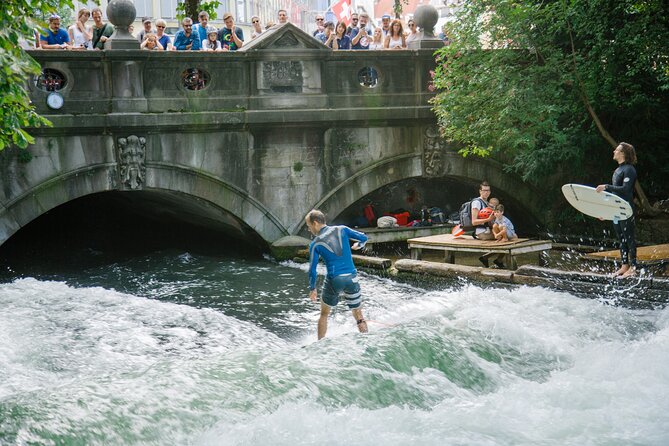
One of the coolest surprises is Eisbachwelle. It is just past a bridge near the Haus der Kunst art museum, where the river forms a standing wave about one meter high. This is a popular river surfing spot.
Important practical detail: the water is cold and shallow, sometimes only around 40 cm deep, and it is described as suitable only for experienced surfers. As a rider, you are mostly here to watch, not to try. But it is such an unmistakably Munich weirdness that it earns its place on a Best Of list.
If you like scenes where people do unexpected things, this will be a favorite stop.
Friedensengel and Maximilians Park, a peace monument with a view
Next you reach Friedensengel, the Angel of Peace, part of Maximilian Park and set on a line of sight connected to Prinzregentenstrasse. It is next to the Isar, slightly elevated above street level, and includes an open space with a fountain that sprays water from a dolphin waterspout plus four smaller ones.
There is also a big viewpoint component: two staircases lead to an observation deck. The column is 38 meters high, Corinthian style, topped with a six-meter statue of the Angel of Peace. It is described as a replica of the Nike of Paeonius.
This stop is about perspective in more than one way. Even if your time here is short, you get a reminder that Munich plans sights as visual anchors, not just backdrops.
Maximilianeum and the Deutsches Museum, civic life meets big science
Two very different “institution” moments follow.
Maximilianeum is described as a palatial building. It was built as a home for a gifted students foundation, and since 1949 it has housed the Bavarian State Parliament. That is an unusual origin story, and it gives the building more personality than you might expect.
Then you roll toward Deutsches Museum, described as the world’s largest museum of science and technology. It has about 125,000 exhibited objects across 50 fields, with about 1.5 million visitors per year.
Here’s the value for you: even if you do not tour it inside on the day, the stop tells you this museum is not a small specialty place. It is massive. If your group includes science lovers, you can plan a separate day around it later.
Viktualienmarkt for the food mood, then Ohel Jakob for modern faith
Near the end, you get a lively market stop at Viktualienmarkt, which grew from a farmers market into a gourmet market. It is described as 140 stalls and shops, with items like flowers, exotic fruit, game, poultry, spices, cheese, fish, and juices.
Even a short visit can help you understand what Munich tastes like. It also sets you up for practical decisions afterward. You will know what ingredients and food types you should look for when choosing lunch or a snack.
Finally, the tour includes Ohel Jakob Synagogue, the Jewish congregation synagogue at Sankt-Jakobs-Platz. It was built between 2004 and 2006 as the new main synagogue for Munich’s Jewish community. It was inaugurated on 9 November 2006, on the 68th anniversary of Kristallnacht.
This stop adds a modern civic and religious chapter to the day’s story. It is not just another building. It helps show Munich as a city that continues to build and serve community life.
Guide style, pace, and safety: why the name on the tour matters
Fat Tire Tours Munich runs this experience with a live guide, electric bikes, and a helmet. The guides stand out in the way they handle pacing and group dynamics, especially in a city environment where narrow spots and traffic can be distracting.
In particular, I like that this tour design seems to favor “read the group” attention. Multiple guides are described as watchful about safety and good at keeping everyone together. That matters because you are riding, not walking, and a calm group is a calmer experience.
You will likely get an English narrative that mixes architecture with stories and practical recommendations. Guides like Rob, Cannan, Susanna, Karl, Mark, Dan, and Suzanne are named across experiences as standout communicators, with people praising their ability to connect facts to what you are seeing right now.
One more practical note for your expectations: many stops are quick, so the guide’s explanations are a big part of the value. If you ask questions, you can usually get very specific suggestions for what to do next in Munich.
Price and value, is $71.90 worth it?
At $71.90 per person for about four hours, the math works best if you value time and context. This cost includes the live guide plus the electric bike and helmet. Food and drinks are extra, so if you plan to add the beer hall sample, budget for that separately.
Where this price feels fair is the combination:
- You cover a lot of ground without the energy drain of all-walking
- You hit key sights in multiple city areas
- You get explanations that help you prioritize what you want to revisit later
If you only care about one or two neighborhoods and you love planning your own day, you might find cheaper free-form alternatives. But if you want an organized first pass through Munich that also helps you understand the city quickly, this is a solid deal.
Who should choose this Munich electric bike tour
This is a great fit if you are:
- A history buff who wants context tied to specific buildings and squares
- A beer fan who wants a classic Munich break at a major biergarten
- A first-time visitor who wants structure without feeling trapped
- Someone who wants to ride a flat route with less fatigue, thanks to e-bike assist
It may be less ideal if you:
- Want long museum visits during the same tour window
- Get overwhelmed in larger groups when bikes are packed together
- Have limited mobility or comfort with sitting and stopping frequently, since you are on a bike for the full loop
Should you book the Best of Munich electric bike tour?
I would book it if your goal is a fast, guided overview that connects Munich’s landmarks to real stories, plus a breather in beer garden territory. The e-bike makes the day feel doable, and the mix of squares, palaces, parks, and even the Eisbach surf wave gives you a Munich experience that is not just one theme.
I would think twice if you have to hit very specific museum times, because the stops are built for quick viewing and orientation. Also, if your schedule is unforgiving, keep a backup plan in mind, since cancellations can happen and plans sometimes shift.
If you want an efficient first look at Munich with a guide who keeps things moving and makes the city click, this tour is the kind of ticket that saves you from wasting your best hours figuring out where to start.
FAQ
How long is the Best of Munich electric bike tour?
It runs for about 4 hours.
What is included in the price?
The tour includes a live guide, an electric bike, and a helmet.
Is the tour offered in English?
Yes, it is offered in English.
Where do I meet for the tour?
The meeting point is Karlsplatz 4, 80335 München, Germany.
Are food and drinks included?
No. Cost of food or drinks is not included.
What is the cancellation policy?
You can cancel for free up to 24 hours in advance for a full refund. If you cancel less than 24 hours before the start time, the amount you paid will not be refunded.
The Munich Bike Lanes
Everything else we filed on Munich
- Munich Beer and Bavarian Bites Private Tour
★ 5.0 · 11 reviews - Private Day Trip from Munich to Neuschwanstein and Linderhof
★ 4.0 · 11 reviews - Private Munich Old Town Walking Tour – with optional Breakfast
★ 5.0 · 11 reviews - Festive Concert in the All-Saints Court Church
★ 4.6 · 11 reviews - Private Castle Tour from Munich: Neuschwanstein, Hohenschwangau, and Linderhof
★ 4.5 · 12 reviews - Munich: Oktoberfest Big Beer Tent Evening including table reservation
★ 4.8 · 12 reviews
E-Bikes, side by side.
 ★ 5.0Best of Berlin E-Bike TourFrom $6477 reviews
 ★ 4.7Berlin: E-Bike Tour of the Berlin Wall and Mitte HighlightsFrom $4860 reviews
★ 5.0Best of Berlin E-Bike TourFrom $6537 reviews
★ 4.7Berlin: E-Bike Tour of the Berlin Wall and Mitte HighlightsFrom $4860 reviews
★ 5.0Best of Berlin E-Bike TourFrom $6537 reviews
 ★ 4.9Dresden: E-Bike Tour and Dresden Heath Forest TrailsFrom $6234 reviews
 ★ 4.7Best of Munich Electric Bike TourFrom $7023 reviews
 ★ 4.8Frankfurt: Unique E-Bikes ToursFrom $7822 reviews
 ★ 4.6Frankfurt: Full-Day Bicycle or E-Bike RentalFrom $2216 reviews
 ★ 4.5Berlin Bike and Electric Bike RentalsFrom $612 reviews
Other lists this tour is on