
REVIEW · WESTPHALIA
e-Scavenger hunt Paderborn: Explore the city at your own pace
Paderborn turns into a game on your phone. This self-paced e-scavenger hunt mixes a light online challenge with a walk through standout old-town spots. I like the mobile game format because it keeps you moving without feeling like a chore, and I also like that the route hits major sights in a logical order. One drawback to plan for, you do need a working smartphone and your own data, since that is not included.
You’ll spend about 2 to 4 hours wandering, then looping back to where you started near Liboriberg. It’s offered in English, and it works for a private group, so you’re not squeezed into a big crowd. There are stops for quiet pauses too, including a central square where you can grab a drink and reset your legs.
In This Review
- Key highlights worth knowing first
- Why this e-Scavenger hunt in Paderborn feels different
- Getting started near Liboriberg parking
- Stop 1: A calm square to reset your pace
- Stop 2: The half-timbered gable house and the Adam and Eve frieze
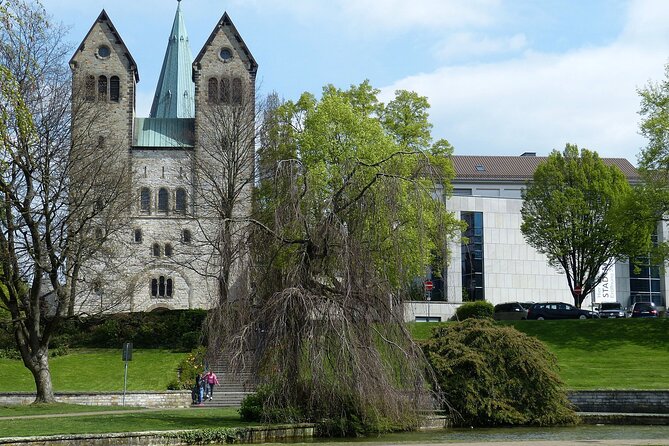
- Stop 3: Abdinghof Monastery, Petrus und Paulus, founded in 1015
- Stop 4: Bartholomäuskapelle, famous hall-church acoustics
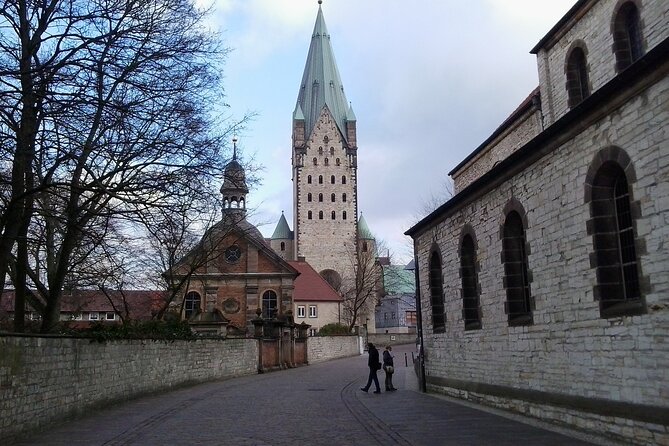
- Stop 5: Paderborn Cathedral and its trio of saints
- Stop 6: Marktkerk, Jesuit roots, and the first University of Westphalia
- Stop 7: The modern shopping street section, a real city break
- Stop 8: Neptune Fountain, Josef Rikus, 1977 to 1979
- Stop 9: Friedrich von Spee, reading a book in bronze
- Stop 10: The Paderborn town hall with three gables
- Stop 11: Follow the Pader headwaters path
- Price and logistics: how $36.69 per group can be good value
- Best way to do this hunt without getting stuck
- Who should book the Paderborn e-Scavenger hunt
- Should you book this e-Scavenger hunt in Paderborn?
- FAQ
- Where does the e-Scavenger hunt in Paderborn start?
- Where does it end?
- How long does the activity take?
- What language is it offered in?
- What is included in the experience?
- Do I need my own smartphone and data?
- Can I cancel for free?
Key highlights worth knowing first
- Phone-led clues, not a traditional guided tour, so you control timing and breaks
- A smart old-town route with famous stops like Paderborn Cathedral and the half-timbered carvings
- Historic acoustics at Bartholomäuskapelle, where the building’s sound reputation is the point
- Perfect photo targets close together, including the Neptune Fountain and a Friedrich von Spee statue
- Group value up to 6, priced per group rather than per person
- Walkable by design, ending back at the same starting point near Liboriberg
More Westphalian towns to compare
- Bielefeld Scavenger Hunt and Private Sights Self-Guided Tour★ 4.0 · 5 reviews
Why this e-Scavenger hunt in Paderborn feels different
A normal walking tour asks you to follow along. This one asks you to notice, then answer. You’ll use a mobile ticket plus an online game and city walk, which makes the whole thing feel more like an active stroll than a lecture.
I like that the pace is yours. If you want to linger at carvings, you can. If you’d rather move on fast, you can. The format also helps you learn without a guide voice filling every gap, which is great when you prefer your travel time to feel your own.
The route also has a nice mix. You get monumental church architecture, yes, but you also get public art, fountains, and the practical everyday parts of town like a modern shopping street. That keeps Paderborn from feeling like a museum you rush through.
Getting started near Liboriberg parking
The start point is Parkplatz Liboriberg, Liboriberg 1004, 33098 Paderborn. The activity ends back at the same meeting point, so you’re not left figuring out how to get home after you finish.
Because this is app-driven, I recommend doing one small prep step before you leave your lodging. Make sure your phone battery is healthy, your location services work, and your map app is ready. If the e-game interface ever feels confusing in the moment, having Google Maps open can help you keep moving.
You can start anytime during the full daily window listed, from 12:00 AM to 11:59 PM. That flexibility is handy if you want to pair this with a meal or a later evening stroll.
Stop 1: A calm square to reset your pace

Your first stop is a nice square in the middle of the city. It’s a simple setup, but I love it for practical reasons. A square gives you breathing room early, and it’s the perfect place to check your phone once, then start walking with confidence.
If you’re traveling with a group of up to six, this is where you can regroup without blocking anyone. If you’re on your own, it’s a good moment to decide how fast you want to go, because the rest of the route is mostly walk-to-walk sightseeing.
Stop 2: The half-timbered gable house and the Adam and Eve frieze
Next you’ll reach a three-storey half-timbered gable house built around 1560. The standout here is the carvings on the friezes, especially the lower one. In the classic reading direction, it tells the story of Adam and Eve’s fall into sin.
This is one of those stops where slow looking pays off. Don’t rush past the woodwork. Instead, watch how the scenes are arranged across the frieze. Even if you only catch bits and pieces, the building gives you a visual narrative instead of just a date on a sign.
A small practical tip: bring your eyes down and up. The most meaningful detail is tied to the gable front and the frieze layers, not just the overall shape of the house.
More puzzles to walk a city with
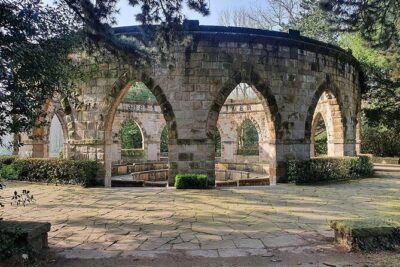
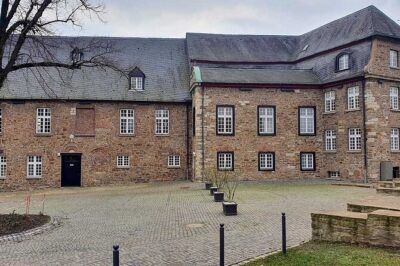

Stop 3: Abdinghof Monastery, Petrus und Paulus, founded in 1015
Then you move to Abdinghof Monastery Petrus and Paulus, a former Benedictine abbey in Paderborn. The monastery was founded in 1015, which means you’re stepping into a place that has been tied to the city for a very long time.
Abdinghof isn’t just about big walls. It’s about context. Monasteries like this were part of how learning, religion, and local community life were organized. Even if you’re not hunting for deep architectural facts, the sheer age of the foundation gives your walk weight.
For this stop, I suggest taking a minute to observe the layout around the monastery as well. The buildings and approaches matter, because the monastery sits in the flow of the city rather than isolated behind gates.
Stop 4: Bartholomäuskapelle, famous hall-church acoustics

The Bartholomäuskapelle is next, and it’s described as the oldest known hall church on German soil. It also impresses with special acoustics.
This is a great stop if you like experiencing a place with your senses, not just your camera. While the data doesn’t spell out what you’ll be asked to do, the point of the stop is clearly the sound character of the hall church. Even standing quietly and listening to how echoes behave can feel like part of the experience.
If you’re the kind of visitor who claps to test sound in churches, use gentle judgment and keep it respectful. The goal is to notice the acoustics, not turn the chapel into a performance venue.
Stop 5: Paderborn Cathedral and its trio of saints
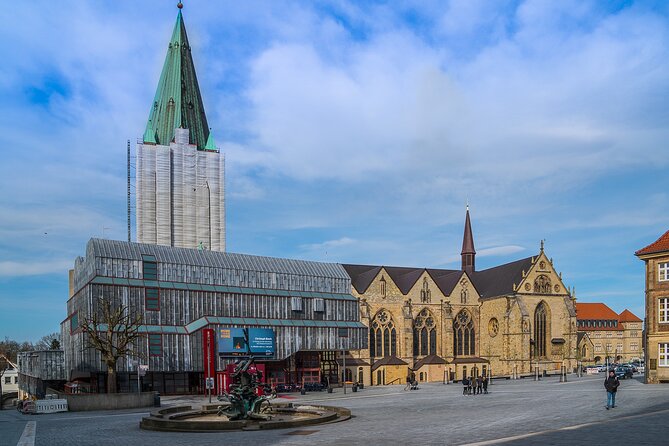
Now you reach Paderborn Cathedral, one of Germany’s most important church buildings from an art-historical point of view. It’s dedicated to Mary, Saint Kilian, and its principal patron, Saint Liborius of Le Mans.
This dedication list matters because it frames how to read the cathedral. You’re not just looking at a generic grand church. You’re looking at a building tied to specific saints and traditions that shaped Paderborn’s identity.
If you want an easy win, spend a short moment checking where you see references to those saints. Then connect that back to why the cathedral is a centerpiece. This stop works well even if you only have limited time, because the cathedral is built to be noticed from multiple angles.
Stop 6: Marktkerk, Jesuit roots, and the first University of Westphalia
After that, you’ll find the Marktkerk in the center of Paderborn. This Roman Catholic church building was originally a Jesuit and university church of the first University of Westphalia, dedicated to Saint Francis Xavier.
That’s a fascinating mix, religion and learning in one place. You might expect one or the other, but here you get the link between Jesuit education and the city’s academic past. The fact that it ties to the first University of Westphalia makes the stop feel more purposeful than a random church photo.
Even if you’re not studying the university story, you can still read the building as a symbol of how Paderborn organized ideas and community life. Take a beat, look for key features, then move on when you feel you’ve got the vibe.
Stop 7: The modern shopping street section, a real city break
Next comes a nice modern shopping street in Paderborn with the city’s nicest, hippest shops. This part is a useful change of pace.
After several religious and historic stops, a shopping street lets your brain reset. You can also use it to adjust your timing. If you’re ahead, you can slow down and browse. If you’re behind, you can keep walking and still be fine.
This is also a reminder that the route is designed for an actual afternoon, not just a sequence of monuments.
Stop 8: Neptune Fountain, Josef Rikus, 1977 to 1979
Then you’ll pause at the Neptune Fountain in the middle of the market square. It’s a work by Paderborn artist Josef Rikus, created from 1977 to 1979.
This is the kind of stop that makes the walk feel grounded in the city, not stuck in the distant past. Contemporary public art shows what a city values right now, and fountains are often where people naturally gather.
If you like photography, aim for angle changes. The Neptune Fountain works from different viewpoints because it sits in the open market space.
Stop 9: Friedrich von Spee, reading a book in bronze
You’ll also see a bronze statue of Friedrich von Spee reading a book.
Statues like this can feel abstract until you slow down and notice the posture. Here, the theme is reading and focus, which makes a neat contrast to earlier stops tied to learning and church tradition.
If you’re doing this with kids or teens, this is a good moment to ask them to guess what the statue represents. A book in someone’s hands is an easy hook for curiosity.
Stop 10: The Paderborn town hall with three gables
Next is the Paderborn town hall with its three gables. It’s described as a prime example of Weser Renaissance architecture, with the upper floor and its numerous windows being especially typical.
This is a great architectural stop because it offers structure. Weser Renaissance details often feel like a blend of bold design and careful rhythm. The three gables give you a clear visual anchor, and the windows on the upper floor help you understand the building’s proportions.
If you want to make this stop more fun, look for symmetry and repetition. Renaissance-style architecture often rewards that kind of attention.
Stop 11: Follow the Pader headwaters path
Finally, you’ll follow the path along the small river Pader, described as the headwaters area of where the city was built. This is a quieter closing segment that helps transition from major monuments to a gentler finish.
A water-following walk is also handy when your feet start to complain. It gives you a natural way to pace yourself without having to constantly decide which way to go next.
If you still have energy, take a few minutes here to enjoy the calm. If you don’t, just use it as a smooth final stretch back toward the start point.
Price and logistics: how $36.69 per group can be good value
The price is $36.69 per group, up to 6 people. That’s the big value story here. If you have two or more people, the per-person cost drops fast compared with paying per head for a guided tour.
You’re also not paying for a guide’s time, you’re paying for the app experience plus the curated route it maps. That is worth it when you like self-guided travel and you’re comfortable spending a bit of time with your phone.
The main logistics catch is simple: use of smartphone and data is not included. So plan for a data connection, or at least offline-ready navigation on your end. If your phone signal is spotty where you are, you may need patience and a fallback map app.
Best way to do this hunt without getting stuck
I like the “keep it simple” method.
- Keep a map app open while you play, so you don’t lose your sense of direction
- Take breaks where the route already gives you space, like that central square
- Don’t treat every stop like a quiz. Treat it like a scavenger-style look and move on
- Save your shopping browsing for the modern street section, it’s built into the pacing
There’s also a small learning curve to any self-guided app. If the site is hard to navigate in the moment, using Google Maps alongside the hunt can make the experience smoother. You still get the game, just with a safety net.
Who should book the Paderborn e-Scavenger hunt
This works best if you:
- Prefer a self-guided walk where you set the pace
- Want to see a cluster of old-town sights in one loop without meeting a guide
- Like light challenges on your phone, not a heavy scripted tour
- Travel as a small group up to six and want good value
It might be less ideal if:
- You hate relying on a smartphone during sightseeing
- You have limited data or a phone with unreliable navigation
- You need constant human explanations for every stop
The route is also described as user-friendly for the hearing impaired, and service animals are allowed. If those factors matter to you, it’s worth considering this option.
Should you book this e-Scavenger hunt in Paderborn?
Yes, I’d book it if you want an easy afternoon plan that mixes major churches and distinctive old-town details with a light game feel. The big win is the pacing: you can rest at the square, slow down for carved scenes, then keep moving when you’re ready.
I’d skip it only if you expect a traditional guided narrative with zero phone use, because the experience is designed around a mobile ticket and phone game. If you’re okay with that tradeoff, you’ll come away with a stronger sense of Paderborn, from Abdinghof and Bartholomäuskapelle to the cathedral dedications, and even the public art like the Neptune Fountain.
Also, because it’s priced per group, it’s a smart choice for friends or family who want to do their own thing while still sharing a common route.
FAQ
Where does the e-Scavenger hunt in Paderborn start?
It starts at Parkplatz Liboriberg, Liboriberg 1004, 33098 Paderborn, Germany.
Where does it end?
This activity ends back at the meeting point (near the Liboriberg parking area).
How long does the activity take?
The duration is about 2 to 4 hours.
What language is it offered in?
The tour is offered in English.
What is included in the experience?
You get a mobile ticket and a great online game and city walk to use on your phone.
Do I need my own smartphone and data?
Yes. Use of smartphone and data are not included.
Can I cancel for free?
Yes. Free cancellation is available, and you can cancel up to 24 hours in advance for a full refund.
Seeing Rhine River in One Go
Play the City, Reviewed
Aachen, Munster and Westphalia
Everything else we filed on Rhine River
- Private scavenger hunt around the Ruhrfestspielhaus Recklinghausen
★ 4.5 · 3 reviews - e-Scavenger hunt Paderborn: Explore the city at your own pace
★ 5.0 · 4 reviews - Bielefeld Scavenger Hunt and Private Sights Self-Guided Tour
★ 4.0 · 5 reviews - Private audio book city rally around the old town of Essen Kettwig
★ 4.0 · 6 reviews - Digital scavenger hunt around Wittringen Castle in Gladbeck
★ 4.0 · 9 reviews - Private city rally around the Zollverein Coal Mine Industrial Complex in Essen
★ 3.5 · 10 reviews
Aachen Munster and Westphalia Tours, side by side.
 ★ 4.7Münster: Old Town Highlights Guided TourFrom $16286 reviews
 ★ 4.4Münster: Nachtwächter-Führung (Erlebnistour)From $19213 reviews
 ★ 4.0Aachen: 24-Hour Hop-On Hop-Off Sightseeing Bus TicketFrom $28208 reviews
 ★ 4.8Münster: Private Guided Rickshaw City TourFrom $33143 reviews
 ★ 4.7Explore Aachen with Passionate Tour GuidesFrom $371 reviews
 ★ 4.8Münster: Night watchman tour through the picturesque old town by lantern lightFrom $2165 reviews
 ★ 4.6Paderborn: Nachtwächter-Führung (Erlebnistour)From $1961 reviews
 ★ 4.7Münster: Beer Tasting Rickshaw TourFrom $7056 reviews
Other lists this tour is on