
REVIEW · GERMANY
Mystic Munich – Sagas and Legends of the Old Town
A city tour that treats Munich like a storybook, but with evidence. This 105-minute walk through the Old Town uses legends and “why it matters” details to help you see familiar landmarks with fresh eyes.
I especially like the mix of German street legend and real architectural landmarks. You get myths tied to places you can point at immediately, like Marienplatz and the church spires, instead of vague storytelling that could be anywhere.
One thing to consider: the tour is German only, and it moves at an evening pace through busy streets. If you are not confident with German, you may miss part of the fun, and if crowds get thick, staying close to the guide matters.
In This Review
- Key Things I’d Pay Attention To
- Legends and Landmarks: The Munich Combo That Works
- Where You Start at Marienplatz 15 (And How Not to Get Lost)
- Old Town Hall and Marienplatz: The Stage for Every Story
- Lindwurm at the New Town Hall: A Monster With Clues
- Marian Column and Putti vs. Monsters: When Art Becomes a Plot
- Old Peter and the Devil: The Dark Secret That Changes How You Look
- St. Onuphrius: One Simple Gesture With Big Story Weight
- Old Court and Old Town Hall Area: Where Power and Myth Meet
- Frauenkirche at Dusk: Why the Timing Feels Intentional
- Tour Length and Price: What $26 Gets You in Real Terms
- Group Size, Crowds, and How to Stay With the Guide
- The Feel of the Guide: Storytelling That Actually Teaches
- Who Should Book This Mystic Munich Tour
- Should You Book Mystic Munich?
- FAQ
- What is the duration of the Mystic Munich tour?
- Where is the meeting point?
- What language is the tour guide speaking?
- How much does the tour cost?
- Is the tour wheelchair accessible?
- What can I expect to see during the walk?
- Are there legends included in the stories?
- Is free cancellation available?
- Is there a gift included?
Key Things I’d Pay Attention To
- Old Town legends tied to specific buildings you can actually find again after the tour
- Stories with a facts-versus-myth feel, so you learn why the legend stuck
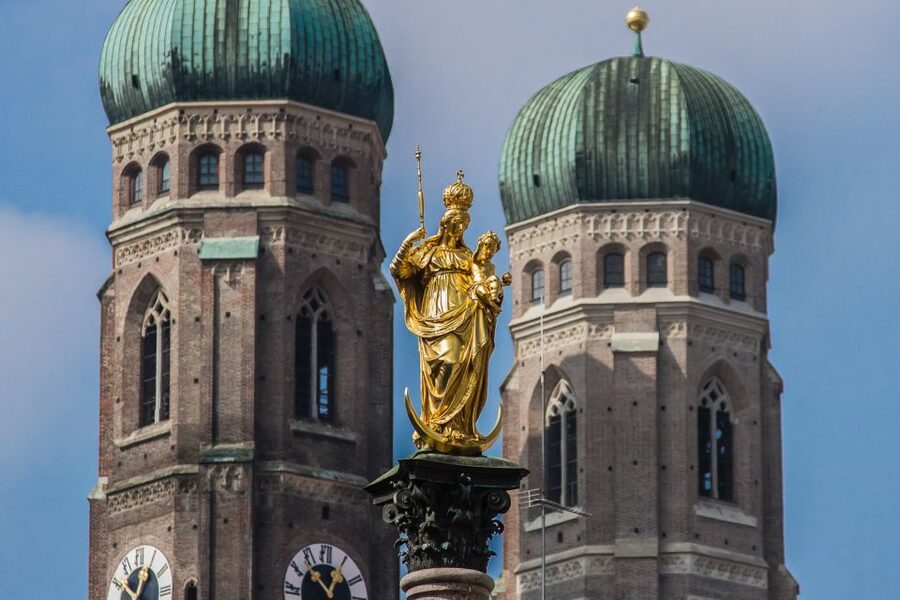
- Key myth moments at major sights like Marienplatz, the Old Peter, and the Frauenkirche
- A small gift at the end, a nice touch after a compact 105-minute format
- A practical starting point at Toy Museum, under the Old Town Hall between Marienplatz and Tal
- A dusk atmosphere that makes the darker stories land better
Undecided? The closest Munich write-ups we have are these.
- From Munich: Neuschwanstein & Linderhof Castle Full-Day Trip★ 4.5 · 12,494 reviews
- Neuschwanstein & Linderhof Castle-Fairytale Day Tour from Munich★ 4.5 · 7,275 reviews
- Munich: Third Reich & WWII Walking Tour★ 4.6 · 6,181 reviews
- Dachau Concentration Camp Memorial Site Tour from Munich by Train★ 4.5 · 5,637 reviews
Legends and Landmarks: The Munich Combo That Works
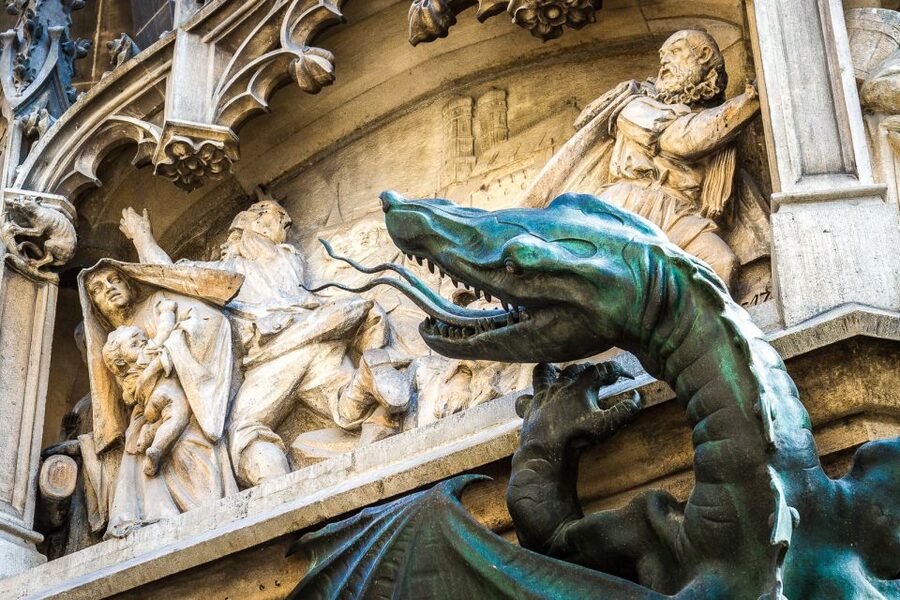
Munich’s center can feel polished and postcard-ready, especially around Marienplatz. This tour gives you a different angle, treating the Old Town like a stage where creatures, devils, and saints keep showing up in stone, carvings, and statues.
What makes this work is how the stories connect to shapes and symbols you can look at right on the spot. You are not just told, you are guided to notice details like the Lindwurm link on the New Town Hall and the Marian column scene involving Putti and monsters.
And you get a “why” layer too. The tour’s promise is not only dark secrets, it also explains the reality behind them, so you end with better mental maps of the city and its symbols, not just scary fun.
Where You Start at Marienplatz 15 (And How Not to Get Lost)
You meet at Marienplatz 15, in front of the Toy Museum entrance. Important detail: the entrance is under the Old Town Hall, between Marienplatz and Tal, so you are looking for the lower entry rather than an open street facade.
This matters because the square is one of the easiest places in Munich to lose track of a group. I’d plan to arrive a few minutes early, then pick a fixed visual cue near you, like the Old Town Hall massing, so you can re-orient if the crowd flows around you.
Once you’re in motion, you’ll be walking through the heart of the historic area. The route is compact, but it still feels like “real city walking,” especially near major sights.
Old Town Hall and Marienplatz: The Stage for Every Story
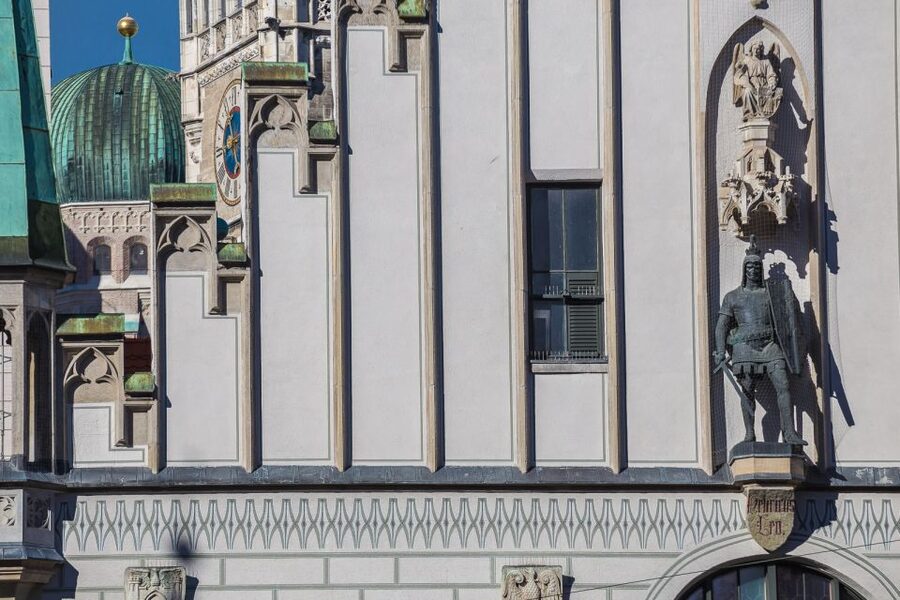
You begin the sightseeing flow by passing the mainfaces of the center, with Marienplatz as the anchor. This is the kind of square where you can stand for ten seconds and instantly see why legends became public entertainment. People meet here, trade here, argue here, and look up at the buildings every day.
The tour uses this everyday setting to frame the myths. When a legend is attached to a city’s public symbol, it becomes shared culture, not just a bedtime tale.
You’ll also get a sense of how the city’s identity was built in layers. The tour keeps nudging you to ask, what is carved here, what is depicted here, and what does it mean that this story is tied to this exact spot?
Lindwurm at the New Town Hall: A Monster With Clues
One of the standout story anchors is the Lindwurm tied to the New Town Hall. Even if you have seen pictures of the building, the legend turns it into something more than architecture. You start looking at the New Town Hall as a place where Munich publicly “talks back” with symbols.
The key is how the tour frames the Lindwurm not as random fantasy, but as a myth that has a reason to live on in public art. That makes you more observant. Instead of treating carvings as decoration, you treat them like a message the city kept repeating over time.
Practical tip: as you hear the Lindwurm story, do a quick visual sweep of the New Town Hall area. The tour is designed so you can connect what you hear to what you see within a minute or two.



Marian Column and Putti vs. Monsters: When Art Becomes a Plot
Another highlight is the Marian column and the hero Putti, who fought monsters. This is the kind of scene that can be missed if you only glance at statues, because the figures do not look like they are telling a “story” at first glance.
On this tour, the guide’s job is to help you read the scene like a sequence. You learn what the figures represent and why the story is remembered the way it is.
The payoff is that you leave with an improved ability to “read” Munich’s sculptural language. That makes the Old Town feel less like a list of stops and more like a connected set of meanings.
Old Peter and the Devil: The Dark Secret That Changes How You Look
The tour also tackles the story of stopping the devil from destroying Old Peter. This is one of those legends that sounds dramatic on paper, but it becomes more interesting when you attach it to a real city landmark.
Old Peter is not just a pretty tower. The legend gives it a protective role, like the city building itself is part of the fight. And that shift in perspective is exactly what makes myth-guided walking so effective.
If you like stories with edge, this is your moment. If you like civic symbolism, it still works, because the legend hints at how communities manage fear, fate, and the idea of protection through shared belief.
St. Onuphrius: One Simple Gesture With Big Story Weight
You’ll hear about why you should look St. Onuphrius straight in the eye. That detail is small, but it’s a perfect tour design choice. It makes you interact with the place instead of just listening.
When a guide tells you to look directly at a saint, you pay attention to expression, posture, and how the figure faces the viewer. And suddenly you understand why legends survive. They train people to approach art with a certain mindset.
Even if you don’t buy every layer of the legend, the guidance helps you see the moment of contact between viewer and figure. It turns a church-town routine into something a bit theatrical.
Old Court and Old Town Hall Area: Where Power and Myth Meet
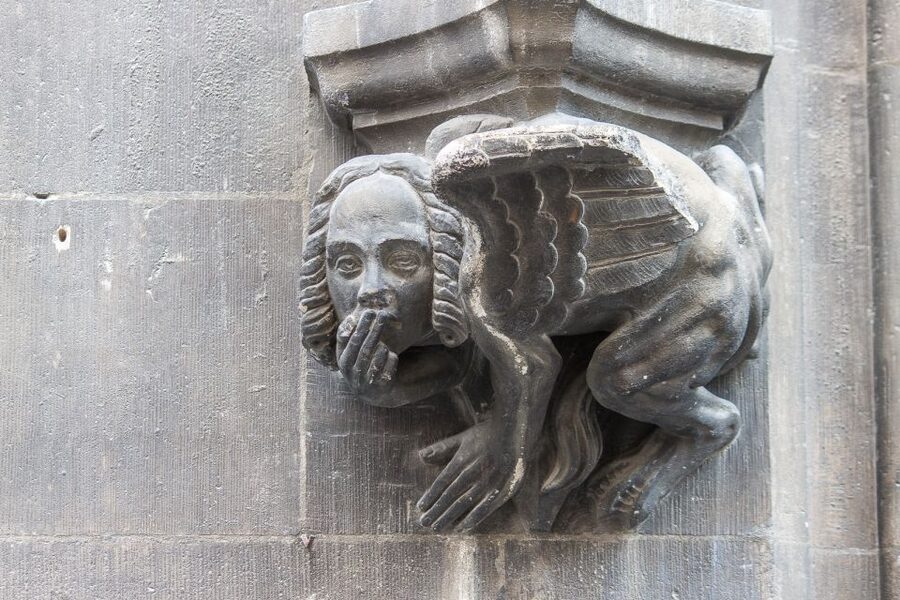
As you move through the Old Town, you’ll pass the Old Court and the Old Town Hall areas. This is where the tour’s “legend versus reality” style pays off, because court spaces and civic spaces are where stories tend to get formalized.
Legends thrive in places tied to authority, because those are the spaces where public life is shaped. When a myth is linked to the civic heart, it becomes a cultural shorthand: this is what the city believes, fears, protects, and repeats.
A practical note here: expect pedestrians, and expect people photographing. Your best move is to keep your attention on the guide’s direction and let your eyes do the work. Quick glances beat prolonged standing, especially when the route keeps rolling.
Frauenkirche at Dusk: Why the Timing Feels Intentional
You’ll also end up by the Frauenkirche, one of Munich’s most recognizable landmarks. The tour’s setting at dusk matters, because the darker stories land better when the lighting shifts and the streets feel less like a showroom.
This is also a good moment to check your own orientation. After listening to myths tied to many corners of the Old Town, you can step back and see how the area holds together visually.
If your day is already packed, this is a helpful evening segment. It lets you get meaning from landmarks without turning your night into a museum marathon.
Tour Length and Price: What $26 Gets You in Real Terms
At $26 per person for about 105 minutes, this is a cost-effective way to get more from the core sights. You are paying for guided attention, story structure, and interpretation of symbols, not just for walking between points.
The value is strongest if you want context. If you like reading plaques and researching later, you might still enjoy this. But the tour is built for people who want the connections explained while you are standing in front of the objects.
A few practical points keep this from feeling rushed. The route focuses on key Old Town landmarks, and the compact timing helps you cover multiple “story anchors” without spending your evening commuting.
Language note: it is a live tour in German. If you understand German comfortably, you’ll likely enjoy the full momentum. If you do not, you can still see the sites, but you might miss the part where the legend becomes the guide’s explanation.
Group Size, Crowds, and How to Stay With the Guide
The Old Town around Marienplatz can get packed, especially as dusk approaches. A past issue that can happen is losing the guide for a few minutes when the group spreads in the crowd, and then it becomes hard to reconnect.
So do yourself a favor: stay close, keep the guide in your line of sight, and avoid drifting for photos when the crowd is thick. If you are visiting with friends, set a simple rule beforehand, like staying within a few steps of each other until the next landmark.
If you want a low-stress experience, this tour works best when you treat it like a guided walk, not a free wandering photo loop.
The Feel of the Guide: Storytelling That Actually Teaches
One name you might hear associated with these tours is Patricia, described as making the stories clear, engaging, and full of joy. That kind of delivery matters here because the tour balances two modes at once: historical explanation and mythic narrative.
When the storytelling clicks, you start noticing details faster. You also leave with better “mental notes” for Munich’s symbolism, which is what makes a follow-up self-walk through the Old Town more rewarding.
You can also see why the format suits both tourists and locals. Even if you think you know Munich, the legend-first approach can pull up details you skipped the first time.
Who Should Book This Mystic Munich Tour
This is a strong pick if you want:
- Old Town sightseeing with meaning, not just photos
- Dark legends that are tied to real places
- A compact evening activity around Marienplatz, Old Peter, and the Frauenkirche
It may be less ideal if you:
- Need an English-language tour, because the live guide is in German
- Hate crowds and prefer wide, quiet sightseeing sessions
- Want a museum-style slow pace with long indoor stops
Also, it is wheelchair accessible, which can make it a helpful option for mixed mobility groups, assuming you can handle outdoor walking along busy streets.
Should You Book Mystic Munich?
I think it’s worth booking if you want your first or second evening in Munich’s center to feel like a story you can follow, not a checklist you endure. The best part is the way the tour uses legends, like the Lindwurm and Putti’s monster fight, to train your eyes on specific details at major landmarks.
Book it if you like guided interpretation, and you can handle German narration. Skip or reconsider if German is a barrier or if you strongly dislike crowded pedestrian areas in the evening.
If you do book, come prepared for dusk lighting and crowd flow, then stay close to the guide. Do that, and you’ll walk away with a sharper sense of why Munich’s symbols keep echoing through the Old Town.
FAQ
What is the duration of the Mystic Munich tour?
The tour lasts about 105 minutes.
Where is the meeting point?
You meet at Marienplatz 15, in front of the entrance of the Toy Museum, which is under the Old Town Hall between Marienplatz and Tal.
What language is the tour guide speaking?
The tour is in German.
How much does the tour cost?
The price listed is $26 per person.
Is the tour wheelchair accessible?
Yes, it is wheelchair accessible.
What can I expect to see during the walk?
You’ll pass and learn about major Old Town landmarks, including Marienplatz, the Old Town Hall, Old Peter, the Old Court, and the Frauenkirche, with legends tied to these locations.
Are there legends included in the stories?
Yes. You’ll hear legends such as the Lindwurm at the New Town Hall, Putti fighting monsters on the Marian column, the devil and Old Peter, and advice about looking St. Onuphrius straight in the eye.
Is free cancellation available?
Yes, you can cancel up to 24 hours in advance for a full refund.
Is there a gift included?
Yes, you receive a small gift as part of the tour.
Everything else we filed on Munich
- Munich Beer and Bavarian Bites Private Tour
★ 5.0 · 11 reviews - Private Day Trip from Munich to Neuschwanstein and Linderhof
★ 4.0 · 11 reviews - Private Munich Old Town Walking Tour – with optional Breakfast
★ 5.0 · 11 reviews - Festive Concert in the All-Saints Court Church
★ 4.6 · 11 reviews - Private Castle Tour from Munich: Neuschwanstein, Hohenschwangau, and Linderhof
★ 4.5 · 12 reviews - Munich: Oktoberfest Big Beer Tent Evening including table reservation
★ 4.8 · 12 reviews