
REVIEW · TRIER
Trier Small-Group Day Trip from Frankfurt
Trier feels like time travel by the Moselle. This full-day small-group trip turns Frankfurt into a quick gateway to Germany’s oldest city, with Roman monuments, Gothic church stops, and even Rococo-era flair. I love the max-8-group feel that keeps the walking tour personal, and I love that the price includes entry to the Trier Amphitheater and Imperial Baths, which are two of the most satisfying Roman stops. The main drawback is that it is a long day, about 10 hours, and you will do real walking in stone-city streets.
You start at 9:30 am from Wiesenhüttenpl. 38 in Frankfurt and ride west in an air-conditioned vehicle for roughly 2.5 hours to Trier. Once you arrive, the day mixes guided sightseeing with free time so you can linger where you want, instead of being herded through every doorway.
The route focuses on the city’s UNESCO World Heritage sites, with big hits like the Porta Nigra and the Cathedral of Trier (also called the High Cathedral of Saint Peter in Trier). If weather turns, the best guides can adjust, and one guide named George is specifically noted for being accommodating when rain changes the plan.
In This Review
- Key things that make this Trier trip worth your time
- Why Trier works so well for a day trip from Frankfurt
- Meeting point, timing, and the logistics that matter
- First leg: the ride to Trier and what you are buying with the guide
- Porta Nigra: the Roman city gate that grabs you instantly
- The Cathedral of Trier (High Cathedral of Saint Peter): oldest cathedral vibes
- Church of Our Lady (Liebfrauenkirche): the Gothic stop that’s worth the detour
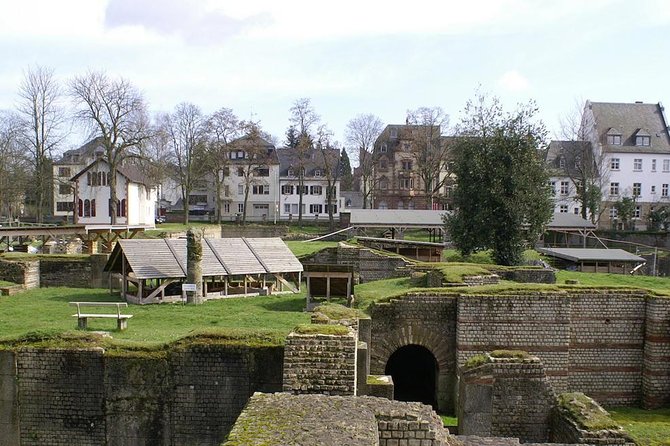
- Trier Amphitheater and Imperial Baths: the Roman parts you will remember
- Free time in Trier: where to aim your hours
- Group size, pace, and the rain factor (yes, it matters)
- Price and value: is $457.25 a fair deal?
- Who this day trip fits best
- Should you book Trier from Frankfurt?
- FAQ
- Where is the meeting point for the Trier small-group day trip?
- What time does the tour start?
- How long is the day trip?
- How many people are in the group?
- Is the ticket mobile, or do I need to print it?
- What is included in the price?
- What is not included?
- Does the tour end back where it started?
- When will I receive confirmation after booking?
- Can I cancel for a full refund?
Key things that make this Trier trip worth your time
- Small group up to 8 means more questions, better pace, and less waiting around.
- UNESCO sites you can actually see in one day, including Porta Nigra and the Cathedral of Trier.
- Included Roman entries to the Trier Amphitheater and Trier Imperial Baths save time and ticket hassle.
- Guided walking tour with context so the ruins make sense, not just look old.
- Free time in central Trier for the Hauptmarkt and Palace Garden at your own speed.
Undecided? The closest Frankfurt write-ups we have are these.
- Frankfurt: River Main Sightseeing Cruise with Commentary★ 4.3 · 5,127 reviews
- Frankfurt: Hop-On, Hop-Off Grand or Express Bus Ticket★ 3.9 · 2,088 reviews
- Frankfurt: 1-Hour Panorama Boat Cruise on the river Main★ 4.4 · 1,822 reviews
- From Frankfurt: Rhine Valley Day Trip★ 4.4 · 1,317 reviews
Why Trier works so well for a day trip from Frankfurt
Trier is the kind of place that makes you stop walking. It is Germany’s oldest city, and it still wears its past on its sleeve: Roman stonework, medieval churches, and later architectural styles in the same compact area. The Moselle River setting also helps. Even when you are moving from stop to stop, you get little pauses where the city opens up.
From Frankfurt, the day trip setup is smart. You do not spend your whole vacation on trains. Instead, you take a comfortable drive west, then use a guided route to hit the major sights without wasting time trying to piece together the best order yourself.
The time commitment is the catch. About 10 hours is plenty for a full day, but your feet will notice it. If you hate long museum-style walking or narrow-town cobblestones, bring good shoes and plan on a relaxed evening afterward.
Meeting point, timing, and the logistics that matter
The tour starts at 9:30 am at Wiesenhüttenpl. 38, Frankfurt am Main, with meeting coordination at the ETS Touristik GmbH area for the Greenline Frankfurt departure setup. You end back at the same meeting point, so you do not need to figure out separate transport at the end of the day.
You also get a mobile ticket, which is convenient. You are not juggling paper vouchers or hunting for printing at home.
Transportation is handled by an air-conditioned vehicle. That matters because Trier is not a single stop. It is a stack of sites, and you will spend some time outside during the walking portion. On warm days, air-conditioning during the drive is a real comfort. On colder or rainy days, at least you are not stuck in an uncooled van.
One practical note for peace of mind: confirmation is sent within 48 hours of booking, and cancellation is free up to 24 hours before the start time. That is useful if your plans are still flexible, or if you want a buffer for weather.
First leg: the ride to Trier and what you are buying with the guide
The day begins with about 2.5 hours of driving from Frankfurt to Trier. That is a lot of seat time, so you want the rest of the day to be worth it. This is where the guide earns their fee.
The guided walking tour is not just a list of buildings. It is built to help you read what you are seeing. Trier’s monuments can look disconnected if you just jump from site to site. With a narrator, you start to connect the dots: why Roman gates survive, how church architecture evolved on top of earlier layers, and how the city’s political and religious roles shaped what you see today.
And since the group is capped at 8 travelers, the guide can actually steer the pacing. That shows up most in the small decisions, like when to pause for a better view or when to let you move ahead to take photos.
Porta Nigra: the Roman city gate that grabs you instantly
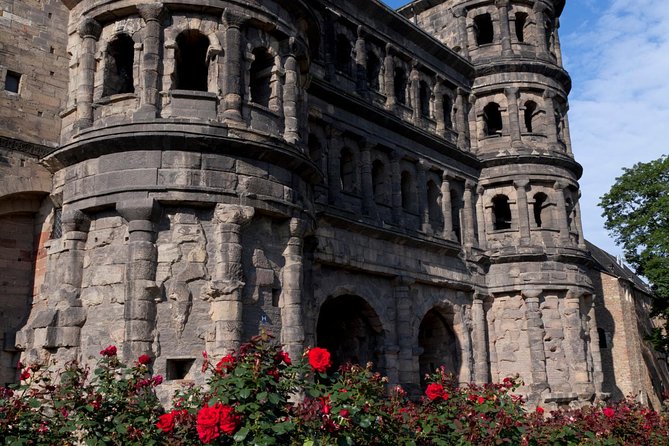
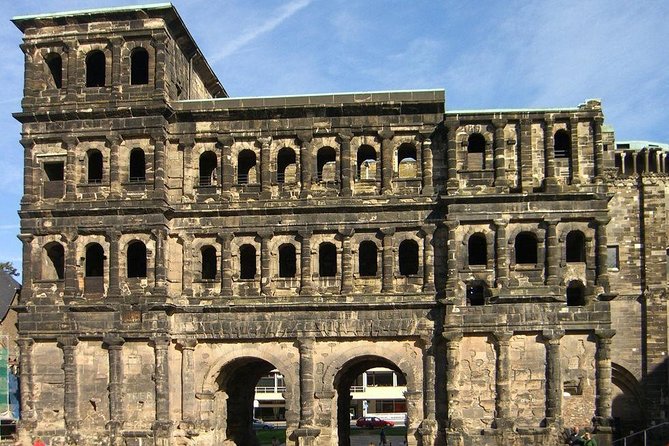
Porta Nigra is the stop that makes Trier feel real fast. This massive Roman city gate, built around 180 BC, is the largest Roman city gate north of the Alps. You can see the scale just by standing in front of it. The sandstone blocks are enormous, and that weight is part of the story. Trier was not a small town pretending to be important. It was a major Roman settlement.
This is also a great introduction to how Trier’s layers work. Porta Nigra sits on medieval and later streets, so you get a visual reminder that cities do not erase their past. They build around it, and sometimes right on top of it.
If you like photography, this is where you will want your time. The gate’s angles look different as you move around it, and the city streets give you foreground options. If your group is slow, you can still take it at a calmer pace because the small-group format helps you avoid a rush.
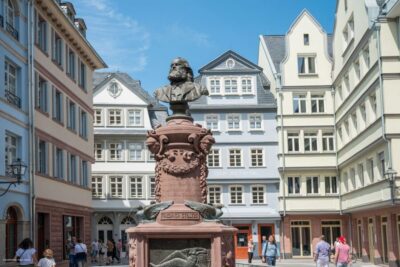
The Cathedral of Trier (High Cathedral of Saint Peter): oldest cathedral vibes
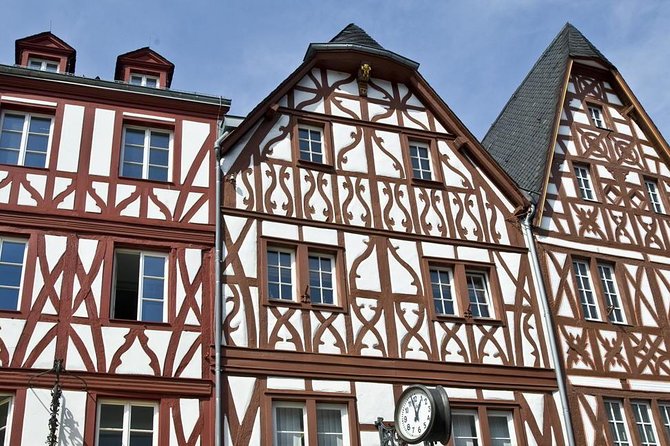
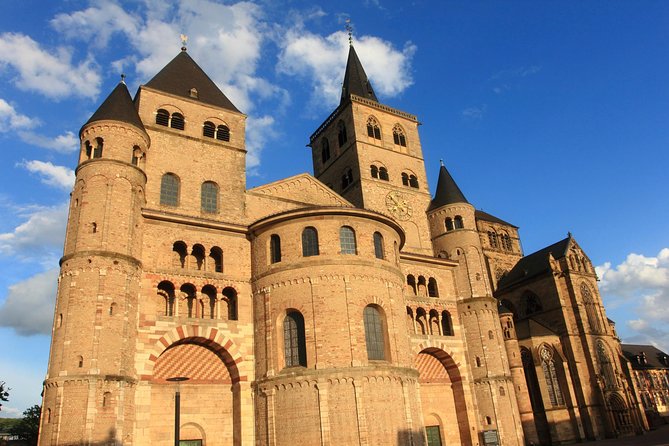
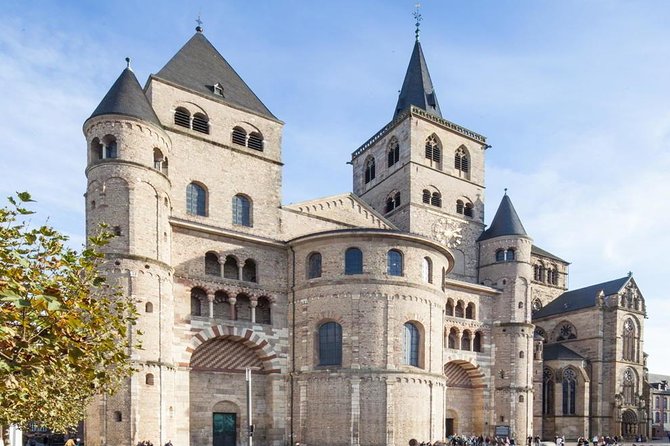
Next up is the Cathedral of Trier, known as the High Cathedral of Saint Peter in Trier. It is described as the oldest cathedral in Germany, and that alone is an attention-getter. But what I find more useful is what this stop gives you: a sense of continuity.
You are moving from Roman stone power to Christian architecture that took over the city’s identity. The cathedral also holds a famed relic associated with the Holy Rock. That kind of detail turns a building into a story, and the guide’s narration helps you see why people cared enough to build, maintain, and protect it.
This is a stop where I would slow down. Even if the interior access depends on what is open at the time of your visit, the outside and the cathedral surroundings are enough to appreciate the scale and the atmosphere.
Church of Our Lady (Liebfrauenkirche): the Gothic stop that’s worth the detour
The Church of Our Lady, also called the Liebfrauenkirche, is highlighted as the oldest Gothic church in Germany. Gothic architecture can be hit-or-miss if you only see it as a style label. Here, it matters because it is tied to a specific place and a specific timeline.
In practice, this is one of those stops where you benefit from a guide explaining what makes it different from the Roman and earlier parts of Trier. Even if you are not an architecture nerd, you will start noticing how form and detail change as the city’s priorities shift.
If you are doing this trip with someone who wants both history and beauty, this church is a solid compromise. It is not only about ruins. You also get a living, working kind of heritage, even if you are only visiting and then moving on.
Trier Amphitheater and Imperial Baths: the Roman parts you will remember
These are the two big Roman sites with included entrance. That inclusion is one of the best value points in the whole day because it saves you the time and decision-making that can bog down self-guided planning.
The Trier Amphitheater is described as a Roman stage that used to host cruel games, including animal and gladiator combats. While you should keep the topic grounded and not treat it like entertainment nostalgia, the site itself is powerful. It helps you understand what Roman public life looked like: spectacle, crowds, and a sense of order enforced through brutal events.
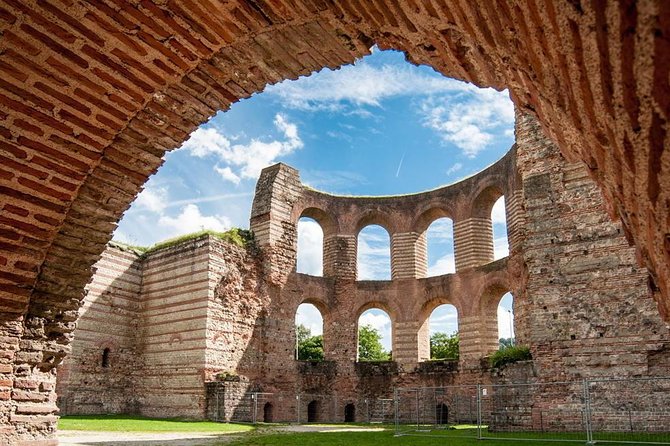
Then there are the Trier Imperial Baths, built in the fourth century AD and noted as among the largest baths of the Roman Empire. Baths were not only for hygiene. They were social spaces, and they were places where status, leisure, and community intersected. Standing among ruins, you can start imagining how daily routines worked. That is what makes ruins feel more than just stones.
If you only do one thing to prepare, I would read nothing. Just show up ready to notice details like the structure, the layout cues, and how the space would have felt when it was in use.
Free time in Trier: where to aim your hours
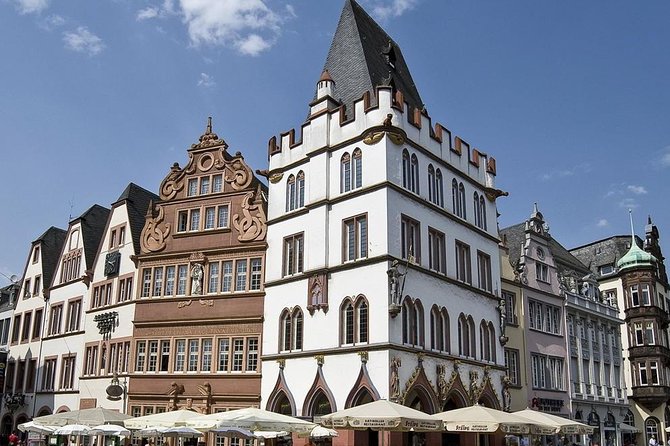
After the main guided portion, you get time to explore on your own. This is where you can shape the trip to your style.
The free-time suggestions are the kind you will actually enjoy if you like strolling:
- The Main Market (Hauptmarkt), the central square.
- The Palace Garden (Palastgarten), described as a garden architecture crown jewel.
- The Archaeological Museum, noted as the largest and most popular museum in Trier.
- The Electoral Palace, linked to the birthplace of Karl Marx and considered a beautiful Rococo palace.
- The Roman Bridge, described as probably the oldest bridge in the country.
Here is my practical advice: pick two targets, not five. Trier is compact, but the Roman and Gothic sites can be mentally heavy. If you try to do everything, you end up sprinting between points and missing the point of wandering.
If the weather is nice, use the Palace Garden or the Hauptmarkt area as your reset. Squares and gardens are how you absorb a city. You also get a break from constant staring upward at façades and stone walls.
Group size, pace, and the rain factor (yes, it matters)
This tour caps at 8 travelers, which is a quiet but meaningful detail. It changes how the day feels. You get enough time to hear explanations, and the guide can slow down for individuals who need a moment.
One note from real experience with the operator is how guides handle weather changes. George is singled out as accommodating when rain hits hard in the area, and that fits the logic of a walking tour in an outdoor historic town. It is not about rewriting the entire itinerary. It is about shifting where you spend the minutes so you still get the best version of Trier.
If weather is rough, build in flexibility. Wear shoes with grip, keep a compact umbrella or rain jacket handy, and accept that you will spend more time under cover and less time lingering in open-air ruins.
Price and value: is $457.25 a fair deal?
At $457.25 per person, this is not a budget day trip. The key question is what you are getting for that cost, and the answer is mostly about friction reduction.
You are paying for:
- A professional guide who connects the sites into a coherent story.
- Air-conditioned transportation for the round trip from Frankfurt.
- A small-group structure that keeps the day moving smoothly.
- Included admission for Trier Amphitheater and Trier Imperial Baths.
If you priced it yourself, the hidden cost is not just ticket prices. It is time spent planning the order, lining up entrance timing, and trying to match guided interpretation to a city packed with UNESCO stops. A day trip like this is often best for people who want the highlights with less hassle.
Who gets the most value? People who care about interpretation, not just checking boxes. If you want context for Porta Nigra, the cathedral, and the Roman sites, the guide makes the trip feel worth the cost.
Who might feel it is too expensive? If you prefer to wander independently and you are fine paying for your own entry tickets, you may be able to assemble a similar trip cheaper. But you will lose some guidance that helps the city click.
Who this day trip fits best
This is a great match if you:
- Want a high-impact day with major UNESCO sites.
- Like historical sites where architecture matters, not only museums.
- Prefer a small group over a big coach crowd.
- Are staying in Frankfurt and do not want to spend time figuring out trains and transfers.
It might be less ideal if you:
- Dislike long days and lots of walking.
- Plan to rely on frequent stops to rest, since the itinerary is built around efficient sight coverage.
- Need full control over timing at every moment, since the day has a set structure with guided narration plus free time.
Should you book Trier from Frankfurt?
I would book this trip if your priority is seeing Trier the smart way: Roman power at Porta Nigra, major church stops, and the two Roman sites with included admission, all backed by a guide who keeps the day understandable. It is also a good buy if you want the almost-private feel that a group of 8 can create, instead of being lost in a crowd.
I would pause if you hate long travel days and you are sensitive to walking. Also, if you are the kind of traveler who absolutely needs your day to be locked in, note there is at least one example of a last-minute problem with operation. The good news is that the booking is set up with free cancellation up to 24 hours before, so you have a safety net.
If you are flexible and you want real Trier, this is one of the cleanest ways to do it.
FAQ
Where is the meeting point for the Trier small-group day trip?
The meeting point is Wiesenhüttenpl. 38, 60329 Frankfurt am Main, Germany.
What time does the tour start?
The start time is 9:30 am.
How long is the day trip?
The duration is about 10 hours.
How many people are in the group?
The tour has a maximum of 8 travelers.
Is the ticket mobile, or do I need to print it?
The tour uses a mobile ticket.
What is included in the price?
Included are an air-conditioned vehicle and a professional guide. Entrance fees to Trier Amphitheater and Trier Imperial Baths are included.
What is not included?
Hotel pickup and drop-off are not included. Food and drinks are also not included unless specified.
Does the tour end back where it started?
Yes, the tour ends back at the meeting point.
When will I receive confirmation after booking?
Confirmation is received within 48 hours of booking, subject to availability.
Can I cancel for a full refund?
Yes, free cancellation is available. You can cancel up to 24 hours in advance for a full refund.
Everything else we filed on Frankfurt
- Frankfurt to Prague – Private Transfer with 2 hours of Sightseeing
★ 5.0 · 3 reviews - Castle Braunfels Day Trip from Frankfurt
★ 5.0 · 3 reviews - Frankfurt – Private tour with Licensed guide
★ 5.0 · 4 reviews - Arrival by Luxury Vehicule from Frankfurt Airport to Frankfurt
★ 4.0 · 4 reviews - Frankfurt MAIN TOWER with Tickets, Guide and Old Town Tour
★ 5.0 · 4 reviews - Discover Frankfurt’s most Photogenic Spots with a Local
★ 5.0 · 4 reviews
Trier Koblenz and the Saarland, side by side.
 ★ 4.4Koblenz: Rhine Valley Castles and Palaces Boat TourFrom $211,824 reviews
 ★ 4.8Trier: Guided City Walk with Wine TastingFrom $43979 reviews
 ★ 4.6Koblenz: 2-Hour Sightseeing Cruise on the RhineFrom $20839 reviews
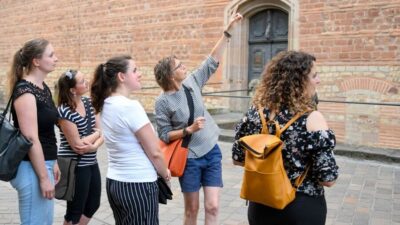 ★ 4.7Trier: Guided Old Town Highlights and History Walking TourFrom $16687 reviews
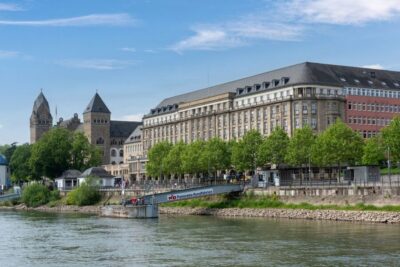 ★ 4.5Koblenz: Old Town Sightseeing Cruise along the RhineFrom $16305 reviews
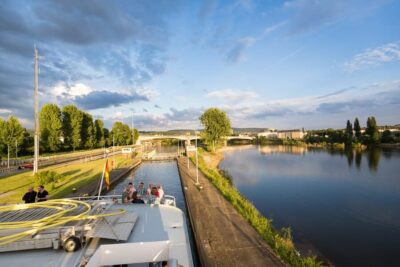 ★ 4.4Koblenz: Panoramic Cruise on Moselle River to WinningenFrom $22283 reviews
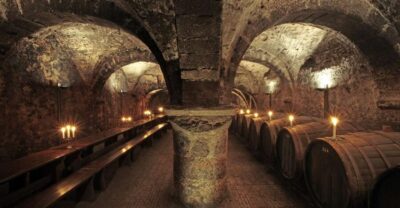 ★ 4.7Trier: Discovery Tour – Germany’s Oldest Wine CellarFrom $20218 reviews
 ★ 4.6Trier: City Walking TourFrom $17118 reviews
Other lists this tour is on