
REVIEW · THURINGIA
Weimar Private Walking Tour With A Professional Guide
Weimar can feel like a storybook you can walk through. This private guided walk links Goethe and Schiller to the birth of modern German democracy, all at street level. I especially like how the route keeps you moving between landmarks that explain why Weimar mattered.
The best part for me is the private guide. When you get a guide like Alexander or Tori (both cited in past tour experiences), the explanations stay sharp, and they handle questions as they come up. The second thing I like is the practical pace, roughly 2 hours of an easy, no-transport stroll through a very walkable center.
One consideration: because the tour is short, you get strong orientation and context, not long, museum-style time inside every spot. If you want to linger for interiors and slow reading, plan to return on your own afterward.
In This Review
- Key highlights worth your time in Weimar
- A 2-hour Weimar walk that connects people to place
- Markt and Theaterplatz, where Classicism becomes street-level history
- The House of the Weimar Republic and the hard turn toward democracy
- Saint Peter and Paul Church, where Luther, Herder, and Anna Amalia share the ground
- Weimar Palace, Duke’s Square, and the power of royal surroundings
- Anna Amalia’s Library and Park an der Ilm, literature in stone and trees
- Goethe’s House, Liszt Haus, and Schiller’s turning point
- Getting the most from a private guide in Weimar
- Price and value for a private group walk
- Who should book this Weimar private walking tour?
- Should you book this private Weimar walk?
- FAQ
- How long is the walking tour?
- Is the tour offered in English?
- Is this a private tour or a shared group?
- How many people can be in a group?
- Do I need transportation during the tour?
- Where does the tour start and end?
Key highlights worth your time in Weimar
- Market Square to Theaterplatz, where classicists are tied to the city’s architecture and pedestrian layout
- The House of the Weimar Republic, built around the 1919 National Assembly and the early attempt at democracy
- St. Peter and Paul Church, with Lutheran ties, Martin Luther preaching there, and burials connected to Anna Amalia and Herder
- Anna Amalia’s Library and Park an der Ilm, where Goethe’s presence shows up in documents, design, and the landscape
- Goethe’s House, Liszt Haus, and Schiller’s House, grouped so the creative story has momentum
- Private-by-your-group format, offered in English, with customization possible on the spot
Other Thuringian towns we have written up
- City game scavenger hunt Erfurt – independent city tour I discovery tour★ 4.0 · 9 reviews
- Eisenach Private Walking Tour With A Professional Guide★ 5.0 · 7 reviews
- Segway tour in Etzelsbach with Eichsfeld breakfast★ 5.0 · 7 reviews
- Stadtspiel scavenger hunt Weimar – independent city tour I discovery tour★ 5.0 · 5 reviews
A 2-hour Weimar walk that connects people to place
This tour is built for getting your bearings fast, without feeling rushed. It’s about 2 hours on foot, with an easy walking level and no special effort required. You also do not need transit during the walk, since the focus is on sites close together in central Weimar.
Because it is private, your guide is with your group only. That matters here. Weimar’s big names can become a blur if you just read signs. With a guide, you can ask follow-up questions, and the story stays tied to what you are seeing right now.
English is available, and you receive a mobile ticket. There is also room for light customizing on the spot with your local guide, which is handy if your interests lean more toward literature, music, theology, or political history.
One more practical note: the route works for people of any age, and it starts at Markt 20 in Weimar. It ends near 99 Weimar, so you do not end up feeling stranded at the far side of town.
Markt and Theaterplatz, where Classicism becomes street-level history
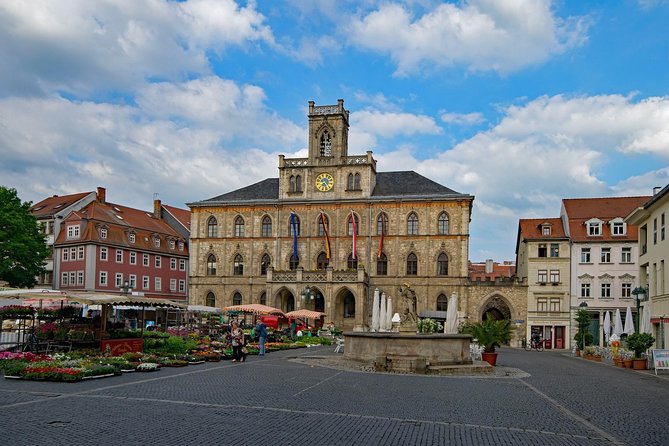
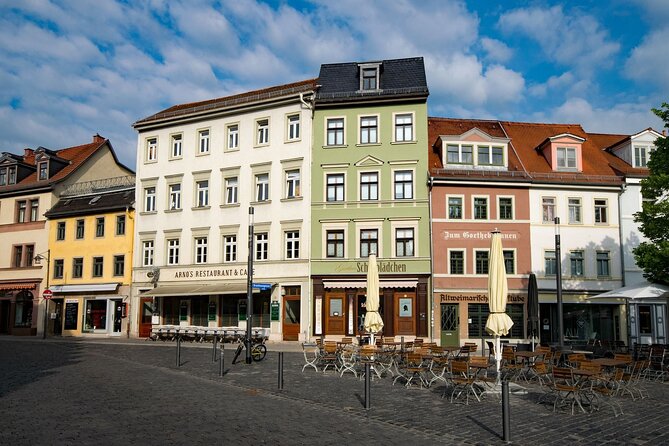
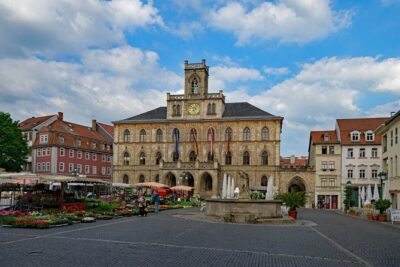
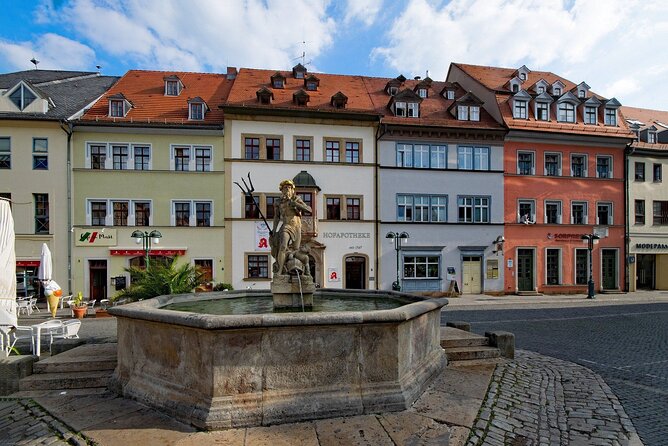
You begin at the Market Square, one of Weimar’s main meeting points. This is the kind of place where you can feel daily life layered over centuries. The tour frames it as a hub where notable residents lived close by, including the renaissance painter Lucas Cranach in nearby buildings.
But the Market Square pulls you toward the classicists, and that is the trick. Weimar is a city of pedestrians, and many major stops sit close enough that you can actually connect them in your head. The architecture around you hints at feudal days, so the city looks like it has a past, not just a brochure.
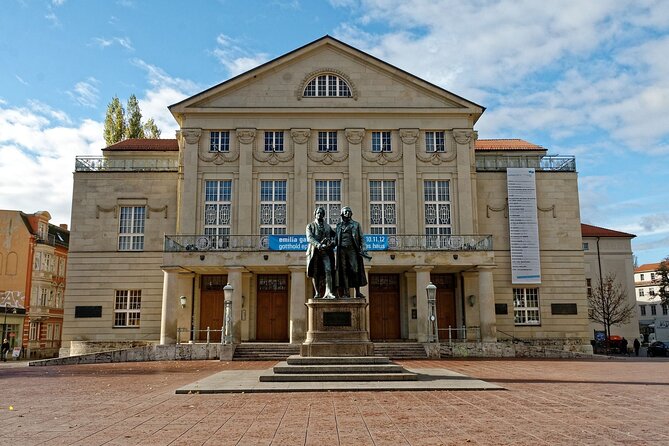
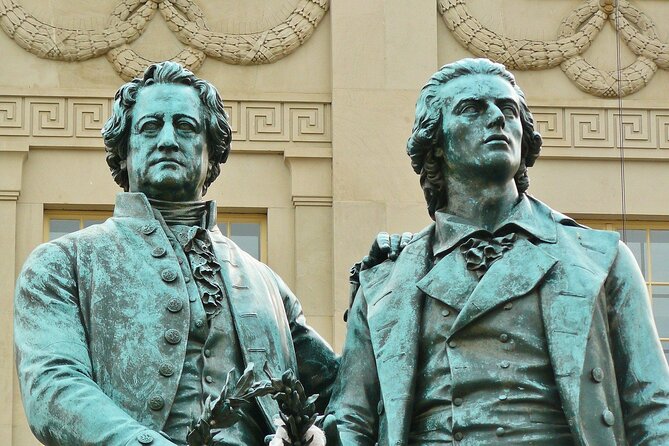
Next is Theaterplatz, where the walk guides you toward the Goethe and Schiller memorial in front of the National Theater. This square is where the writers turn from names into a physical presence in town. The story runs through Anna Amalia, the dowager duchess who hosted gatherings that included Goethe and Schiller, helping explain how Weimar became a magnet for German classicism.
You also get a clear sense of how the area is set up to impress. The memorial stands tall as a focal point, and the surrounding theater space reinforces the idea that ideas and art were treated like public life, not private hobbies.
The House of the Weimar Republic and the hard turn toward democracy
From Theaterplatz, you head to the House of the Weimar Republic. The location is key because it keeps the story anchored in the same urban fabric. The tour points out that this is where the National Assembly gathered in 1919, discussing the future of post-World War I Germany.
This stop gives context for why the term Weimar Republic exists at all. It was Germany’s first attempt to build a democracy after the fall of the German Empire. The tour also makes the political timeline clear: the system was destroyed when the Nazi party came to power in 1933.
What I like here is how the tour doesn’t treat democracy as an abstract concept. It explains it as something built in a specific place, by specific people, during a specific moment in history. The building is also described as a renovated space and a Forum for Democracy, which makes the site feel more than just a memorial.
If you like understanding cause and effect, this is the stop where your earlier classicism story can shift gears into modern political history. You finish this portion with a better sense of why Weimar’s legacy is complicated, not only literary.
Saint Peter and Paul Church, where Luther, Herder, and Anna Amalia share the ground
The walk then moves to the Saint Peter and Paul Church, described as the most important church in Weimar. The tour gives you the long-building arc first: it sits on foundations of a 13th-century church, and the structure was built in the 16th century in Gothic style.
Then comes the religious turning point. The church was converted to Lutheran belief in the 16th century, and the tour notes that Martin Luther himself preached there. That detail matters because it ties a major historical figure to an everyday city site you can stand in front of.
The tour also adds names you might not expect in the same breath. The theologian Johan Gottfried Herder is buried here, since he served as superintendent of the church. Duchess Anna Amalia is buried there too, which brings the political and cultural leadership back into view through a religious lens.
In front of the church, you can see the Herder Memorial, dedicated in 1850. This is a nice moment to slow your attention for a minute. You are not just walking between famous addresses, you are seeing how the city chose to remember specific thinkers.
Other walking routes through Germany
Weimar Palace, Duke’s Square, and the power of royal surroundings
Next up is Weimar Palace, tied to the dukes of Saxe-Weimar and Eisenach. The tour frames it as an evolving residence, starting as a medieval castle. It notes the earliest mention in the 10th century, then explains that the palace was remodeled after multiple destructive fires to become the residential palace you can recognize in its later form.
What I like about this stop is the scale of time. The tour says it took about 500 years to develop it to its present state. That is a reminder that Weimar’s look and meaning did not appear overnight. It was built, damaged, and rebuilt over centuries.
From there, you reach Democracy Square, which used to be called Duke’s Square. The tour emphasizes how the setting itself communicates hierarchy, because the square sits amid royal buildings. You hear about the red and yellow palaces and the house where Duke Charles Augustus lived.
This is a useful mental link for visitors. Democracy Square can sound like it belongs only to the 20th century story. The tour shows how the royal surroundings help explain the contrast. You are standing in a space that changed role over time, from ducal power to democratic memory.
Even if you only take one takeaway from this segment, I’d make it this: the buildings matter because they show you what kind of society people had before the modern ideas arrived.
Anna Amalia’s Library and Park an der Ilm, literature in stone and trees
Anna Amalia’s Library is one of the stops that feels both intimate and important. The tour describes it as a small palace library with treasures collected over centuries, and it credits the dowager duchess Anna Amalia for supporting it decisively.
If you care about how Goethe fits into the city, this is one of the best moments. The tour notes that you can find a document that offers an early indication of Wolfgang von Goethe’s presence in Weimar. It also explains that Goethe ran a library for decades, which helps you understand him as a working presence in town, not a distant genius who visited occasionally.
Right beside the library is Park an der Ilm. The tour says it was created in the 18th century, and it is known for valuable trees and architectural gems like the ruins of the Tempelherrenhaus. This is where the city turns from buildings into a designed outdoors setting.
Goethe’s influence shows up again here. The tour explains that he played a part in designing the park and that he spent his first years in Weimar in a house near the park. That house was a gift from Charles Augustus, tying literature to patronage and daily living.
If you want a break from dense political facts, this segment is your reset. It also gives your eyes a different kind of learning. You can start noticing how Weimar’s cultural life shaped not just books and theaters, but the parks people walked through.
Goethe’s House, Liszt Haus, and Schiller’s turning point
On Frauenplan, the tour goes to Goethe’s House. The walk explains that it became his more impressive new residence after 1782. The big payoff here is the sense of staying power: the tour says many rooms look exactly as they did in the poet’s last years.
One specific detail is highlighted in the study where Goethe wrote works like Faust. The tour notes that the study is unchanged, and it also states that Goethe stayed in Weimar until his death in 1832. This is the kind of stop where you can feel why the city still feels literary, even when you are not reading German.
Then the walk shifts to music at Liszt Haus. The tour shares that Franz Liszt lived there during many summers, gifted by the local duke. It also notes something very practical and human: in his Weimar house, Liszt taught young pianists from all over Europe for free.
That free teaching detail is memorable because it changes Liszt from a famous name into a mentor. It also fits Weimar’s overall theme of ideas shared through institutions, patronage, and public culture.
Finally, you reach Friedrich Schiller’s House. The tour connects Schiller and Goethe through an assembly that brought them together. When they met, Goethe invited Schiller to Weimar, and from that moment the tour frames an intense creative association between them.
This sequence of houses is what makes the route work. It is not random sightseeing. You move through three core creative figures, and the guide helps you see how Weimar’s culture was a network, not a collection of isolated monuments.
Getting the most from a private guide in Weimar
Because the walk is easy and compact, you can treat it like a focused introduction. I like to ask one or two questions per stop, then let the guide’s answer point me to what to look for next. With a private setup, you are not stuck waiting for the group.
Here are a few practical moves that fit this specific experience:
- Wear comfortable shoes. The tour is described as easy, but you still cover multiple stops within about 2 hours.
- Use the tight location to your advantage. Since the sites are close together, you can compare architectural styles and civic themes without losing the thread.
- Expect a mix of topics. You will go from theaters and memorials to a church with Lutheran ties to democracy-era politics and then back to literature and music.
- Ask about connections. A strong guide can link Anna Amalia’s role in gatherings to why the library and memorials matter later in the story.
You also have flexibility. The tour notes customization is possible on the spot, so if you care most about one figure, you can steer the guide’s emphasis while staying on route.
Finally, plan to arrive a little early at Markt 20. That way you start your walk calmly and get the full timing window.
Price and value for a private group walk
The tour price is $244.41 per group for up to 15 people, lasting about 2 hours. That pricing structure is often the difference between feeling like a splurge and feeling like a smart use of money.
If you travel as a small group, you are still paying per group, which means the effective cost per person drops as your group size grows. For solo travelers or couples, it can feel pricier, unless having a guide focused only on you is a priority.
Where the value shows is in the guide-led context. The sites span major themes: classicism, a key political turning point, Lutheran religious history, and the physical spaces tied to Goethe, Schiller, and Liszt. A good guide helps you connect all those dots during the walk, instead of trying to do it later using fragmentary notes.
Also, the tour includes a mobile ticket and is available in English. That reduces friction, especially when you want a guided experience without arranging extra logistics.
In plain terms: if your group size is at least a few people and you enjoy guided stories over self-guided sign reading, this can be good value.
Who should book this Weimar private walking tour?
This is a strong fit if you want an orientation to Weimar’s big ideas, in a manageable time window. The tour is listed as suitable for any age and easy on your feet, which makes it practical for multigenerational groups and people who do not want a long hike.
It also suits book-and-arts lovers. You get Goethe, Schiller, and Liszt tied to places you can point to. If democracy-era history is your interest, the House of the Weimar Republic and Democracy Square segment gives you a clear political frame.
If you are traveling with someone who likes history but does not want museum-only time, the mix of squares, church, palaces, and writers’ homes helps keep attention moving.
If you are a hardcore detail seeker who wants hours inside every building, you may find the pace too fast. The tour is meant to set the stage, then you can go deeper later on your own.
Should you book this private Weimar walk?
I think you should book if you want a guided introduction that links names, buildings, and turning points in about two hours. The private format, English availability, and guide-led connections make it especially good for first-time visitors who want Weimar to make sense.
Skip it or plan an add-on if you need long, slow time in interiors and galleries. This walk is about momentum and context. Treat it as your smart start, then let your interests pull you into follow-up visits around town.
If you like talking to a real person while you walk, this one is worth it.
FAQ
How long is the walking tour?
The tour lasts about 2 hours.
Is the tour offered in English?
Yes, it is offered in English.
Is this a private tour or a shared group?
This is a private tour/activity, and only your group will participate.
How many people can be in a group?
The price is per group for up to 15 people.
Do I need transportation during the tour?
No transportation is needed, and it is a walk-only experience.
Where does the tour start and end?
It starts at Markt 20, 99423 Weimar, Germany, and ends at 99 Weimar, Germany.
Pavements of Germany
Through Thuringia and the Harz
Everything else we filed on Germany
- Segway tour around the Werra horseshoe
★ 5.0 · 3 reviews - Private Sightseeing Flight Over Hamburg
★ 5.0 · 3 reviews - Kassel’s Private City Walk through 1100 years
★ 5.0 · 4 reviews - Self-Guided Walk Around Quedlinburg’s Timber-Framed Houses
★ 4.0 · 4 reviews - Stadtspiel scavenger hunt Weimar – independent city tour I discovery tour
★ 5.0 · 5 reviews - Weimar Private Walking Tour With A Professional Guide
★ 5.0 · 5 reviews
Weimar Erfurt and Thuringia Tours, side by side.
 ★ 4.7Erfurt: Old Town Guided Walking TourFrom $151,617 reviews
 ★ 4.7Weimar: Old Town Guided Walking TourFrom $111,080 reviews
 ★ 4.5Night Watchman Tour through QuedlinburgFrom $131,040 reviews
 ★ 4.8Erfurt: Guided Tour of The Petersberg CitadelFrom $12674 reviews
 ★ 4.7Goslar: Tausend Schritte durch die AltstadtFrom $16417 reviews
 ★ 4.5Quedlinburg: Guided City Highlights Walking TourFrom $11353 reviews
 ★ 4.7Erfurt: With Night Watchman Schwalbe through the Old Town, including tastingFrom $18297 reviews
 ★ 4.5Fulda: Night Watchman TourFrom $23167 reviews
Other lists this tour is on