
REVIEW · PRIVATE CAR WITH DRIVER
Berlin City Tour by Private Car
Berlin, decoded from the sidewalk. This private car tour links Berlin’s biggest historical markers into one logical half-day loop, with an English-speaking guide to keep the timeline clear. You start at Potsdamer Platz and move through the Wall era, the Cold War line, and the city’s everyday center.
Two things I like a lot are the pickup-by-car convenience (so you spend less time figuring out transit) and the guide style of Shadi, who is praised for being careful, thoughtful, and full of practical history. One main consideration: the day depends on good weather, and the schedule is tight, with most time spent outdoors or on short walks, so plan for a steady pace.
In This Review
- Key highlights you get on this Berlin private-car loop
- A 4-hour Berlin highlight run that keeps the timeline straight
- Potsdamer Platz: from border strip to Berlin’s big-stage square
- Brandenburg Gate: Doric columns, Prussian power, and freedom symbolism
- Holocaust Memorial: giving yourself the 25 minutes it deserves
- Alexanderplatz: city-center wayfinding with real landmarks
- Berlin Wall Memorial: seeing a divider as both physical and ideological
- Checkpoint Charlie: the border crossing where 1961 tension became real
- Jewish Museum Berlin: exhibitions that connect past, present, and Jewish art
- Price, timing, and what to pack for a smooth private half-day
- Should you book this Berlin private car city tour?
- FAQ
- How long is the Berlin City Tour by Private Car?
- Is pickup available for this tour?
- Is the tour private?
- What languages is the tour offered in?
- Do I need to buy admission tickets for the stops?
- How do I access my tickets?
- What if the weather is bad?
- Is the Jewish Museum stop included, and how long do you spend there?
Key highlights you get on this Berlin private-car loop
- A one-day storyline from border strip to Wall to reunified Berlin, in a route that makes sense
- Major icons in efficient order: Potsdamer Platz, Brandenburg Gate, Holocaust Memorial, Alexanderplatz
- Cold War stops paired for clarity: Berlin Wall Memorial plus Checkpoint Charlie right after
- Time for reflection at the Holocaust Memorial without skipping it
- Shadi’s guiding and driving style is repeatedly noted as careful, helpful, and accommodating for mobility needs
The wider Berlin sightseeing pile
- Berlin: 1-Hour City Tour by Boat with Guaranteed Seating★ 4.3 · 16,993 reviews
- Berlin: City Sightseeing Hop-On Hop-Off Bus Tour★ 4.1 · 4,233 reviews
- Berlin: 1-Hour City Sightseeing Cruise★ 4.4 · 2,210 reviews
- Berlin City Hop-on Hop-off Tour with Optional Cruise★ 3.5 · 1,155 reviews
A 4-hour Berlin highlight run that keeps the timeline straight
This is a 4-hour, private Berlin city tour by car, offered in English with mobile tickets. Because it is private, it is just your group, not a big bus shuffle. Pickup is offered, and the tour is designed so you can move between neighborhoods without burning half your day on transit.
The big value here is the structure. Berlin can feel like a lot of separate “must-sees,” but this route strings them into a story you can follow: Potsdamer Platz (modern Berlin after the Wall era), Brandenburg Gate (unity and freedom), Holocaust Memorial (what happened and why remembering matters), Alexanderplatz (Berlin life and landmarks), then Wall Memorial and Checkpoint Charlie (the border reality), and finally the Jewish Museum Berlin (history plus art and current topics).
Price is $355.04 per person. That sounds like a premium, but consider what you are buying: a dedicated guide, a private car for multiple stops, and a route that hits several top-tier sites within a half-day. Also, the itinerary lists admission as free at each stop, which lowers the “hidden add-ons” factor.
Who this suits best: first-timers who want the “best-of” condensed into one morning or afternoon, history-minded couples, and anyone who would rather let the guide handle the sequencing. If you want a slow museum day with lots of independent wandering, you might find the pacing a bit brisk.
Potsdamer Platz: from border strip to Berlin’s big-stage square
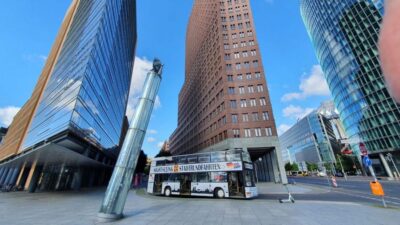
Your tour opens at Potsdamer Platz, the area that went from border strip to one of the city’s most dramatic redevelopment stories. This is where Berlin’s contradictions show up fast: old political separation replaced by modern scale, signage, and bustle.
You get about 40 minutes here, and the context matters. Potsdamer Platz is tied to the idea of the Wall era and the later transformation into a modern “largest construction site in Europe” style moment. It is also associated with major culture, including The Wall rock concert concept and the Berlinale, Germany’s major film festival, which is closely linked with this area.
Practical tip: use your first stop to get your orientation. When you learn where the border used to cut through the city, later stops start clicking into place. If you like photos, this is also where you will naturally frame wide views of modern Berlin, with history hovering just behind the streets.
What to watch for: since this is the first stop, it can feel like a quick opening act. If you are the type who hates rushing, you might want to ask your guide for a “top two things to look for” right at the start.
Brandenburg Gate: Doric columns, Prussian power, and freedom symbolism
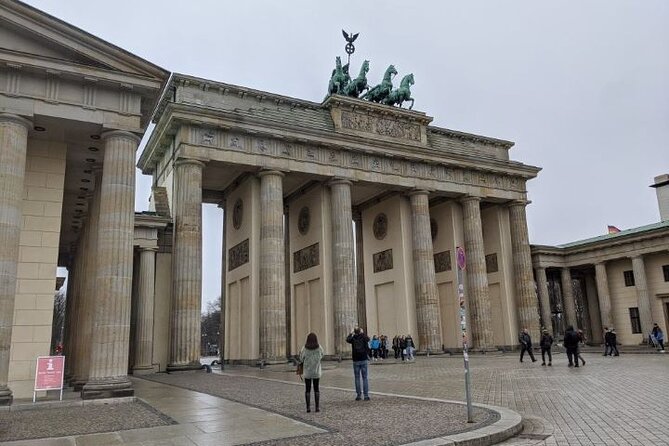
Next up is Brandenburg Gate, with about 40 minutes. This is one of those places where a short visit can turn shallow if you do not know what you are looking at, which is exactly why guided context helps.
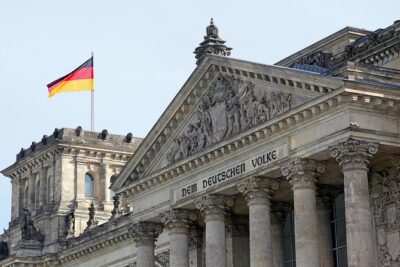
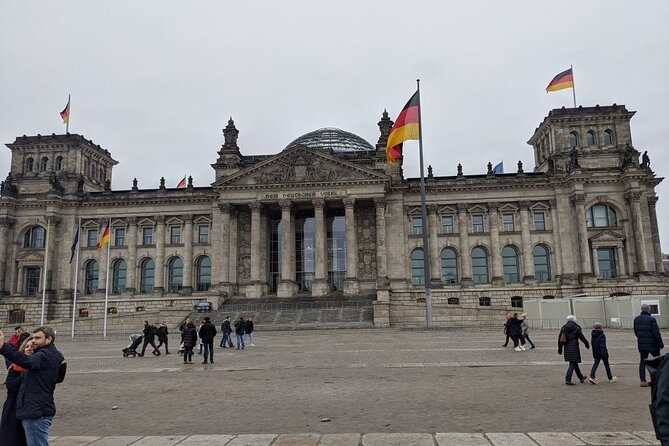
The gate was built from 1788 to 1791, designed under Carl Gotthard Langhans, commissioned by Prussian King Friedrich Wilhelm II. The design is modeled after the grand gateways of the Athenian Acropolis, and the familiar look comes from its Doric columns.
More importantly, your guide will help connect the architecture to Berlin’s political meaning over time. Today it is often treated as a symbol of unity and freedom. That symbolism is powerful, but it lands better when you know it sits inside a much longer history of power, rebuilding, and shifting eras.
Practical tip: stand back far enough to see the full gate in one frame, then walk closer for the column rhythm. It sounds basic, but doing both helps you remember the place, not just capture it.
A consideration: this is a major landmark. Expect people and noise. If you want quiet, you might shift your focus to details, like stonework and symmetry, rather than trying to find empty space.
Holocaust Memorial: giving yourself the 25 minutes it deserves
Then you head to the Memorial to the Murdered Jews of Europe, with about 25 minutes. This is not the stop for “quick photos and move on.” The site is built for slow thinking, and the experience is meant to stay with you.
Your itinerary places this memorial near Brandenburg Gate, which creates an intense contrast. On one side you have symbols of unity and freedom. On this side you have the reality of mass murder and the urgent need to remember.
The tone is reflective and direct, with the idea of Never Again as a promise to learn and not forget. What makes this stop valuable in a guided format is the pacing. If you only have a few hours in Berlin, it is easy to shortchange places like this. Here, you are given real time.
Practical tip: if you are visiting with someone who wants to talk, ask for a quiet moment first. This memorial works best when you slow your thoughts down. Comfortable shoes help too, because you will likely walk within the memorial grounds.

Alexanderplatz: city-center wayfinding with real landmarks
After the solemn stops, you move to Alexanderplatz, with about 30 minutes. This is Berlin’s everyday center, and it is a great place to understand how the city functions now.
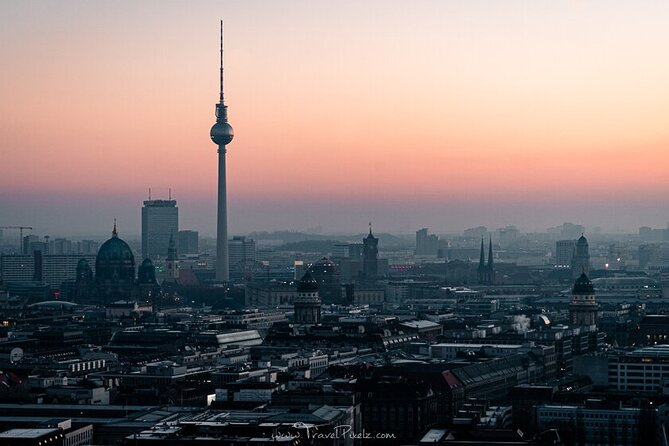
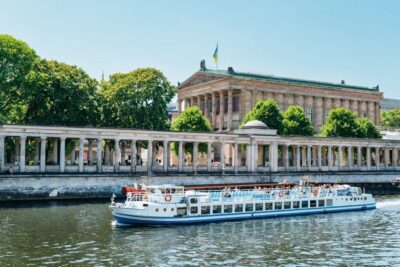
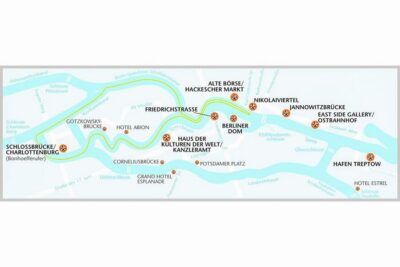
Your route includes highlights around Alexanderplatz, including the Nikolaiviertel with cobblestone streets, the Fountain of Friendship between Peoples, the Berlin City Hall, and the Pleasure Garden. You also get the big visual anchor of the Berlin TV Tower and the playful reference point of the Berlin World Clock.
This is a “map-making” stop. Even if you do not go up any towers or enter every building, you learn where key sights sit relative to each other. It makes future self-guided exploring easier, because you start recognizing the city’s layout and landmarks.
Practical tip: if you want to take in the feel of Berlin without exhausting yourself, Alexanderplatz is the right place. The area is built for walking, pausing, and rechecking where you are headed next.
Potential drawback: the time is limited. If you fall in love with one exact detail, you may not have time to linger. That is normal for a half-day itinerary, so I suggest choosing one “must notice” item and letting everything else be a bonus.
Berlin Wall Memorial: seeing a divider as both physical and ideological
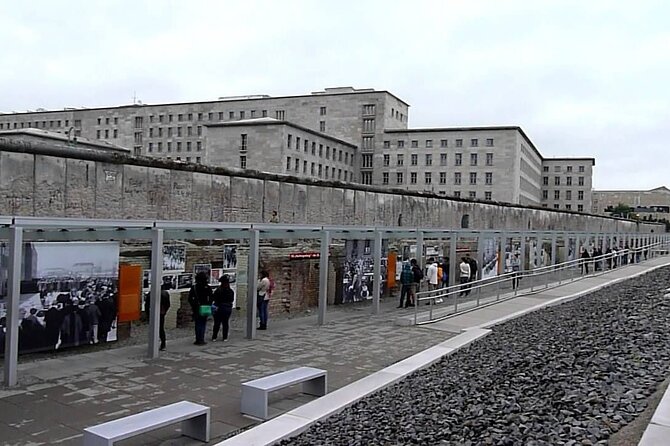
Now the tour turns back to Cold War reality at the Memorial of the Berlin Wall, with about 30 minutes. This section is one of the most important stops because it explains what the Wall did beyond dates.
You learn how the Wall was erected by the German Democratic Republic and how it prevented East Berliners from reaching the freedom of the West, all while major Western Allies watched. The point is not just that a wall existed. The point is that it reshaped daily life, movement, and choices.
Your guide’s job here is key: the Wall era can turn into abstract facts if you only see a small remnant. With interpretation, you start understanding it as both physical barrier and ideological divider.
Practical tip: treat this stop like a “think” moment. If your feet are tired, it is tempting to rush to the next photo spot. Instead, spend time listening, because the explanation is what makes the memorial meaningful.
Checkpoint Charlie: the border crossing where 1961 tension became real
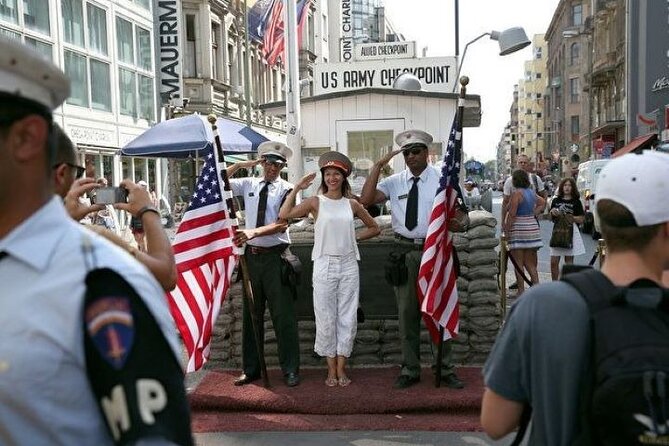
A short move brings you to Checkpoint Charlie, with about 30 minutes. This is one of the most recognizable border crossings from Cold War Berlin, and it is easy to think you already know the story until you hear the specific context.
Your tour focuses on what made this crossing so iconic: the Berlin Crisis in 1961, with American and Soviet tanks positioned in a tense standoff. It is the kind of moment that helps you understand why Cold War Berlin felt sharper than a history chapter.
Checkpoint Charlie works especially well in a guided route because it fits directly after the Wall Memorial. You can connect the idea of separation to the reality of confrontation at a visible crossing point.
Practical tip: ask your guide how the Wall and checkpoints fit together. You will likely leave with a clearer mental diagram, which makes Berlin’s history feel less like disconnected pieces.
Jewish Museum Berlin: exhibitions that connect past, present, and Jewish art
The tour ends at the Jewish Museum Berlin, with about 40 minutes. This is a different kind of stop from the outdoor memorials, and that balance helps your day feel more complete.
The museum experience on your itinerary focuses on special exhibitions that cover history, current topics, and the creativity of Jewish creators. It is presented as a place where lives and communities in Germany are connected across time, not just displayed as old artifacts.
Because you have only 40 minutes, this is not a “read every label” assignment. Instead, use the time to pick what matches your interests. If you like seeing how history evolves into present-day conversations, this is the part of the day that can feel most relevant.
Practical tip: bring a phone for quick notes. After a day of heavy context, it is easy to mix details. A couple of saved keywords will help you remember what you want to follow up on later.
Price, timing, and what to pack for a smooth private half-day
Let’s talk about the value equation. The tour costs $355.04 per person and runs for about 4 hours. Within that time, you are covering seven major stops, with listed time windows at each: Potsdamer Platz (40 min), Brandenburg Gate (40 min), Holocaust Memorial (25 min), Alexanderplatz (30 min), Wall Memorial (30 min), Checkpoint Charlie (30 min), and Jewish Museum Berlin (40 min).
Those durations add up to more than four hours, but the difference is likely absorbed by transit between stops. In other words, this tour is designed to be efficient. It does not mean it is rushed in the sense of being careless. It means you are on a schedule, and you should expect a steady rhythm.
The itinerary also lists admission as free at each stop. That is a big plus for budgeting. Still, if you care about a specific museum detail, you might want to decide in advance how you plan to use your limited museum time.
Weather matters. The experience requires good weather, so if it is rainy or miserable, you may need flexibility. For your comfort, dress in layers and wear comfortable shoes. Also, make sure your phone is charged, since you use a mobile ticket.
If you are traveling with mobility needs, there is a key signal from past experiences: people selected this tour because someone in the group had mobility issues, and the guide was described as attentive, with careful driving. That does not guarantee every personal need will be covered, but it is a positive sign that the tour operator and guide understand real-world constraints.
Should you book this Berlin private car city tour?
I think it is a strong pick if you want Berlin’s top landmarks with a guide who can tie them into one clear story. You get the big symbols, the Wall and Cold War line, plus a museum stop that connects history to today’s conversations. The private car format helps a lot when you want the highlights without spending your day in transit.
You might skip it if you prefer a slower pace, long museum time, or if the idea of the Holocaust Memorial and Wall stops feels too heavy for your schedule. Also, since the tour depends on good weather, you will want to plan it when the forecast gives you a chance.
My practical advice to make this work for you:
- Treat it like a guided “timeline walk,” not a free-for-all sightseeing day.
- Ask the guide at the first stop what theme connects the route, then listen for that thread all day.
- If you have one place you care about most, tell your guide early so time at the end can fit your priorities.
FAQ
How long is the Berlin City Tour by Private Car?
It is listed as approximately 4 hours.
Is pickup available for this tour?
Yes. Pickup is offered.
Is the tour private?
Yes. It is a private tour, and only your group participates.
What languages is the tour offered in?
The tour is offered in English.
Do I need to buy admission tickets for the stops?
The itinerary lists admission tickets as free for the stops shown.
How do I access my tickets?
You receive a mobile ticket.
What if the weather is bad?
The experience requires good weather. If it is canceled due to poor weather, you will be offered a different date or a full refund.
Is the Jewish Museum stop included, and how long do you spend there?
Yes, the itinerary includes the Jewish Museum Berlin, with an allotted time of about 40 minutes.
Seeing Berlin in One Go
Everything else we filed on Berlin
- Private Photo Tour in Kreuzberg
★ 5.0 · 3 reviews - Kreuzberg Private Walking Tour: Immigrants, Artists & Hipsters
★ 5.0 · 3 reviews - Berlin’s Jewish Heritage: Private Tour of the Vibrant Jewish District
★ 5.0 · 3 reviews - Individual city tour Berlin for max. 8 persons
★ 5.0 · 3 reviews - Berlin & The Third Reich Private Guided Tour
★ 5.0 · 3 reviews - Private Analogue Photography Experience in Berlin
★ 5.0 · 3 reviews
Private Car with Driver, side by side.
 ★ 5.05hours: Guide, Chauffeur & Photographer in Berlin private TourFrom $71266 reviews
 ★ 4.5Hamburg: 3-Hour Limousine Tour with Driver-GuideFrom $32456 reviews
 ★ 5.0Potsdam City Tour by Private CarFrom $42110 reviews
 ★ 5.0Munich private Car & Walking Tour incl. BMW World & River SurfersFrom $6828 reviews
Other lists this tour is on