
REVIEW · WARTIME HISTORY
Berlin & The Third Reich Private Guided Tour
Berlin keeps receipts of its past. This private 4-hour guided walk strings together the story of how Nazi power took hold in Berlin, then ends with the city’s final break in 1945. I love the way the tour uses major, real-world locations as your timeline, and it does it with clear narrative links instead of disconnected facts.
I also like that every scheduled stop is admission-free, so your money goes to the thinking and storytelling, not museum ticket math. One thing to consider: the pacing is brisk, with short stops like 10 to 20 minutes, so if you prefer long reading and deep museum time, you may want to add follow-up visits.
In This Review
- Key points to look for on this Berlin Third Reich tour
- What makes this Berlin Third Reich walk worth your time
- Pariser Platz and Unter den Linden, where power plays start
- Reichstag Building and the Dome: the parliament behind the fire myth
- Brandenburg Gate: royal entrance, division wall trap, and a new symbol
- Holocaust Memorial: paying attention without turning it into a photo pit
- Fuhrerbunker and Potsdamer Platz: where WWII leaves marks you can still read
- Checkpoint Charlie: Cold War tension at an easy-to-find corner
- Price and private-group value: when $329.92 makes sense
- Who this tour is best for, and who should skip it
- Should you book this tour?
- FAQ
- How long is the Berlin & The Third Reich private guided tour?
- How much does the tour cost?
- Is it a private tour?
- Where does the tour start?
- Does the tour offer pickup?
- Is there an admission fee at the stops?
- Do I need a physical ticket?
- Is the meeting area easy to reach with public transportation?
- Are service animals allowed?
- What is the cancellation policy?
Key points to look for on this Berlin Third Reich tour
- A tight 4-hour storyline that moves from power-building to the end of WWII
- Free entry at each major stop, so you’re not constantly paying to get in
- Private group format, meaning questions fit naturally into the walk
- Historic sites in sequence, so you learn why each place matters
- Guides with strong narration, including names like Walid, Campbell, and Gregor from past experiences
Further wartime history walks we have written up
- Berlin: Third Reich and Cold War 2 Hour Walking Tour★ 4.9 · 6,830 reviews
- Berlin’s Best: 2 Hour Walking Tour Third Reich and the Cold War★ 5.0 · 5,486 reviews
- Third Reich Berlin: Hitler and WWII Walking Tour★ 5.0 · 3,301 reviews
- Berlin: Third Reich, Hitler, and WWII Walking Tour★ 4.9 · 1,133 reviews
What makes this Berlin Third Reich walk worth your time
Berlin has an odd talent: it can look normal while quietly carrying the scars of the worst chapters of the 20th century. This tour leans into that contrast. You don’t just see famous monuments, you learn how specific places connect to the rise of the Nazis, the machinery of control, and the end of the regime.
The value here is not in “big names” alone. It is in how you’re taught to read the city. On a good day, you’ll start noticing details you would otherwise miss, like how political power used public buildings as stage sets, and how later rebuilding changed what the city wants to emphasize.
One practical bonus: because it is a private tour, your guide can slow down when something doesn’t click yet. In a place like Berlin, that matters, because symbols can be confusing if you only see them for a minute.
Pariser Platz and Unter den Linden, where power plays start
Your first stop is Pariser Platz, at the end of Unter den Linden, and right by the Brandenburg Gate. This is the kind of location that helps you get your bearings fast. Even if you’ve seen photos, being on the ground helps you understand how this area functions as a formal entrance to Berlin.
Pariser Platz is also a good “warm up” for the tour’s tone. You are starting in a space that feels polished and important, then you’ll quickly move into the places where politics, propaganda, and violence used that sense of importance as leverage.
Timeline note: you’ll spend about 15 minutes here. That’s enough time to orient yourself, notice key sight lines, and let the guide set up what you’re going to see next. If you want extra photos, you’ll have to do them right there, because you won’t have hours at any single stop.
Reichstag Building and the Dome: the parliament behind the fire myth
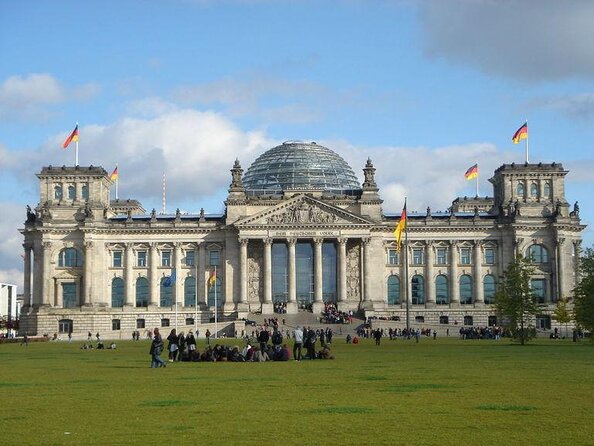
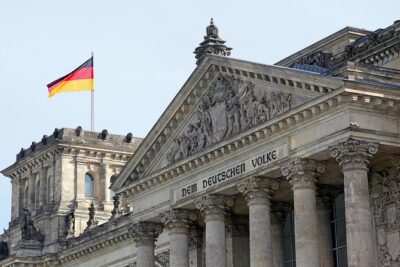
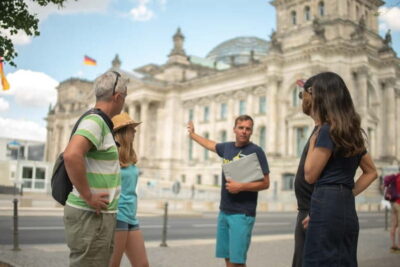
The Reichstag Building is the German Parliament, and it carries one of the most infamous turning points tied to Hitler’s rise: the fire that became a tool for taking total control. The building is not just architecture, it is a political instrument with a long memory.
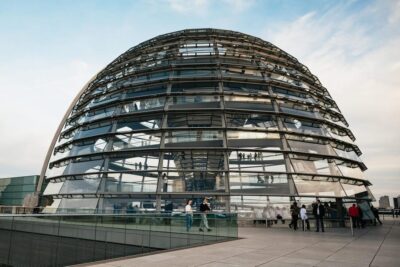
You’ll also see how Berlin layers time on top of time. The Reichstag is now topped with a glass cupola designed by British architect Sir Norman Foster. From street level, it can be hard to picture how that dome changes the way the building “feels.” That is why having a guide explain the shift in meaning is useful.
Expect about 10 minutes at the Reichstag. That can feel short if you like to linger. Still, it works well for the purpose of this tour, which is narrative rather than museum-style pacing. If you want more time inside related spaces later, you can plan that after the walk.
Brandenburg Gate: royal entrance, division wall trap, and a new symbol
Next comes the Brandenburg Gate, one of Berlin’s former city gates and a royal entrance to the Hohenzollern family. It survived major shocks over centuries, including Napoleon and WWII, and then it became trapped in the middle of the Berlin Wall for almost 30 years.
That last detail is the emotional hinge for many visitors. The gate is familiar from travel photos, but when you learn it sat in the middle of a divided city for decades, the monument changes from “landmark” to “witness.”
You’ll get about 15 minutes here. I like that the tour does not drag this stop. The point is to let the story land, then move on before you get stuck only on the visual.
Also, take a moment to watch how the gate is used today. Reunified Germany turns the same structure from a symbol of division into a symbol of unity. That is not just a political statement. It is an example of how societies rewrite public meaning after trauma.
Holocaust Memorial: paying attention without turning it into a photo pit
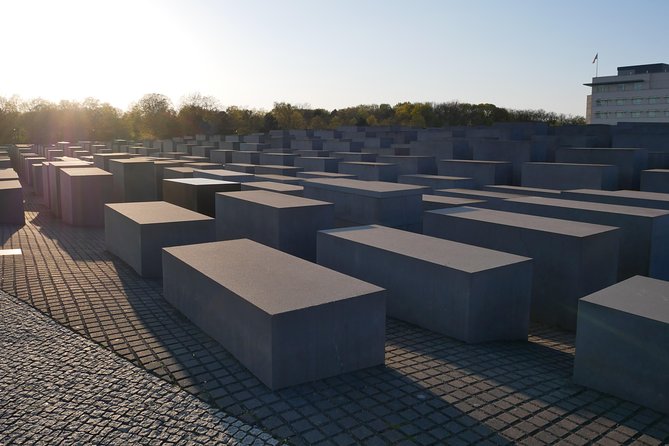
The Holocaust Memorial, officially the Memorial to the Murdered Jews of Europe, is a massive site covered with stone stelae. It is the central Germany memorial to the Jewish victims of the Holocaust. This is not a place for speed-walking or treating it like a “see it, post it, done it” stop.
You’ll spend around 20 minutes, which is enough time to slow down and follow a route through the space with the guide’s framing. A good visit here is more about attention than sightseeing. You’ll learn how the memorial’s design encourages disorientation and reflection, and that it asks you to feel something uncomfortable: the weight of what was done and what was lost.
Because this tour includes heavy themes, the memorial can become the emotional anchor. If you do not handle intense subject matter well, this stop might feel like a lot. On the other hand, if you want Berlin to mean something, this is where it stops being abstract.
Tip for your own comfort: wear shoes you can stand in for a while. You may not realize how much walking happens on this surface until you are there.
Fuhrerbunker and Potsdamer Platz: where WWII leaves marks you can still read
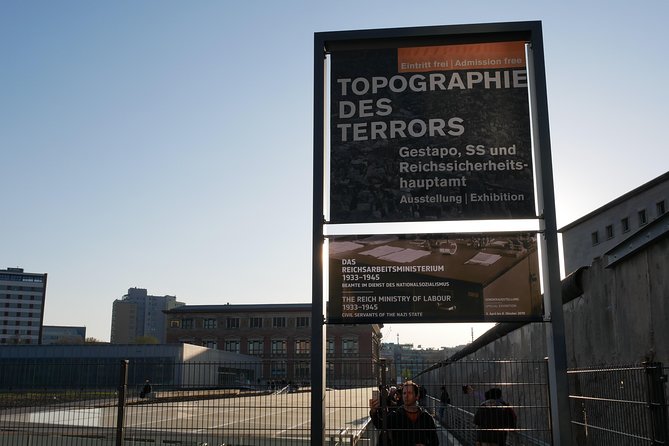
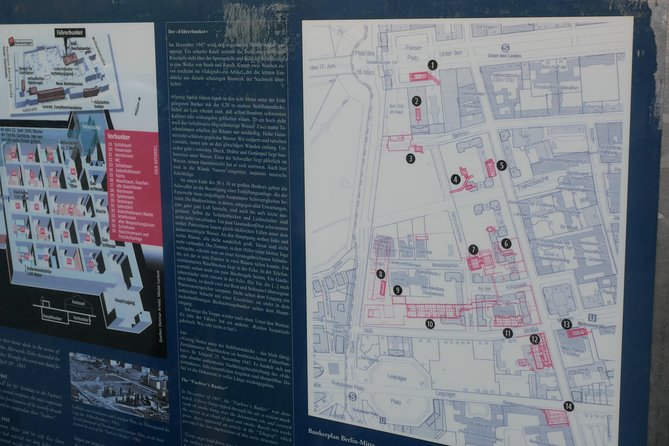
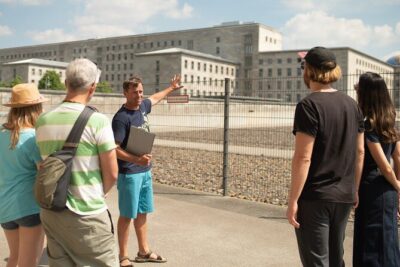
One of the most striking stops is the Fuhrerbunker. Today it is essentially a parking lot with a simple sign. That contrast is the point. You are standing where Hitler spent his final days, married, and then committed suicide in the final days of WWII in Europe. The lack of drama in the present-day setting can feel surreal.
You’ll get about 15 minutes there. This is not the kind of location you need extra time for, but it does benefit from context. Your guide’s job is to connect what happened here to what you’ve seen in earlier stops, so the ending of the story doesn’t feel random.
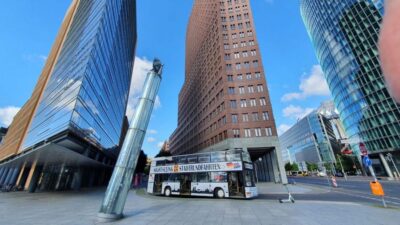
Then you move to Potsdamer Platz. In the 1920s it was one of the busiest traffic intersections in Europe. WWII destroyed it almost completely, and in the 1990s and early 2000s it was rebuilt into Berlin’s most modern precinct.
This pairing works because it shows two versions of reality side by side. The Fuhrerbunker stop gives you the end of a regime. Potsdamer Platz gives you the aftermath, the rebuilding, and the city’s return to everyday motion.
You’ll spend about 10 minutes at Potsdamer Platz. That’s enough to grasp the transformation, but not enough to replace a longer visit to the area if you are a architecture or urban design person. If you like to keep exploring, Potsdamer Platz is a good place to continue on your own after the tour.
Checkpoint Charlie: Cold War tension at an easy-to-find corner
Checkpoint Charlie is the famous frontline checkpoint manned by the Americans and Soviets during the Cold War. It is one of those Berlin sites that visitors recognize instantly from movies and photos, but the tour gives you the chance to interpret what that “frontline” meant in daily life.
This stop is about 10 minutes. That’s appropriate because the main goal is to understand the transition from WWII to the next era of conflict. You are not just seeing a place, you are seeing what replaced the Nazi era in Berlin, and how the city became a stage for power between East and West.
Checkpoint Charlie also helps you connect Berlin’s layers. Nazi Germany was one type of brutality. The Cold War was another kind of tension and control, even without identical methods of mass terror. Your guide can help you see those differences without letting the story turn into a blur of “bad things that happened here.”
Price and private-group value: when $329.92 makes sense
The price is $329.92 per group, up to 15 people, and it runs about 4 hours. That sounds steep if you assume you’re paying per person. But since it’s priced per group, it can be a strong value when multiple adults split the cost.
Here is the simple way to think about it: if you can fill more of that group cap, your per-person share drops fast. If you are two people and nobody else joins your group, you pay much more per person. So this tour tends to fit best when you have a small group of friends, a family with multiple members, or a group of colleagues who want a guided story with no compromises.
Also, the tour is private, meaning only your group participates. That matters for a tour like this, because you may have questions, emotional reactions, or just a need to move at a steady pace. A shared public group can feel like it is rushing past serious subject matter.
Two logistics perks are worth noting. Pickup is offered, and you’ll use a mobile ticket. Plus, it is near public transportation, so even if you skip pickup, getting there is straightforward.
Booking timing is another practical piece. It is often booked about 12 days in advance on average, so if you want a specific date, don’t wait until the last week.
Who this tour is best for, and who should skip it
This tour is a fit if you want Berlin to make sense as a chain of events. If you enjoy walking tours but you also want context that turns street scenes into history, this is a smart choice. It is also a good fit for visitors who like clear structure, with each stop tied to a specific chapter.
It is likely best for adults and teens who can handle heavy topics. The Holocaust Memorial and the Third Reich sites are not light stops, and the tour’s power is in confronting that reality directly.
You might want to choose something else if you mainly want museums, because this is a street-and-site experience with short stop durations. It is also not ideal if you need long periods of quiet sitting and reading.
Good to know: most travelers can participate, and service animals are allowed. The pacing is walk-based, so wear comfortable shoes even though the total time is only about 4 hours.
Should you book this tour?
I’d book it if your goal is to see the key sites in a logical order and understand what they mean beyond the postcard level. The admission-free nature of the scheduled stops helps you keep your spending focused, and the private format helps the story land in a way that feels personal rather than rushed.
I would not book it if you want slow, museum-style immersion at a single site. This tour gives you the big narrative map, not a long stay at any one location. Think of it as the route that makes everything else in Berlin more understandable.
If you’re on the fence, here’s the quick test: if you want to connect Pariser Platz, the Reichstag, the Brandenburg Gate, and the memorial sites into one coherent timeline, this tour will do exactly that.
FAQ
How long is the Berlin & The Third Reich private guided tour?
It lasts about 4 hours.
How much does the tour cost?
It costs $329.92 per group (up to 15 people).
Is it a private tour?
Yes. Only your group participates.
Where does the tour start?
It starts at Brandenburg Gate, Pariser Platz, 10117 Berlin, Germany.
Does the tour offer pickup?
Yes, pickup is offered.
Is there an admission fee at the stops?
The listed stops show Admission Ticket Free.
Do I need a physical ticket?
No. A mobile ticket is provided.
Is the meeting area easy to reach with public transportation?
Yes. It is near public transportation.
Are service animals allowed?
Yes. Service animals are allowed.
What is the cancellation policy?
The experience is non-refundable and cannot be changed for any reason.
Wartime History Walks We Have Reviewed
Everything else we filed on Berlin
- Private Photo Tour in Kreuzberg
★ 5.0 · 3 reviews - Kreuzberg Private Walking Tour: Immigrants, Artists & Hipsters
★ 5.0 · 3 reviews - Berlin’s Jewish Heritage: Private Tour of the Vibrant Jewish District
★ 5.0 · 3 reviews - Individual city tour Berlin for max. 8 persons
★ 5.0 · 3 reviews - Berlin & The Third Reich Private Guided Tour
★ 5.0 · 3 reviews - Private Analogue Photography Experience in Berlin
★ 5.0 · 3 reviews
Third Reich and Wartime History Tours, side by side.
 ★ 4.9Berlin: Third Reich and Cold War 2 Hour Walking TourFrom $236,830 reviews
 ★ 4.6Munich: Third Reich & WWII Walking TourFrom $316,181 reviews
 ★ 5.0Berlin’s Best: 2 Hour Walking Tour Third Reich and the Cold WarFrom $245,486 reviews
 ★ 4.5Third Reich Walking Tour MunichFrom $454,291 reviews
 ★ 5.0Third Reich Berlin: Hitler and WWII Walking TourFrom $243,301 reviews
 ★ 4.7Nuremberg: Walking Tour of Former Nazi Party Rally GroundsFrom $151,665 reviews
 ★ 4.9Berlin: Third Reich, Hitler, and WWII Walking TourFrom $201,133 reviews
 ★ 4.8Nuremberg: Historischer Kunstbunker WWII Art Bunker TourFrom $14921 reviews
Other lists this tour is on