
REVIEW · CRUISES & BOAT TOURS
Berlin East Side Tour 2.5 hour cruise with commentary
The Spree turns Berlin into a moving picture book. This 2.5-hour East Side cruise mixes big landmarks with the parts you usually only spot on a walk, then adds live English and German commentary so you actually know what you are looking at.
I like the longer route for $36.04, because you get more than the usual quick loop. I also like that the tour focuses on specific places along the river, including the Wall story at the East Side Gallery and the governmental core around the Reichstag. One drawback to plan for: if you are sensitive to noise or heat, top-deck sound and lower-deck ventilation can be inconsistent depending on conditions.
In This Review
- Key things you will notice on this East Side Spree cruise
- From Alte Börse to the Spree, here is what the ride feels like
- The route’s big theme: East Berlin, then and now
- Mühlendammschleuse, Berlin’s lock moment you can actually watch
- East Side Gallery: graffiti art with real border geography
- Bridges and sculptures: Oberbaumbrücke and the Molecule Man
- Museum Island, Berlin Cathedral, and the Humboldt Forum axis
- Nikolaiviertel and TV Tower, a classic Berlin contrast
- Reichstag, government buildings, and the view from the Spree
- Palace of Tears area, and the border story you can picture
- Onboard comfort and sound: where you sit changes everything
- Price and value: is $36.04 worth it?
- Should you book this East Side Spree cruise?
- FAQ
- How long is the Berlin East Side Tour cruise?
- Where does the tour start and end?
- What languages is the commentary offered in?
- What is included in the ticket price?
- Are food and drinks included?
- Is there a toilet onboard?
- Is there a limit on group size?
- Are service animals allowed?
- Is free cancellation available?
- Is it suitable for wheelchair users?
Key things you will notice on this East Side Spree cruise
- A real lock stop at Mühlendammschleuse, where the boat works its way through a drop of about 1.51 meters
- East Side Gallery wall context from the water, including how the Kreuzberg side and Hinterland Wall worked
- Wall-to-government storytelling, from 1990 graffiti to today’s Reichstag and chancellery buildings
- Views that feel different than walking, especially near bridges like Oberbaumbrücke and Weidendammer Bridge
- Live narration in both languages, with occasional reports that hearing English clearly can take a bit of attention
More decks and gangways around Berlin
- Berlin: 1-Hour City Tour by Boat with Guaranteed Seating★ 4.3 · 16,993 reviews
- Berlin: Boat Tour Along the River Spree★ 4.4 · 11,252 reviews
- Berlin: 3.25-Hour Spree & Landwehrkanal Boat Tour★ 4.6 · 4,311 reviews
- Berlin: Hop-On Hop-Off Sightseeing Bus with Boat Options★ 4.3 · 4,012 reviews
From Alte Börse to the Spree, here is what the ride feels like
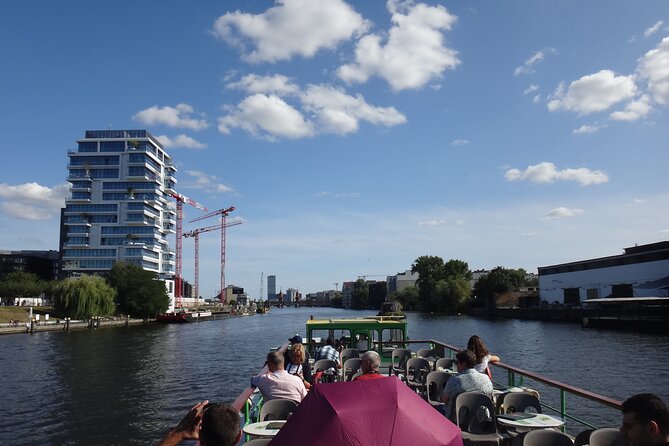
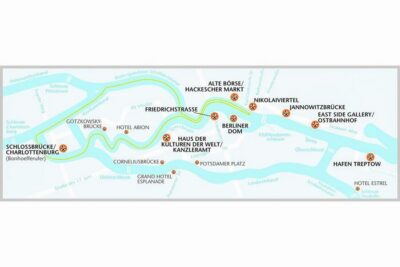
The experience starts at the Anlegestelle Alte Börse dock, tied to BWSG Berliner Wassersport und Service. Once you are onboard, you settle into a simple sightseeing rhythm, sit down, and let Berlin drift past. It is not a frantic hop-from-stop-to-stop style tour. It is more like a guided float through the city’s most photographed stretches, with time built in for a couple of key water moments.
What makes this cruise work well is the pacing. The schedule runs about 2 hours 30 minutes, and you get at least one meaningful pause for the Mühlendammschleuse lock. That matters because you are not just looking at buildings, you are watching Berlin’s water infrastructure and history in action.
Also, the boat carries live commentary in English and German, and it is clear that the guides want you to follow along. Still, a few guests noted that the deck setup can make top-deck listening harder, so you may want to keep one ear trained and adjust where you sit once underway.
The route’s big theme: East Berlin, then and now
This cruise earns its name by leaning into Berlin’s East Side geography. You cruise along the Spree corridor that slices through the city, and the guide ties the view to what happened here. You do not just see the attractions, you get the map in your head: what was borderland, what was central, and how those zones became today’s city neighborhoods.
A strong example is how the tour handles the Berlin Wall story. The East Side Gallery is more than a pretty open-air mural stretch. You hear how that section was painted after the Wall opened in spring 1990 by 118 artists from 21 countries along about 1,316 meters. You also learn the reason the gallery exists where it does, including the way the Hinterland Wall lined up against what was effectively the locked-off East Berlin side.
That kind of explanation is what turns a “sight you take a photo of” into a “sight you understand.” And that is exactly why longer cruises can feel smarter than quick ones.
Mühlendammschleuse, Berlin’s lock moment you can actually watch
One of the best parts of the route is the lock at Mühlendammschleuse. This is not just a scenic stop. It is a practical piece of Berlin’s early history and later engineering, sitting east of Mühlendamm on the Fischerinsel in the Mitte district along the Spree-Oder waterway.
The guide frames why it is important: long ago, waterways linked Berlin and Cölln, the area that became Berlin. Then, in modern times, the lock was put into operation in 1942 and it overcomes a drop of about 1.51 meters. During the cruise, you have around 20 minutes to experience the process rather than zipping past.
Why you will probably enjoy this: you get a slow, real-world view of how boats move through a city. It breaks up the standard “stand and look” pattern of sightseeing and gives your eyes something different to track. If you like photos, the lock time also gives you angles that you do not get from land.
East Side Gallery: graffiti art with real border geography
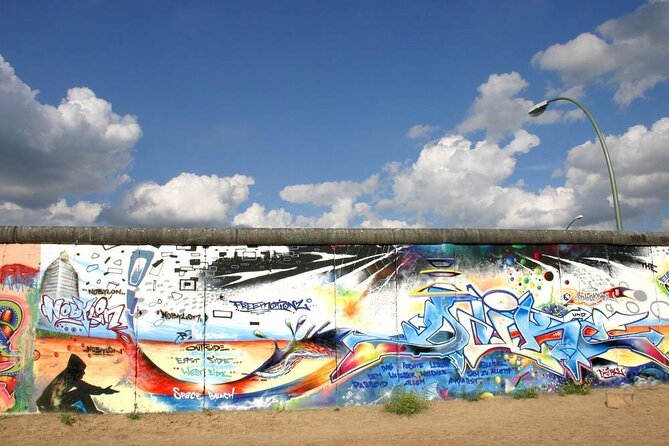
The East Side Gallery sits in Berlin-Friedrichshain on Mühlenstraße along the Spree, spanning the longest surviving section of the Berlin Wall you can still see in place. From the water, the scale can surprise you. It is long enough that it feels like an entire chapter, not a single mural wall.
The story you hear is the key. After the Wall opened, artists painted the section in spring 1990 to comment on political changes of 1989 to 1990. The guide also points out something important for your expectations: not everything from that original run is preserved today. Urban planning altered the full section, so what you see now includes replicas made in 2009.
The tour further connects this spot to the river’s history. The actual border here was tied to the Kreuzberg bank of the Spree, and the gallery relates to the Hinterland Wall that sealed off the border area to East Berlin. In other words, the water is not just scenery. It is part of the boundary story.
This is one of the highlights that guests repeatedly rate highly because it feels educational without being dry. If you only do one Wall-related stop on your Berlin trip, I would take the time to do it from the Spree.
Bridges and sculptures: Oberbaumbrücke and the Molecule Man
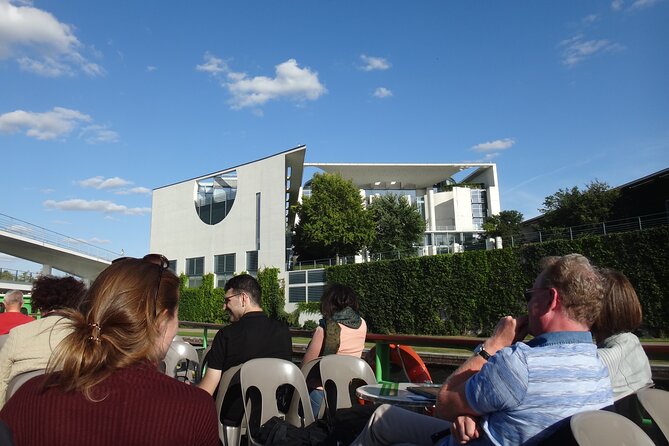
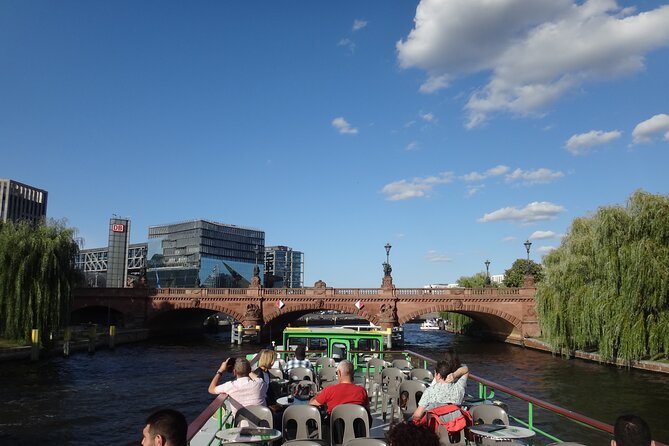
Once you are in the East Side zone, the cruise starts stacking up visual icons. You pass near Oberbaumbrücke, one of Berlin’s most distinctive bridges, and the narration uses these spans to explain how the river connected districts and shaped movement.
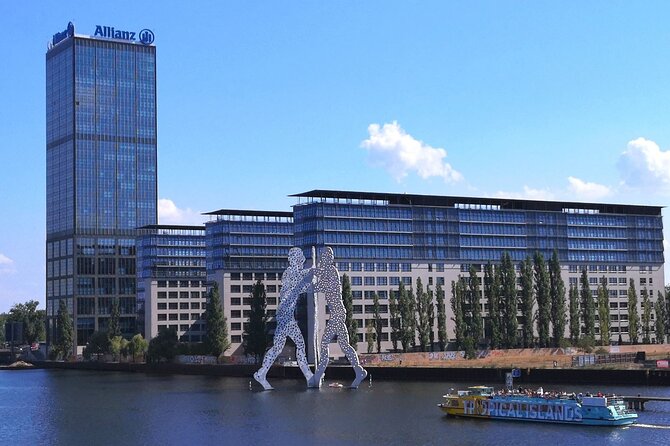
A standout nearby is the Molecule Man by American sculptor Jonathan Borofsky, installed in May 1999. This three-person sculpture sits in the Spree between Elsenbrücke and Oberbaumbrücke near the meeting point of Kreuzberg, Alt-Treptow, and Friedrichshain.
Why this matters on a cruise: from the sidewalk, sculpture can feel random or out of reach. From the water, it becomes a clear landmark. You can also catch it in relation to the bridge lines and the river corridor, which helps you understand the shape of the city in a way that maps do not fully explain.
If you like photography, this is the section where you might want to be ready with your camera, especially on clearer days. Several guests also described this boat ride as a chance to see things you would miss if you only toured on foot.
Museum Island, Berlin Cathedral, and the Humboldt Forum axis
The cruise also swings you toward Berlin’s cultural powerhouse near Museum Island. You see the Berlin Cathedral (Oberpfarr- und Domkirche zu Berlin) at the Lustgarten on Museum Island. The guide highlights its role as a major Protestant church built between 1894 and 1905 in Neo-Renaissance and Neo-Baroque style by Julius Raschdorff. It is also noted as the largest Protestant church in Germany by area and tied to dynastic burial history.
Nearby, the cruise brings you alongside the Humboldt Forum in the Berlin Palace complex. You get the quick orientation: it functions as a universal museum and houses collections like the Ethnological Museum and the Museum of Asian Art, plus programming through Berlin City Museum elements and the Humboldt Laboratory. Even if you do not step inside during the cruise, you get a strong sense of why this palace-area rebuild matters.
If you are wondering why I am grouping these together, it is because the narration tends to connect power, religion, and culture along the Spree. You can see how Berlin’s central identity concentrates in this stretch.
One note: the cruise is still a moving window view. If you want museum time, you will need a separate visit. The value here is orientation and context, not indoor deep study.
Nikolaiviertel and TV Tower, a classic Berlin contrast
As the river carries you along, you also pass through the “old Berlin” vibe around Nikolaiviertel in Mitte. This is described as the oldest settlement area in the capital, largely destroyed in World War II, and then rebuilt in 1980 to 1987 by architect Günter Stahn for Berlin’s 750th anniversary. The rebuilt area uses an almost medieval floor plan around the reconstructed Nikolaikirche, with a mix of historic-style townhouses and adapted prefabricated buildings.
This stop works because it provides contrast. Museum Island and palace-land sound very official and monumental. Nikolaiviertel feels human scale, street-level, and neighborhood-like, even if it is reconstructed.
Then you get the skyline reminder with the Berlin television tower. At 368 meters, it is Germany’s tallest building and a major sight since it was completed in 1969. On the cruise, the tower is a reference point. It helps you understand distances and direction as the boat moves.
If you are the kind of traveler who likes to understand how neighborhoods sit relative to the landmarks, this part of the ride gives you those visual anchors fast.
Reichstag, government buildings, and the view from the Spree
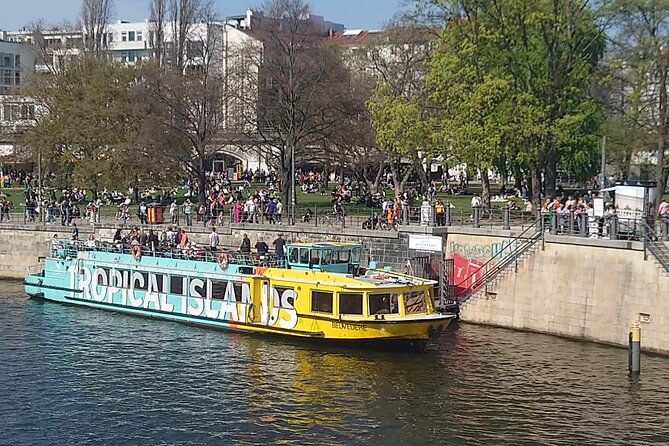
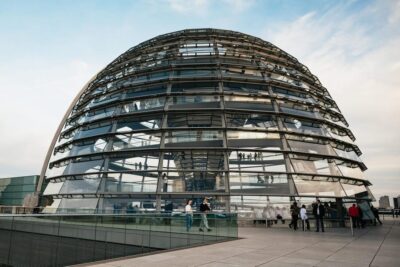
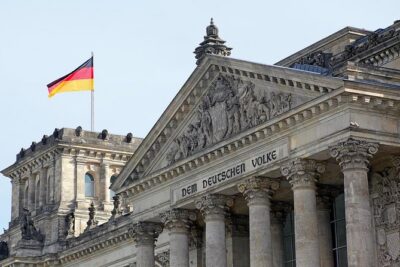
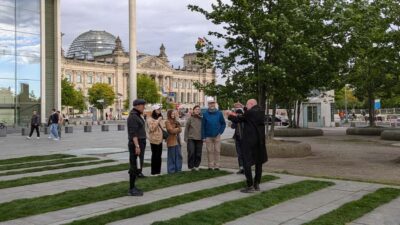
A big reason to choose this cruise is the government-district scenery along the river. You pass the Reichstag building at the Republic Square, now the seat of the German Bundestag since 1999. The guide covers the arc: built between 1884 and 1894 in Neo-Renaissance style by Paul Wallot, damaged in the Reichstag fire of 1933 and during World War II, then restored and redesigned by Norman Foster for permanent parliamentary use from 1995 to 1999. The glass dome above the plenary hall is a key modern landmark tied to this design.
From the water, the dome can feel almost like a floating crown rather than just a skyline detail.
You also glide past the surrounding official buildings and park edges, including structures tied to the Federal Chancellery complex and the larger set of modern institutions around the Spreebogenpark. You may also see the House of World Cultures (HKW), known for contemporary international art and discussions, housed in the former congress hall that even has a Berlin nickname based on its shape.
I like this section because it shows Berlin is not only history. It is a living political city, right on the river.
Palace of Tears area, and the border story you can picture
The cruise narrative also touches the darker border history near Bahnhof Friedrichstraße, including the area known as Palace of Tears. The guide explains why it got the name: East Germans often said goodbye to Western visitors in tears, because in many cases they themselves were not free to travel to the Federal Republic.
You also hear what happened operationally in that space: check-in counters staffed by Ministry for State Security employees in GDR border troops uniforms. That kind of detail is heavy, but the river setting makes it easier to connect the story to the physical city layout.
Even if you already read about the border era, seeing how the river corridor lines up with these places gives your brain a stronger spatial memory. Berlin can be overwhelming. A guided float helps.
Onboard comfort and sound: where you sit changes everything
This is the part you should take seriously, because Berlin boats vary in comfort, and your seat choice can affect your whole experience. Reviews flag a few issues: connected seats that can feel tight, and reports of warm conditions downstairs when windows did not open and ventilation or cooling was not working properly.
If you want the best views, you generally want the top deck. But be aware that a few guests found top-deck listening harder. The narration is live, and the mix of German and English means you might want to stay alert, especially if English starts after German.
Also consider motion sensitivity. One guest reported severe motion sickness when sitting in a way that faced backwards. You might be fine, but if you have motion sickness issues, try to pick the most stable-facing option you can and consider sitting toward the direction that feels least unsettling.
Finally, there is an onboard bar with drinks and food available for purchase, but outside food is not allowed per one guest note. So plan to treat this as a sightseeing ride with optional drinks, not a picnic.
Price and value: is $36.04 worth it?
At $36.04 per person for around 2.5 hours, this cruise is priced above the shorter 1-hour options, but the math is pretty reasonable. The key value is time plus route coverage. You are not just reaching a couple of photo spots and turning around. You get more of the Spree corridor, more bridge perspectives, and enough time for the lock stop.
You also get live guidance in English and German. In practice, that can save you hours of self-explaining while you are on the water. Even when sound is not perfect, the overall structure of the narration is designed to connect you to what you see, not just name it.
Still, there are trade-offs. One review said the cruise felt slower than other boats. Another said the commentary pacing felt like a lot, especially with long stretches between story beats. So if you prefer short answers and lots of time to sit silently, you might find this more talk-heavy than you expect. If you like learning as you go, this should feel like a sweet spot.
Should you book this East Side Spree cruise?
I think this cruise is a strong choice for first-timers and returnees who want a different angle on Berlin. Book it if you want Wall history with geography, plus a smooth look at Museum Island and the Reichstag government belt, all from the water. It is also a good day-one orientation move, because the landmarks line up into a mental map fast.
Skip it, or at least choose your seating carefully, if you are very sensitive to cramped seating, heat downstairs, or if you rely on clear audio no matter where you sit. If you mostly listen for English, be aware the narration includes both languages and hearing details can vary by deck.
If you pick a calm day and grab a good seat up top, this is one of those Berlin experiences that makes the city feel legible. And from the Spree, that is half the magic.
FAQ
How long is the Berlin East Side Tour cruise?
It runs about 2 hours 30 minutes.
Where does the tour start and end?
It starts at Anlegestelle Alte Börse at Burgstraße 27, 10178 Berlin, Germany, and ends back at the meeting point.
What languages is the commentary offered in?
The cruise includes live commentary in English and German, and the experience is offered in English.
What is included in the ticket price?
Your ticket includes the boat trip and live commentary. There is also an onboard bar with food and drinks available for your own expense.
Are food and drinks included?
No. Food and drinks are available onboard, but you pay for them separately.
Is there a toilet onboard?
Yes, there is a toilet on board.
Is there a limit on group size?
Yes, the tour has a maximum of 55 travelers.
Are service animals allowed?
Yes, service animals are allowed.
Is free cancellation available?
Yes. You can cancel up to 24 hours in advance for a full refund.
Is it suitable for wheelchair users?
The provided information does not guarantee wheelchair access. One review noted that it might be difficult for a wheelchair user to access the trip.
On the Water Near Berlin
Everything else we filed on Berlin
- East Berlin: City of Shadows Walking Tour
★ 5.0 · 11 reviews - Berlin: Die Stachelschweine – Frank Lüdecke – Träumt Weiter
★ 4.7 · 11 reviews - Potsdam Day Trip from Berlin with a Local: Private & Personalized
★ 4.0 · 11 reviews - An Introduction to Berlin Walking Tour
★ 5.0 · 11 reviews - DJ for a Day: Learn to Mix Like a Pro in Berlin
★ 5.0 · 11 reviews - 2-H Segway Sightseeing Tour Berlin
★ 4.5 · 11 reviews
Cruises & Boat Tours, side by side.
 ★ 4.3Berlin: 1-Hour City Tour by Boat with Guaranteed SeatingFrom $2516,993 reviews
 ★ 4.6Hamburg: 1.5-Hour Harbor and Speicherstadt Day CruiseFrom $4014,200 reviews
 ★ 4.4Berlin: Boat Tour Along the River SpreeFrom $3411,252 reviews
 ★ 4.5Hamburg: 90-Minute Evening Lights Harbor CruiseFrom $277,728 reviews
 ★ 4.7Hamburg: 2-Hour XXL Port of Hamburg Cruise TourFrom $476,979 reviews
 ★ 4.3Cologne: Panoramic City CruiseFrom $235,698 reviews
 ★ 4.3Dresden: River Sightseeing Boat CruiseFrom $315,323 reviews
 ★ 4.3Frankfurt: River Main Sightseeing Cruise with CommentaryFrom $185,127 reviews
Other lists this tour is on