
REVIEW · POTSDAM
Private taxi tour to Potsdam and Sanssouci 6-8h
Potsdam becomes a palace circuit. One day in a private taxi tour turns Berlin into Frederick the Great’s playground, with Sanssouci Park and the royal architecture laid out in a logical, easy pace. Instead of a hurried bus ride, you get a guided route built for seeing, walking a bit, and getting the big picture.
I love how Gunter Bauer works the trip like a moving story, pointing out why each building looks the way it does. I also love that the stops go beyond Sanssouci, reaching gates, neighborhoods, and palaces around Potsdam so you understand the city, not just the postcard views.
One thing to plan for: some castle interiors depend on which ticket option you book, so you may still face entry fees if you do not choose Sanssouci+.
In This Review
- Key highlights before you go
- A taxi day that turns Berlin into Potsdam’s royal world
- Meet Gunter Bauer, the guide who connects style to story
- Enter Sanssouci Park the easy way: gates, playful fake ruins, and hidden engineering
- Sanssouci Palace: rococo, small scale, and a very specific king
- The Historic Windmill and Orangery: the park as a working system
- The Chinese House and Tea House: Mode Chinoise with real gold details
- The vineyards, wine terraces, and the postcard fountain view
- Friedenskirche campanile: Italian shape, reflection, and a quiet pause
- Sanssouci Park as a full route: Roman baths, grotto cravings, and family palaces
- New Palace and the 600-room flex, plus the steam-power detail
- Dutch Quarter and Potsdam gates: the city beyond the palace fences
- Cecilienhof and the Potsdam Conference room that still matters
- Schloss Babelsberg and Glienicke: English battlements, then Berlin spy-story scenery
- Timing, walking, and what to pack for a comfortable 6 to 8 hours
- Price and value: is $179.01 per person worth it?
- Should you book this Potsdam private taxi tour?
- FAQ
- How long is the private taxi tour to Potsdam and Sanssouci?
- What time does the tour start?
- Where will I be picked up?
- Is the tour private?
- What language is the tour offered in?
- Is admission to Sanssouci Palace included?
- What is included in the price besides the taxi ride?
- Are snacks included?
- Can I bring a pet?
- Can I cancel for a full refund?
Key highlights before you go
- A private taxi route with real guidance: you are not stuck guessing what you are looking at.
- Sanssouci views built for photos and orientation: palace terraces, fountains, and park sightlines.
- Architecture talk that follows your feet: rococo details, Italian campanile shapes, and park design choices.
- Gunter Bauer’s photo and messaging habit: he takes photos during key stops and shares them after.
- More than palaces: Dutch Quarter, city-center sights, Cecilienhof, plus the Glienicke area on the way back.
- Practical pacing for a long day: time for park wandering, viewpoints, and a café break.
Other Potsdam days worth the S-Bahn
- Berlin: World Heritage Cruise to Potsdam★ 4.5 · 1,435 reviews
- Berlin: Sachsenhausen Concentration Camp and Potsdam Tour★ 4.6 · 1,334 reviews
- From Berlin: Potsdam and Sanssouci Palace Tour with Entry★ 4.5 · 1,094 reviews
- Potsdam Half-Day Walking Tour from Berlin★ 4.5 · 398 reviews
A taxi day that turns Berlin into Potsdam’s royal world
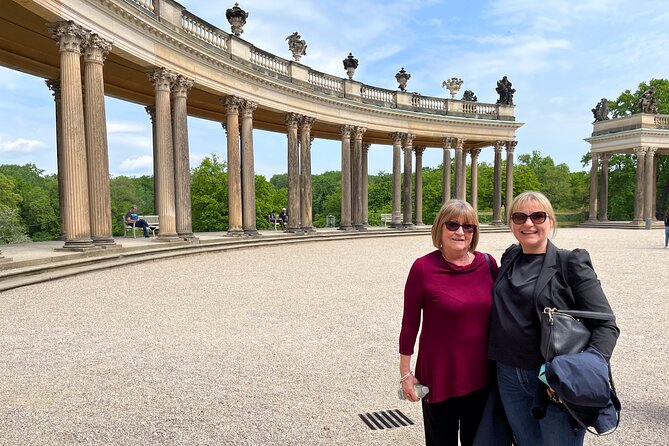
This is one of those Berlin-area ideas that makes you wonder why you ever tried to do Potsdam with public transit and random ticket lines. The whole point is simple: you ride comfortably, then you step out where it counts. With a 6 to 8 hour plan, you get breadth without trying to conquer everything at full speed.
You start with pickup, not a meeting point trek. The driver brings you from your hotel or accommodation, and the vehicle is air-conditioned. That matters because Potsdam involves a fair bit of walking over grounds and paths that can be uneven, especially in the park areas.
If you like history, this works because it is not only dates and rulers. It is the shapes and decisions behind them. Frederick the Great and later Prussian leaders built like they were creating a stage set, and the tour helps you see those choices in context as you move from place to place.
Meet Gunter Bauer, the guide who connects style to story
The experience stands or falls on the guide, and here that is a clear strength. Reviews highlight how Gunter Bauer is strong on architecture and design, not just a list of names. When you pass buildings damaged during the war, he explains what was rebuilt or renovated and what used to be there. That turns a lot of the city back into something understandable.
Another real perk: he is described as safe, focused, and good at personalizing. If you ask for a specific side stop, he has a track record of adding it when it fits your day. One review even mentions a request to include the Russian village, Alexandrowka, for lunch, and the guide worked it in.
You also get photo help. Multiple reviews mention he takes photos of your group at key spots and then sends them to you afterward. It is a small service that saves time later.
Finally, the vibe is not robotic. People describe his commentary as conversational and energetic, like you are learning while sightseeing with someone who genuinely cares.
Enter Sanssouci Park the easy way: gates, playful fake ruins, and hidden engineering
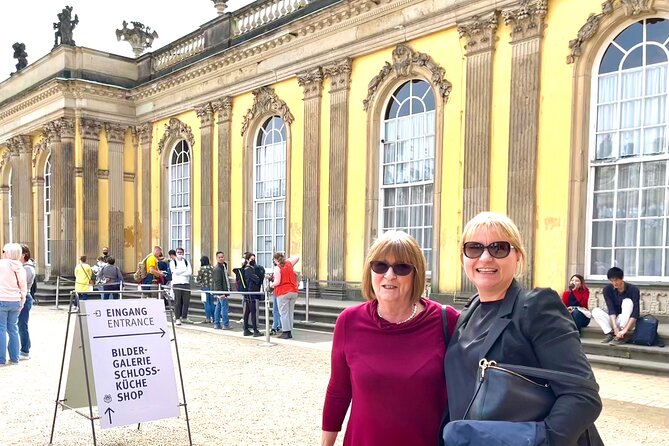
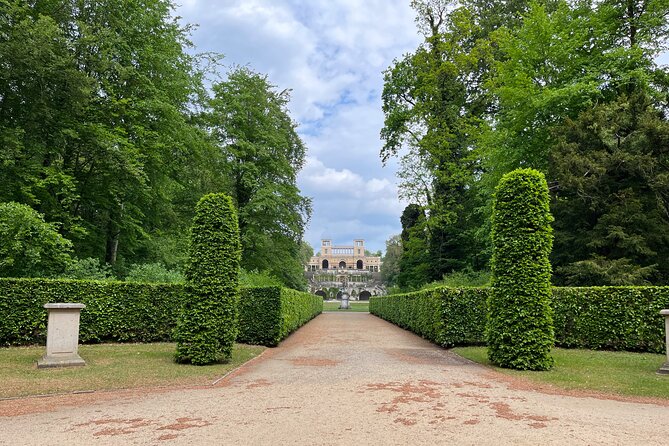
Sanssouci starts before the palace. You first get a taste of the park’s theatrical thinking, including entrance ideas that look almost like fantasy props. One standout concept: obelisks made by hand in the Brandenburg region, complete with fantasy-style hieroglyphs on the entrance portal. Up close it is obviously not real, but that is the point. The park is designed to play with illusion.
You also learn how Prussian rulers used eye-catching design to hide practical needs. One ruined-looking structure exists not only as a visual feature, but to conceal a technical system tied to water. Higher up sits the pond that feeds the fountain in front of Sanssouci Palace. It is history with a wink: look at the ruin, but you are really looking at infrastructure.
These early stops help you understand what comes next. When you finally reach Frederick the Great’s main residence, it will make more sense why the entire park feels engineered for spectacle and comfort at the same time.
Sanssouci Palace: rococo, small scale, and a very specific king
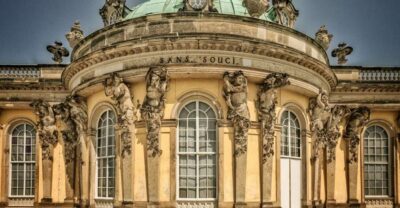
Sanssouci Palace is the big moment. It is a rococo dream castle sitting alone on a small vineyard slope, with wine still growing nearby today behind glass. Inside, the palace is surprisingly compact for such a famous name, with only eight rooms. Each room connects to the garden, so the landscape is basically part of the interior experience.
The tour gives you a clear idea of who the spaces were for. Frederick the Great did not treat this as a public monument. The palace is described as especially for the king, his dogs, and male-only visitors like the French philosopher Voltaire. You even get a sense of how cultural life worked here, including discussions in French and the king’s music habits, including playing the flute.
Here is the practical tradeoff: palace entry is not included by default. The stop is around 30 minutes, and the included time helps you absorb the atmosphere, but you still need to choose your ticket approach. If you want castle interiors covered smoothly, the Sanssouci+ option is the one to look at.
The Historic Windmill and Orangery: the park as a working system
After the palace, the tour keeps pulling back the curtain on how the park worked. The Historic Windmill is a great example. It remains because the owner won a legal dispute with the king, at least in the first instance. The mill still grinds grain, and the real reward is the viewpoint over the park. Even if you care less about mills, the perspective is worth it.
Next comes the Palace Orangery, and this is not just for plants. It has an excellent view over the park and functions as winter shelter for exotic plants. The building also contributes to the park’s layered look, and the ridge includes another Roman-style element. In other words, you are seeing a garden designed like architecture, not like a random collection of trees.
If you like to connect dots, these stops make sense of Sanssouci Park as a planned system: water, climate control, production, and views, all tied into the same design logic.
The Chinese House and Tea House: Mode Chinoise with real gold details
One of the joys of Sanssouci is how often you think you are in one theme, then a totally different theme takes over. The Chinese House café area traces back to the time when it served winegrowers in the Potsdam vineyard. In the park it becomes a visual statement in Chinese pagoda style, built with the idea of giving you sight and taste.
The tour then leads you to the Chinese tea option, described as more than a simple pavilion. It is Mode Chinoise, with precious furniture and delicate Chinese porcelain, plus lavish gold decoration. You are meant to step into the imagined world, not just stop for a quick look.
And one detail that makes it feel real: this is not a room meant for casual lounging. The tour explains how bathing was rarely done, with the spaces designed to please the senses through decoration, eye-candy, and imagination. That is a useful mindset for your own visit. Spend a little longer watching the design, not only reading a plaque.
The vineyards, wine terraces, and the postcard fountain view
Between the palace and the big open views, you get the Weinbergterrassen, often the most “postcard” section. The terraces explain why wine growing happened here at all. Potsdam sits far enough north that growing grapes outdoors without help would be difficult, so the gardeners used glass protection behind the vines, almost like seasonal beds.
You also get the behind-the-scenes water story. The fountain area ties back to that higher-lying system concealed by earlier structures. One described feature is a separate lake created higher up, artfully disguised with a ruin-like look, and not completed during Frederick the Great’s lifetime.
Admission here is free, and the stop is short, about 15 minutes. That means it is best used as a payoff moment. Take a few minutes to orient yourself to the palace sightlines, then let the guide explain the logic so you can look at the park with new eyes.
Friedenskirche campanile: Italian shape, reflection, and a quiet pause
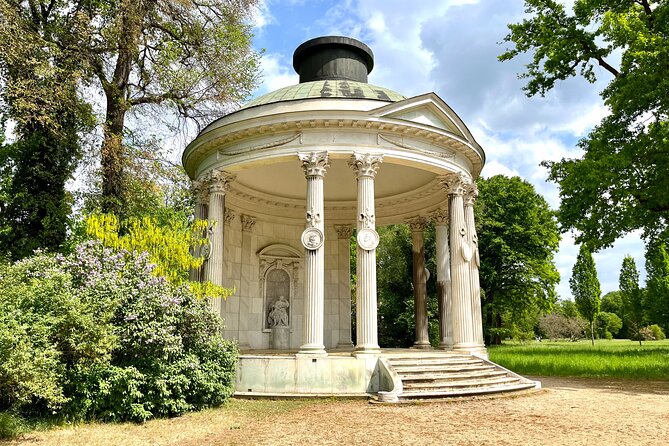
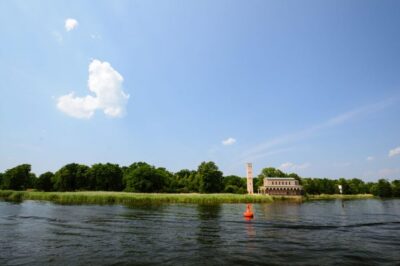
If Sanssouci is about spectacle, Friedenskirche is where it slows down. You get a look at King Friedrich Wilhelm IV’s love of Italy expressed in architecture, including a bell tower shaped in Italian style, separated from the main building like a campanile.
There is also a small artificial pond that creates an ideal reflection, so you are not only seeing the tower, you are seeing it doubled. The tour notes this is also where the ruler found his final resting place, away from Berlin’s Hohenzollern burial spot in Berlin Cathedral.
This stop is a good reset during a long day. You trade big palace rooms for a calm, scenic atmosphere that helps you keep your energy for the later park walking.
Sanssouci Park as a full route: Roman baths, grotto cravings, and family palaces
Sanssouci Park is described as the real attraction, with a 2 kilometer connection between Sanssouci Palace and the large fountain viewpoint, then on to the New Palace area. Along the way, you encounter multiple small attractions, vanished paths, planting schemes, and built features.
The tour does not treat the park as a single blob. You get a sense of how each structure played a role. There are references to things like Roman baths and a Chinese tea stop, plus smaller castles and garden highlights that invite short walks.
You also learn about the way rulers assigned space within the estate. The idea is that every king’s child had a castle, so the park becomes a collection of residences and themed rooms. One example described is an interior that includes an oriental tent element, meant for the Crown Princess, along with a garden feature set up with fir trees.
There is even a more intimate option: the Friendship Temple, described as inviting a small tête à tête compared with larger spaces.
Finally, you get the romantic age logic behind grottoes, plus the idea that such features were popular because they offered variety and shade, not because they were practical engineering miracles. That gives you a better lens for what you see in the landscape, especially when a structure feels slightly odd or pointless at first glance.
New Palace and the 600-room flex, plus the steam-power detail
The New Palace, in the tour description, is the big flex. It is said to shine with 600 rooms and functions as a holiday-style setup for royal relatives during visits. It is divided into apartments, with reception, music, bedrooms, and writing rooms. Even the bathroom situation is described, including rooms where bathrooms were built into small adjoining cabinets.
The kitchens were not inside where it mattered. The tour explains that food was largely cold on arrival because kitchens were in separate common buildings, and the smell explained why. It is a lesson in court life and architecture working together.
A separate highlight connects past to practical modernity. There is a mention of an elevator with a mechanical drive in the New Palace for the empress, and the industrial look being hidden behind an oriental-looking building. The story continues with a mosque-style building that includes a minaret acting as a chimney for a steam turbine that still produces electricity today. Even if you do not love industrial details, it helps you see why these palaces look the way they do, both for the era’s aesthetics and for the era’s technology.
If you love learning how design solves problems, this part is a standout. If you dislike long walks, do not worry. The tour pacing gives you short stop moments so you can keep moving without feeling trapped.
Dutch Quarter and Potsdam gates: the city beyond the palace fences
Once you step out of Sanssouci territory, Potsdam feels more like a real place. The tour includes the Dutch Quarter, tied to a story of skilled workers. In the 17th century, the Great Elector brought canal builders from exile back to the region during the Thirty Years’ War, and they built in traditional Dutch style. The result is a red clinker look that can feel like Holland, even though it is absolutely Potsdam.
This part is also shop-friendly. You get small businesses, craft and antique browsing, plus bars and cafés. The tour even notes a royal visit by Queen Beatrix in the past, which adds a fun extra layer to the neighborhood story.
From there, you explore the main street as a pedestrian zone with an ensemble of town houses and small shops. The tour points out that the layout is geometric and organized into quarrés, so walking feels intentional, not random.
The gate stops also matter. Potsdam has classic gates with very specific roles in the city’s layout. One of the clearest is the Nauen Gate, described as one of four surviving gates, kept in medieval Romanesque style, and unusually large compared with Potsdam’s smaller buildings. The square around it is a natural place for a break.
Cecilienhof and the Potsdam Conference room that still matters
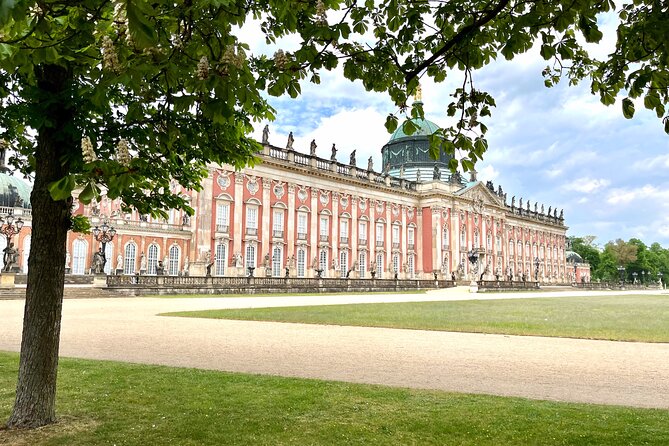
If you are only coming to see royal buildings, you will still want Cecilienhof because it connects monarchy to a defining 20th century moment. Cecilienhof is described as the youngest of the Prussian palaces. Built for the Crown Prince and his wife Cecilie von Braunschweig, the marriage happened in 1913 just before the First World War.
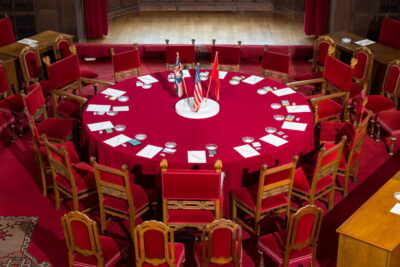
The palace is said to be modern inside, with central heating and bathrooms, but it hides that comfort behind an English country house appearance. There is even a ship-cabin style room mentioned because the princess loved sea voyages. Still, most visitors focus on the 1945 Potsdam Conference, where Stalin, Truman, and Churchill met.
The tour notes the conference room is furnished as it was then, and the outdoor areas were part of the same setting. It is a reminder that “palace sightseeing” can connect to real political history, not just decorative life.
Schloss Babelsberg and Glienicke: English battlements, then Berlin spy-story scenery
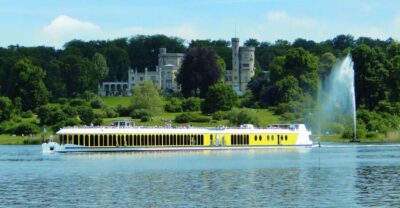
Another palace highlight is Schloss Babelsberg, built in English style for the Prussian crown prince and his wife Augusta. Later, it is linked to Kaiser Wilhelm II. The tour also describes how, in old age, he climbed a medieval-style tower for views every day, with the tower described as a copy of the Eschenheim Tower in Frankfurt.
Then, on the way between Berlin and Potsdam, you hit one of the area’s most famous border landmarks: the Glienicke Bridge. It was closed for 40 years as a border between West Berlin and the GDR. The tour includes the spy exchange story, and it also notes the bridge has been used as a real film backdrop because Hollywood likes the drama.
Finally, you pass the Italian-style Glienicke Palace area. The park sits right by the federal highway 1, and the tour description focuses on a patio-like layout near the bridge, with lake views across toward Potsdam. On the other side sits the New Garden with the Marble Palace. The area is described as Italian in style, with a separate casino for entertainment.
This stretch works well if you like scene-setting. You are not only walking through history, you are watching it in geography: lakes, bridges, and borders that shaped how the modern city grew.
Timing, walking, and what to pack for a comfortable 6 to 8 hours
This is a long but manageable half-day to full-day outing. The actual time you spend inside places varies, and some palaces or buildings depend on which ticket option you choose. You should also plan for time moving between sights and stepping out for viewpoints.
Wear good walking shoes. The park includes mostly unpaved paths around palaces and gardens, and sandals are a poor choice here. I also suggest bringing a light layer, because palace and garden temperatures can shift during the day.
Snacks are not included, so you will likely want to grab something yourself during breaks. There is also a café stop tied to the park area concept, so you might get lucky with a convenient place to pause, but do not count on a full included meal.
If you travel with a stroller or baby gear, plan space. The stroller rules specify the cradle must be removable and the frame foldable, leaving room for extra suitcases in the taxi.
If you travel with pets, the tour notes service animals are allowed. For companion animals, the rules get specific, including that only up to medium-sized dogs may lie on the rear floor, while larger dogs can only be placed in the back, and taxis have limits on where animals can sit unless in suitable transport boxes.
Price and value: is $179.01 per person worth it?
At $179.01 per person, you are paying for more than driving. You are paying for a private vehicle with parking included, pickup from your accommodation, and a guide who spends the day connecting architecture, history, and garden design.
You also get value through time control. You are not stuck with long lines or waiting for everyone to catch up. A private taxi setup means the day can flex slightly around your pace, and Gunter Bauer’s style seems to be a big reason people score it so highly.
The one cost variable is admissions. The itinerary includes both ticket-free stops and ones that require a ticket, with the key interior moments such as Sanssouci Palace not included unless you pick the Sanssouci+ option. So here is the smart approach: decide what you want more, building interiors or park atmosphere. If you want the interiors, the package option is likely the easiest way to avoid surprise costs.
Overall, the price makes sense if you want the full “palace plus city plus story” day with a guide who actually talks about what you are seeing.
Should you book this Potsdam private taxi tour?
Book it if you want a single-day Potsdam plan that covers the must-sees without feeling rushed. It is especially worth it if you care about architecture and design, because Gunter Bauer’s focus helps you understand what you are looking at, from rococo interiors to Italian campanile shapes and the logic behind park features.
Skip it or adjust expectations if you are mainly after a low-cost, self-guided stroll. This is not positioned as a budget DIY day, and admission choices can add to the final bill. Also, it is a full day with park walking, so comfortable shoes are non-negotiable.
If your priority is a guided route that blends Sanssouci Palace and park beauty with Potsdam’s broader story, this one is a strong pick.
FAQ
How long is the private taxi tour to Potsdam and Sanssouci?
It runs about 6 to 8 hours.
What time does the tour start?
The start time is 10:30 am.
Where will I be picked up?
Pickup is offered from your desired location in the city, including your hotel or apartment.
Is the tour private?
Yes, it is private. Only your group participates.
What language is the tour offered in?
The tour is offered in English.
Is admission to Sanssouci Palace included?
Admission is not included by default for Sanssouci Palace, unless you book the Sanssouci+ option (all castle tours). Sanssouci Park is listed as included, and some sections are free.
What is included in the price besides the taxi ride?
Included features cover pickup, an air-conditioned vehicle, parking fees, and the taxi ride and city tour (with stated VAT).
Are snacks included?
No, snacks are not included.
Can I bring a pet?
Service animals are allowed. Companion animal rules are described for dogs, including size limits and seating restrictions, plus transport box requirements in some cases.
Can I cancel for a full refund?
Yes. Free cancellation is available if you cancel up to 24 hours in advance for a full refund.
A Day in Potsdam, Compared
Everything else we filed on Berlin
- East Berlin: City of Shadows Walking Tour
★ 5.0 · 11 reviews - Berlin: Die Stachelschweine – Frank Lüdecke – Träumt Weiter
★ 4.7 · 11 reviews - Potsdam Day Trip from Berlin with a Local: Private & Personalized
★ 4.0 · 11 reviews - An Introduction to Berlin Walking Tour
★ 5.0 · 11 reviews - DJ for a Day: Learn to Mix Like a Pro in Berlin
★ 5.0 · 11 reviews - 2-H Segway Sightseeing Tour Berlin
★ 4.5 · 11 reviews
Potsdam and Sanssouci Day Trips, side by side.
 ★ 4.7Potsdam: City and Castles TourFrom $293,721 reviews
 ★ 4.5Potsdam: Palace Tour by BoatFrom $272,369 reviews
 ★ 4.5Potsdam: Sanssouci Palace and Prussian Palaces Entry TicketFrom $252,101 reviews
 ★ 4.5Berlin: World Heritage Cruise to PotsdamFrom $251,435 reviews
 ★ 4.6Berlin: Sachsenhausen Concentration Camp and Potsdam TourFrom $651,334 reviews
 ★ 4.6Potsdam by Boat: Island CruiseFrom $421,308 reviews
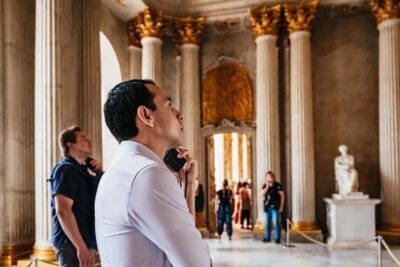 ★ 4.5From Berlin: Potsdam and Sanssouci Palace Tour with EntryFrom $731,094 reviews
 ★ 4.2Potsdam: City Sightseeing Hop-On Hop-Off Bus TourFrom $23864 reviews
Other lists this tour is on