
REVIEW · SEGWAY AND RICKSHAW CITY RIDES
Rickshaw Sightseeing City Tours Berlin – Rikscha Tours
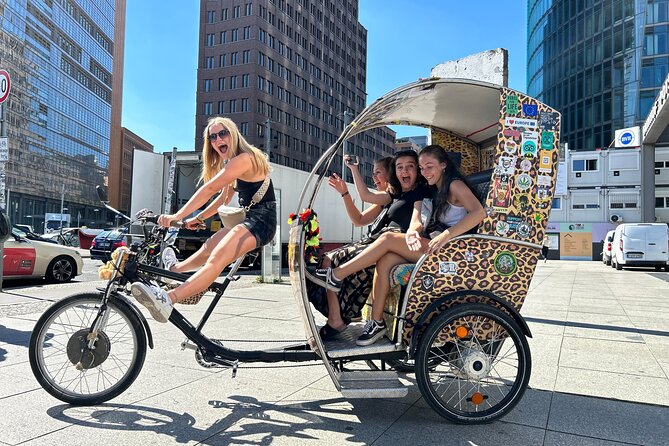
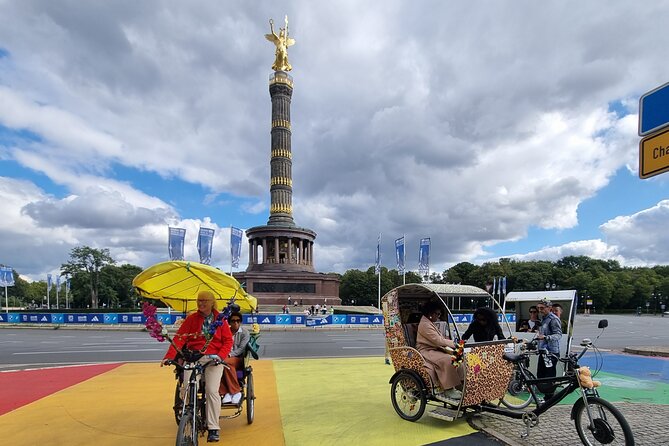
Berlin by rickshaw feels personal fast. This private ride links major sights into a smooth route, with guided storytelling in English and practical onboard Wi-Fi as you roll past Brandenburg Gate, the Reichstag area, and the Wall-era stops.
I especially like the close-up views. You get your face near the architecture and memorials, then you pause long enough to actually look and take photos, not just catch a blur through a bus window. Add the included warm blanket, and you can keep going on colder evenings without turning the tour into a shiver test.
One real consideration: this is a weather-dependent activity, and the experience is built around short stops at big landmarks. If you’re working on a tight schedule, plan a calm backup plan and confirm details the day of.
In This Review
- Key things to love about this rickshaw sightseeing tour
- A rikscha is the right size for Berlin’s major squares
- What you get on board: Wi-Fi, blankets, and a guide who helps you shoot photos
- Brandenburg Gate to the Reichstag area: classicism meets 20th-century shocks
- The German Chancellery and Tiergarten: glass, transparency, and the weight of monuments
- Tiergarten park feel: pleasure park roots and a park you can wander
- Potsdamer Platz, Topography of Terror, and Gropius Bau: modern city energy with hard history close by
- Wall era essentials: Berlin Wall memorial, Checkpoint Charlie, and the shopping spine of Friedrichstrasse
- Gendarmenmarkt to Deutscher Dom and Konzerthaus: elegant squares with a serious education track
- Bebelplatz and Neue Wache: book burning and memorials for war and tyranny
- Museum Island, Lustgarten, and the Berlin Cathedral area: UNESCO views you can stitch together fast
- Nikolaiviertel to Alexanderplatz to the East Side Gallery: old town charm to wall art
- How long is enough? Choosing the 1 to 4 hour timing
- Who should book this rickshaw tour, and who might want to skip it
- Should you book Rikscha Sightseeing City Tours Berlin?
- FAQ
- What is the price for this rickshaw sightseeing tour?
- How long does the tour take?
- Is the tour offered in English?
- Do they offer pickup, and how far is it from Brandenburg Gate?
- What’s included in the tour?
- What is not included?
- Are tickets included for the stops?
- Is the tour private, and can I bring a service animal?
Key things to love about this rickshaw sightseeing tour
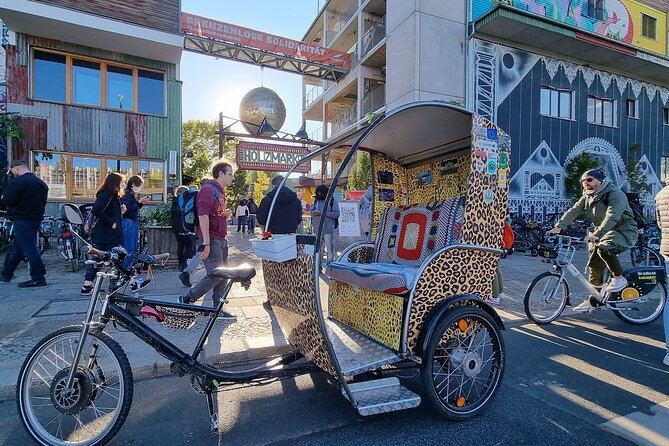
- Up-close landmark photos you simply can’t get from traffic-slowing tour buses
- Onboard Wi-Fi so you can check transit, restaurants, or maps while moving
- Warm blanket and music on request for comfort and a more relaxed vibe
- Private group up to 2 people, which makes the pacing feel flexible
- Leo’s hands-on guiding and photography help, including taking pictures with your camera
More wheels for covering ground fast
- Berlin 2-Hour Segway Tour★ 4.6 · 238 reviews
- Berlin: Private Guided E-Rickshaw Tour★ 4.9 · 157 reviews
- Berlin: 2-Hour Premium Segway Tour★ 4.5 · 157 reviews
- 2-Hour Segway Discovery Tour Berlin★ 5.0 · 154 reviews
A rikscha is the right size for Berlin’s major squares
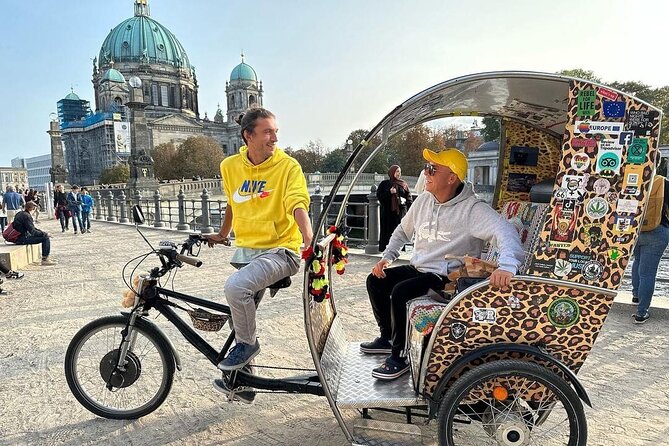
Berlin’s classics can look best when you slow down. From Brandenburg Gate to Gendarmenmarkt, a rickshaw keeps you close to the buildings and lets your guide set the pace by what you want to notice.
The route is built for seeing a lot without walking for hours. You get frequent short stops, which matters in Berlin, where getting from one big landmark to the next often involves crossing long distances.
If you like history told as a human story, this style fits. Leo’s approach tends to be interactive, funny in a light way, and willing to adjust if you have a must-see theme like WWII sites or Wall era locations.
What you get on board: Wi-Fi, blankets, and a guide who helps you shoot photos
This isn’t just transportation. The tour includes warm blanket, music on request, and WiFi on board, plus a photographer element as part of the experience.
Here’s why that matters for your comfort. Berlin evenings can turn chilly quickly, and a blanket means you spend less energy bracing for cold and more time watching details. Wi-Fi also helps you stay oriented, especially when you’re bouncing between neighborhoods quickly.
And if you care about photos, you’re in good shape. In feedback, Leo is described as acting as a personal photographer, taking pictures for you and maneuvering the rickshaw into positions that make photos easier than you’d expect.
Brandenburg Gate to the Reichstag area: classicism meets 20th-century shocks

You start at Brandenburg Gate, built from 1788 to 1791 based on designs by Carl Gotthard Langhans the Elder. It was intended as a grand architectural finish for the boulevard Unter den Linden, leaning on references to the propylaea of the Athens Acropolis.
This opening matters because it gives you a “before and after” lens for the rest of Berlin. The gate is German classicism at its most formal, and your guide uses that contrast to tee up the modern political drama nearby.
Then you move to the Reichstag/Bundestag area. It’s associated with major turning points: Philipp Scheidemann’s call for the republic on November 9, 1918, the Reichstag fire on February 27, 1933, and the Red Army symbolism on April 30, 1945.
Plan to view this area from the outside. Admission isn’t included for the Reichstag stop, so think of it as a history-rich look from the curb or nearby viewpoints, not a guaranteed interior visit.
The German Chancellery and Tiergarten: glass, transparency, and the weight of monuments
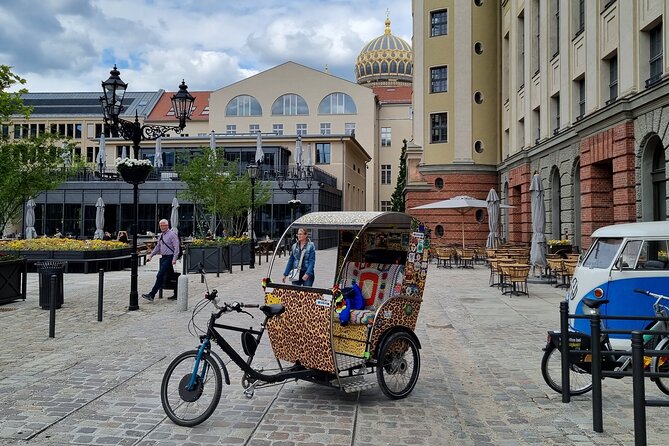
Next comes the German Chancellery, a striking 36-meter-high building rising between administrative wings. The north and south walls use arches, while the structure includes large glass surfaces between concrete pillars, giving it an unusually transparent look.
If you like architecture that feels like government trying to look open, this stop delivers. The design choices, with offices organized around glazed atriums, are easier to appreciate when your ride is slow enough to notice shapes rather than just passing at speed.
From there, you head into the Soviet War Memorial Tiergarten area. It’s flanked by two T-34 tanks, with a bronze statue of a Red Army soldier carrying a rifle. Behind it, you’ll see names of fallen Soviet soldiers, and deeper in the memorial area are graves of around 2,500 soldiers.
This is one of those places where a short stop still feels meaningful. The rickshaw helps you get the right angles for photos and a quick read of the memorial elements, without the pressure of lining up for anything.
The wider Berlin sightseeing pile
Tiergarten park feel: pleasure park roots and a park you can wander
Between these stops, the ride threads through the Tiergarten world of greenery and landmarks. The area links back to the end of the 17th century, when Elector Friedrich III created a pleasure park from former hunting ground, later reshaped by landscape designer Peter Joseph Lenné between 1833 and 1838 into an English public park style.
And the park experience isn’t only trees. You’ll also hear about monuments and memorials, plus big-name anchors like the Victory Column and cultural and civic buildings that sit along the park edges. The English Garden around a pond is one of the calmer areas and is described as a standout corner of the park.
In practice, this is where the rickshaw shines. You get the “park vibe” plus landmark context, even if you don’t have time to do a full walk through the whole 200-hectare expanse.
Potsdamer Platz, Topography of Terror, and Gropius Bau: modern city energy with hard history close by
Then the tour shifts gears to Potsdamer Platz, planned as an entire district by architects. The area grew around cafes, cinemas, and shops inside futuristic high-rise buildings, and Berliners accepted the new life here strongly.
This stop works well for resetting your mood. After memorial-heavy scenes, Potsdamer Platz feels like the modern Berlin you can still enjoy with energy and movement.
After that comes Topography of Terror, a key site tied to the planning and control of Nazi crimes from 1933 to 1945. It served as the central location for institutions including the Secret State Police Office and SS and police leadership offices. It’s a heavy topic, but it’s also one of the clearest places to connect the names and systems to the geography of the time.
Admission is free at this stop, which is helpful if you want to spend your money on meals and transit instead of tickets.
Next you pass or stop near Gropius Bau, linked to cultural history, contemporary art, and photography. The tour keeps it short, so treat this as a view-and-context moment unless you already planned a separate museum visit.
Wall era essentials: Berlin Wall memorial, Checkpoint Charlie, and the shopping spine of Friedrichstrasse
You then reach the Memorial of the Berlin Wall, a brief stop where the history of division becomes visible in the landscape. Even in a short time, the rickshaw format helps you see more than one angle of the memorial, since you’re not stuck behind a line or bus crowd.
After that: Checkpoint Charlie. This was the most famous border crossing among Berlin’s controlled crossing points. The Americans controlled it next to the Glienicke Bridge, with other checkpoints including Helmstedt-Marienborn (Checkpoint Alpha) and Dreilinden-Drewitz (Checkpoint Bravo). The crossing was used by foreigners and certain West and East officials.
Again, timing matters. This isn’t built for a long museum-style experience, but it is ideal for orientation, because your guide can connect what you see to what the crossing meant during the division of Berlin.
From here, you roll along Friedrichstrasse, a north-south axis where a shopping mile developed after the fall of the Wall between Checkpoint Charlie and Friedrichstrasse station.
If you’re the type who likes to understand Berlin as neighborhoods, not just landmarks, this stretch helps you feel the city’s post-Wall transformation.
Gendarmenmarkt to Deutscher Dom and Konzerthaus: elegant squares with a serious education track
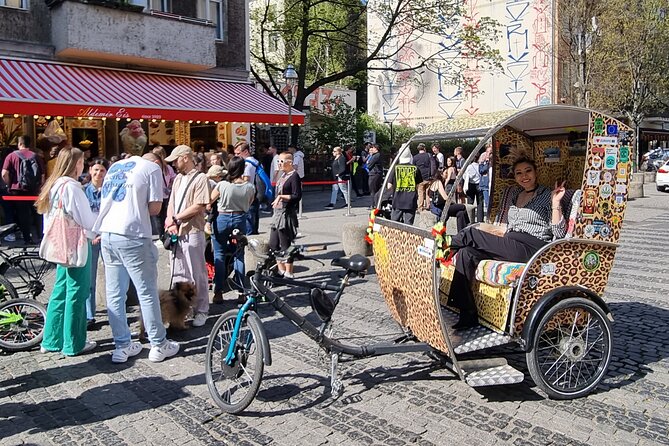
Next up is Gendarmenmarkt, created at the end of the 17th century. It started with French immigrants, mainly French Protestants, and went through several names over time. In 1799 it became Gendarmenmarkt due to the guard and stables of the Gens d’armes regiment.
Then you’ll see the Deutscher Dom, a cathedral space hosting an exhibition called Ways, wrong trails, detours. It focuses on the historical development of liberal parliamentary democracy in Germany across five floors.
You also reach the Konzerthaus am Gendarmenmarkt, a classicist architectural masterpiece by Karl Friedrich Schinkel. The building traces back to a small comedy house opened in 1776, later renamed Royal National Theater in 1787, showing how quickly the arts culture grew importance.
Here’s a practical tip: even when admission isn’t included for these stops, the exterior details are worth it. Schinkel’s style looks best when you have time to look up, and a rickshaw stops you from rushing past.
Bebelplatz and Neue Wache: book burning and memorials for war and tyranny
At Bebelplatz, the story moves from architecture to memory. Nazis burned books here on May 10, 1933, with over 20,000 volumes reportedly destroyed as part of a campaign against what they labeled non-German spirit. The names associated with the event include Erich Kästner, the Mann family, Magnus Hirschfeld, Lion Feuchtwanger, Karl Marx, Else Lasker-Schüler, and Heinrich Heine.
It’s the kind of place that can feel heavy in a quiet way. But because your ride keeps the stop organized and fast, you can absorb the meaning without getting stuck in an all-day museum mood.
Right near here is Neue Wache, built between 1816 and 1818 based on Karl Friedrich Schinkel designs. Since 1993, it has served as a central memorial of the Federal Republic of Germany for victims of war and tyranny.
This is another stop that benefits from being short and guided. Your guide gives you the framing so you know what you’re looking for, rather than trying to piece together meaning from signage alone.
Museum Island, Lustgarten, and the Berlin Cathedral area: UNESCO views you can stitch together fast
Then you reach Museum Island, one of Europe’s outstanding museum complexes and a UNESCO World Heritage Site. The island is big enough for a full day, but the rickshaw gives you the fast “threading” view, where you can understand how all the major pieces sit together.
Around the same general area, you’ll also take in the Berlin Cathedral as a must-see. Near it is the Lustgarten, once part of the Berlin City Palace, now a spacious square people return to for a break.
And you’ll also see the New Synagogue on Oranienburger Strasse, described as the once-largest and most important synagogue in Germany. It’s another moment where the route turns into a living map of communities and cultural change.
One advantage here is your pace. Museum Island can feel overwhelming if you land there unprepared. This route helps you build a “mental layout” so you can decide later what deserves a separate deep visit.
Nikolaiviertel to Alexanderplatz to the East Side Gallery: old town charm to wall art
Next comes Nikolaiviertel, Berlin’s first and oldest residential area, with old-town flair, historic houses, restaurants, and coffee shops. Even with a quick stop, the vibe feels different than the monumental zones, more human-scale and lived-in.
Then you roll to Alexanderplatz, a famous and lively place that has been energetic through the 1920s, GDR times, and today. It’s a strong contrast point after memorial and museum areas.
Finally, you end up at the East Side Gallery, a remnant of the Berlin Wall transformed into an open-air gallery. It’s described as the longest open-air gallery in the world, and the art becomes the tour’s emotional release valve.
If you’re trying to see Berlin’s story arc in one afternoon, this landing spot works well. You finish with something you can actually enjoy with your eyes and not just your head.
How long is enough? Choosing the 1 to 4 hour timing
The tour runs about 1 to 4 hours, and the stops are mostly measured in minutes at each major landmark. That’s a feature, not a bug, because it keeps you moving through the biggest “greatest hits” without turning the day into marathon walking.
If you pick the shorter end, focus your energy on the Wall era and WWII-era storytelling, since those stops are often what people most want concentrated. If you choose longer timing, you’ll have more room for photos, extra questions, and a smoother rhythm through the architecture and memorial clusters.
Either way, tell Leo what you care about most. In feedback, he’s described as interactive and willing to include specific places you want to see.
Who should book this rickshaw tour, and who might want to skip it
This tour is a great fit if you want a private Berlin experience and you like your history paired with movement. It’s also smart for couples or friends up to two people, since the price is per group and the format keeps it personal.
It’s also a nice pick for chilly evenings because you get the warm blanket and you’re not stuck doing long walks while waiting for buses or taxis.
I’d think twice if you need maximum certainty down to the minute for a strict itinerary. The experience depends on good weather, and it runs on a tight routing schedule that assumes the operator arrives and gets you started on time. If your day is packed, keep the start flexible or build a backup plan.
Should you book Rikscha Sightseeing City Tours Berlin?
Yes, if you want Berlin’s landmarks in a compact, human-scale way and you like the idea of a guide who can bring the story to life while helping you with photos. The value is strongest for a couple or small group, and the included Wi-Fi and warmth reduce the usual friction of sightseeing in a big city.
Before you go, do one simple thing: tell Leo your priorities, then ask for a plan that matches how long you booked. If your focus is WWII and Wall history, point that out early so the route and narration match your goals.
If you want the safest experience for a high-stakes day, aim for good weather and confirm the day of. When it runs smoothly, this is one of the more fun ways to get close to Berlin’s most important places without spending the whole day walking.
FAQ
What is the price for this rickshaw sightseeing tour?
It costs $105.72 per group for up to 2 people.
How long does the tour take?
The duration is about 1 to 4 hours.
Is the tour offered in English?
Yes. It is offered in English.
Do they offer pickup, and how far is it from Brandenburg Gate?
Pickup is included within a 2 km radius from Brandenburg Gate. More than 2 km can cost an additional €10 per km.
What’s included in the tour?
Included items are a warm blanket, music on request, a photographer, and Wi-Fi on board.
What is not included?
Alcoholic beverages and coffee and/or tea are not included.
Are tickets included for the stops?
Admission tickets are not included for some stops, while others are marked as free. You should assume you may need to handle tickets separately if you want entry at places where admission is not included.
Is the tour private, and can I bring a service animal?
It is private, with only your group participating. Service animals are allowed.
Seeing Berlin in One Go
On Two Wheels and Three
Everything else we filed on Berlin
- East Berlin: City of Shadows Walking Tour
★ 5.0 · 11 reviews - Berlin: Die Stachelschweine – Frank Lüdecke – Träumt Weiter
★ 4.7 · 11 reviews - Potsdam Day Trip from Berlin with a Local: Private & Personalized
★ 4.0 · 11 reviews - An Introduction to Berlin Walking Tour
★ 5.0 · 11 reviews - DJ for a Day: Learn to Mix Like a Pro in Berlin
★ 5.0 · 11 reviews - 2-H Segway Sightseeing Tour Berlin
★ 4.5 · 11 reviews
Segway and Rickshaw City Rides, side by side.
 ★ 4.9Dresden: Segway Tour Along the Elbe and Old TownFrom $74392 reviews
 ★ 4.8Heidelberg: Philosophers’ Walk Guided Segway TourFrom $67322 reviews
 ★ 4.6Munich: City Highlights Guided Segway TourFrom $99266 reviews
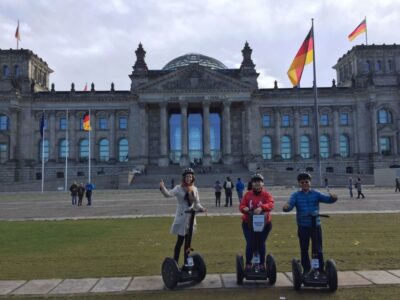 ★ 4.6Berlin 2-Hour Segway TourFrom $69238 reviews
 ★ 4.8Heidelberg & Neckar Valley: Segway Tour – 360 DegreesFrom $88227 reviews
 ★ 4.9Munich 3-Hour Segway Tour: Nazi Munich & Royal ArchitectureFrom $91194 reviews
 ★ 4.8Heidelberg Highlights Segway Tour with CastleFrom $74191 reviews
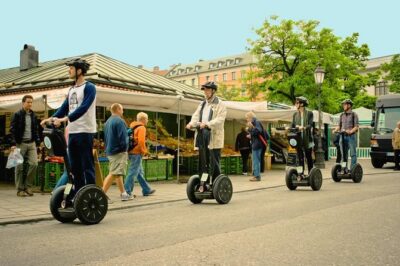 ★ 5.0Munich Segway TourFrom $90181 reviews
Other lists this tour is on