
REVIEW · SEGWAY AND RICKSHAW CITY RIDES
Rickshaw Tour-Cruise Ship guests arrive 9.30 upto 11.30 am Berlin
Rickshaws turn Berlin into your own movie. This private 3-hour ride is designed for cruise-ship timing, with Berlin pickups geared for guests arriving between 9:30 and 11:30 am, and a route that can be tailored to what you care about most. You start, then you return to the same meeting point, with just your group in the rickshaw.
My favorite parts are the close-up photo access at major landmarks, plus guides who bring the stories to life in plain, human language, including people like Levent and Gregor. The one watch-out is that most stops are quick looks from the street, and Berliner Fernsehturm admission is not included, so you will want a plan if you expect to go inside.
In This Review
- Key things that make this Berlin rickshaw cruise excursion work
- Berlin rickshaw vs. big bus: why this format saves your time
- Price and group size: what $264.35 really means for your day
- Getting started at Alexanderplatz and the Berlin TV Tower
- Museum Island and Unter den Linden: the UNESCO boulevard run
- Bebelplatz and the May 10, 1933 Nazi book burning memorial
- Gendarmenmarkt: German Dom, French Dom, and that postcard symmetry
- Checkpoint Charlie: a quick stop with long echoes
- Topography of Terror and the Wall strip along the way
- Potsdamer Platz: construction-era Berlin, now built into the skyline
- Holocaust Memorial: walking through the emotions without extra tickets
- Brandenburg Gate and the turn toward today’s Berlin
- Reichstag area and the Government District: parliament in motion
- Fuhrerbunker area, Unter den Linden, and the opera stop
- Berliner Dom: ending with one last big architectural finish
- What the included drinks and blanket are really for
- Mobility-friendly details that make a real difference
- Should you book this Berlin rickshaw tour?
Key things that make this Berlin rickshaw cruise excursion work
- Hotel pickup and rickshaws that arrive together at your chosen meeting point
- Built-in flexibility so the guide can adjust the route and pacing to your interests
- Major landmark photo stops across Mitte, including Brandenburg Gate and the Holocaust Memorial
- Comfort included with a cozy blanket, bottled water, Berlin Sect, Berlin Beer, and soft drinks
- Mobility-friendly format that can accommodate a walker and allows stops for pictures with minimal steps
More wheels for covering ground fast
- Berlin 2-Hour Segway Tour★ 4.6 · 238 reviews
- Berlin: Private Guided E-Rickshaw Tour★ 4.9 · 157 reviews
- Berlin: 2-Hour Premium Segway Tour★ 4.5 · 157 reviews
- 2-Hour Segway Discovery Tour Berlin★ 5.0 · 154 reviews
Berlin rickshaw vs. big bus: why this format saves your time
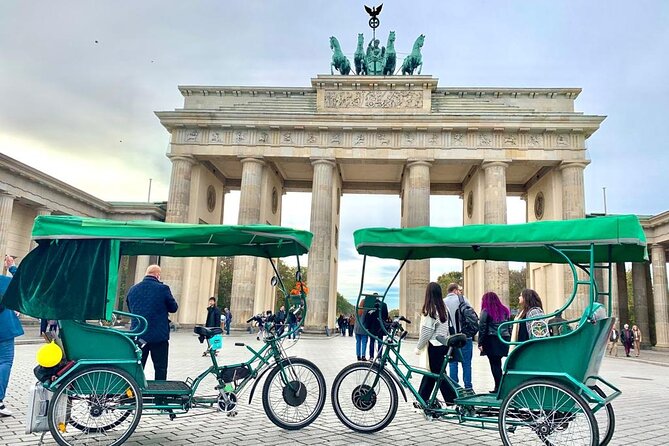
If you’re in Berlin for a cruise connection, time can feel like it’s made of paper. This experience uses a small, practical vehicle, so you can cover a lot of ground in a short window without the stress of finding parking or wrestling for seats on a large bus.
The private setup also matters. You are not stuck following a fixed script. The guide can adjust the route like an a la carte plan, updating how the day begins based on what your group wants to focus on. You also get a return to the meeting point, which is a big deal when you have onward plans.
And since it is offered in English with a mobile ticket, it is easy to manage even if you are on a tight schedule.
Price and group size: what $264.35 really means for your day
The published price is $264.35 per group (up to 2), and the tour lasts about 3 hours. That can feel like a lot until you do the math against the day you are buying: private guiding, direct transportation, and multiple major stops packed into one run through Berlin Mitte.
Where value really shows up is when you compare the experience to a classic “see the highlights” bus ride. Here, you get more control over photo stops and pacing, plus you are traveling in a way that lets you get very close to monuments and memorials without walking big distances.
It is also worth noting the vehicle plan for bigger groups. For 3 to 4 people, the operator provides 2 rickshaws and drivers. For 5 to 6 people, it is 3 rickshaws and drivers. If your group is larger than that, you would need to contact them for additional rickshaws.
Getting started at Alexanderplatz and the Berlin TV Tower
Your route starts at Berlin’s iconic TV Tower area, right in Alexanderplatz. It’s the kind of starting point that makes orientation instant. Even if this is your first time in Berlin, you can quickly place yourself in the middle of things.
From there, the ride passes key landmarks on the way toward Museum Island, including the Red Town Hall, Marien Church, and Neptune Brunn. The goal is not to rush you past everything. It’s to set up the story of Berlin Mitte before you start hitting the major sites.
You’ll have a short stop at Berliner Fernsehturm for about 5 minutes. Admission is not included, so think of this as a photo and viewpoint moment rather than a full visit inside. If you want to go up into the tower, you would need separate planning for tickets and extra time.
Practical tip: plan for photos here, then again later at other viewpoints. This stop works best when you treat it as your first “Berlin postcard” moment.
Museum Island and Unter den Linden: the UNESCO boulevard run
Next up is Museum Island, a UNESCO World Heritage Site made for people who like big cultural landmarks but hate spending hours in lines. The ride gives you a structured look at the area without forcing a museum marathon.
You also get the chance to see the historic boulevard of Unter den Linden from the right angle. That boulevard is one of those Berlin “main threads” that ties the city’s civic buildings together, and seeing it from the route helps everything make more sense.
At Museum Island, you’ll have around 10 minutes. Admission is listed as free for this stop, and you can capture major exteriors such as Berlin Cathedral and the unfinished reconstruction of the City Palace. You’ll also pass visual highlights like the Old Museum, Old National Gallery, Pergamon Museum, and the Bode Museum.
The value here is clarity. You leave with a mental map of what you actually want to return to if you have time for a deeper museum visit later.
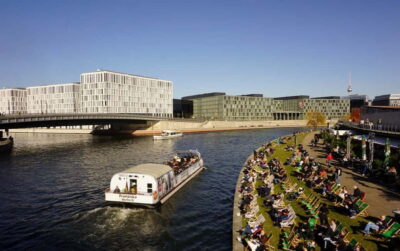
More decks and gangways around Berlin



Bebelplatz and the May 10, 1933 Nazi book burning memorial
Then the tour turns heavier. You reach the Memorial to May 10, 1933 Nazi Book Burning at Bebelplatz, with a focus on remembrance and context.
This stop is about 10 minutes and admission is free. You are also guided through the broader forum area, including the State Opera, Humboldt University buildings, the State Library, St. Hedwig’s Cathedral, and the Law Faculty. The idea is to show you how these institutions shaped daily life, then how the Nazi book burning targeted ideas at the cultural and educational core.
Bebelplatz is often described as a dramatic reminder in a normal-looking square. The important takeaway is how quickly the city can move from classic architecture to a memorial that makes you think about what happens when censorship takes over.
Gendarmenmarkt: German Dom, French Dom, and that postcard symmetry
After the memorial areas, you get a breather at Gendarmenmarkt. Here, Berlin shifts back into something more visually formal and elegant.
You’ll see the square with the former Royal Concert Hall, plus the German Dom on one side and the French Dom on the other. This part of the ride is short, around 10 minutes, but it is built for pictures and for noticing how the buildings mirror each other across the space.
If you’ve ever found it hard to remember what Berlin’s historic squares look like, this is a good one to anchor your memory.
Checkpoint Charlie: a quick stop with long echoes
Next is Checkpoint Charlie, one of the most famous border crossings tied to the Berlin Wall era. Your stop here is about 5 minutes, with admission listed as free.
This is not a deep museum stop. It’s a landmark stop, the kind where your guide can connect what you see to why the crossing mattered and what it meant for everyday fear and international tension.
Given the speed of the stop, I recommend treating it as a “place marker.” If you want more detail than a quick orientation moment, plan to return later with extra time.
Topography of Terror and the Wall strip along the way
Then you reach the Topography of Terror area, again very tied to the period of National Socialism. Your time here is about 5 minutes, and the stop is listed as free.
Along this stretch, you’ll see original parts of the Berlin Wall and the documentation centre called Topography of Terror, linked to the headquarters of the SS and Gestapo. Right next to it is Martin-Gropius-Bau, a venue that has hosted exhibitions including those connected to Ai Weiwei and David Bowie.
Even if you do not go inside, seeing the wall remnants and hearing the guidance helps this area land in your mind differently. It stops being abstract, and becomes geographic.
Potsdamer Platz: construction-era Berlin, now built into the skyline
After the memorial weight, you get a shift to Potsdamer Platz. The ride covers about 10 minutes here, with admission free.
This square is described as Europe’s largest construction site since, now an ensemble of skyscrapers and futuristic buildings, including the Sony Center. It is one of those areas where Berlin’s second act is visible in architecture and planning choices.
This stop is short, but it’s useful. It reminds you that Berlin is not only about what was lost. It also rebuilt into something modern and international.
Holocaust Memorial: walking through the emotions without extra tickets
Next comes the Memorial to the Murdered Jews of Europe, also called the Holocaust Memorial. This stop is about 10 minutes and admission is free.
You learn that it opened in 2005 and commemorates the murder of more than 6 million Jews during National Socialism. The impact of this place often changes from person to person, but the timing and guidance matter. Because the tour keeps moving, you get just enough time to feel the space without turning it into a rushed checklist.
If you are sensitive to heavy sites, pace yourself and follow the guide’s cues. This is a location where your body often needs a slower rhythm than your schedule.
Brandenburg Gate and the turn toward today’s Berlin
Then you reach Brandenburg Gate, one of the most famous landmarks in Berlin. Your stop is about 10 minutes with admission free.
This is the kind of sight you might already recognize from photos, but seeing it from the route you travel gives you a better sense of scale. It also works well right after the Holocaust Memorial, because it connects different layers of Berlin’s public life and political symbolism.
Reichstag area and the Government District: parliament in motion
From here, you enter the Government District area, including the Reichstag/Bundestag and Chancellery. Your time is short, around 5 minutes, and admission is free.
You also pass the Memorial to the Murdered Sinti and Roma, which is an important reminder that remembrance is spread across multiple locations, not only one.
This segment is about orientation. You get the big landmarks of governance without the long wait times that some official buildings can bring on busy days. The guide can help you understand what you are looking at quickly, so you are not just seeing famous facades.
Fuhrerbunker area, Unter den Linden, and the opera stop
The tour continues through the Fuhrerbunker area, then along Unter Den Linden, described as a royal street. You’ll spend about 10 minutes at Fuhrerbunker parking, then around 10 minutes along Unter Den Linden.
You also have a stop noted as Oper House, which likely means you will get a brief orientation stop at the opera area on the route. The key point is that this section keeps your eyes moving along Berlin’s “main lines,” connecting major sights into a continuous story rather than isolated photo stops.
If you like cities where the streets themselves tell you what the city values, Unter den Linden does that. You can spot why Berlin uses grand boulevards for civic identity.
Berliner Dom: ending with one last big architectural finish
You finish near Berliner Dom, the cathedral in Berlin. Your time here is about 10 minutes, and admission is listed as free for the stop.
This is a strong way to end because it lets you end on something visually clear and majestic rather than another memorial site. You can take final photos and do a quick reset before you head off with your day.
Since the tour ends back at the meeting point, it’s easy to continue on your own, whether that means another walk, a museum you choose, or simply taking a break.
What the included drinks and blanket are really for
The operator includes comfort items that matter in real life: a cozy blanket, bottled water, and also Berlin Sect, Berlin Beer, and soft drinks.
On a cold day, the blanket is not a gimmick. It helps you stay outside for the stops without rushing to warm up. It also makes the ride feel more like a guided outing than a transportation service.
The drinks and water are also practical. On a tight schedule, it is nice not to worry about finding something quickly between photo stops.
One more practical note: this is a private tour, so you get that smoother flow where the guide can time stops to your group rather than to a bus schedule.
Mobility-friendly details that make a real difference
One thing I appreciate about this setup is how it handles mobility. You can enter the rickshaw with just a few steps. If you use a walker, you can take it with you, and the guide can stop anywhere you want for memorable pictures.
Even if you do not step out much, you can come close to monuments, and in some cases you can even touch them. That is rare on short, large-sight itineraries, and it makes this tour feel more accessible without turning it into a compromise.
If your group has someone who walks slowly or needs frequent pauses, this format helps you keep the day enjoyable instead of exhausting.
Should you book this Berlin rickshaw tour?
I think you should book it if your goal is simple: see the big Berlin highlights in a short, guided, low-stress way, especially with cruise timing and minimal walking.
Book it when you want:
- private guiding, not a crowd
- quick landmark stops from close range
- comfort extras like the blanket and included drinks
- a route across Mitte that hits both landmarks and key memorial sites
Skip it if you want deep museum time. The stops are short, and Berliner Fernsehturm does not include admission. If you want to go inside multiple buildings, you’ll likely need a longer day plan.
If you are deciding right now, this one is an efficient, human-scale way to get oriented fast, while still giving weight to the memorials that define Berlin’s modern identity.
On the Water Near Berlin
On Two Wheels and Three
Everything else we filed on Berlin
- Private Photo Tour in Kreuzberg
★ 5.0 · 3 reviews - Kreuzberg Private Walking Tour: Immigrants, Artists & Hipsters
★ 5.0 · 3 reviews - Berlin’s Jewish Heritage: Private Tour of the Vibrant Jewish District
★ 5.0 · 3 reviews - Individual city tour Berlin for max. 8 persons
★ 5.0 · 3 reviews - Berlin & The Third Reich Private Guided Tour
★ 5.0 · 3 reviews - Private Analogue Photography Experience in Berlin
★ 5.0 · 3 reviews
Segway and Rickshaw City Rides, side by side.
 ★ 4.9Dresden: Segway Tour Along the Elbe and Old TownFrom $74392 reviews
 ★ 4.8Heidelberg: Philosophers’ Walk Guided Segway TourFrom $67322 reviews
 ★ 4.6Munich: City Highlights Guided Segway TourFrom $99266 reviews
 ★ 4.6Berlin 2-Hour Segway TourFrom $69238 reviews
 ★ 4.8Heidelberg & Neckar Valley: Segway Tour – 360 DegreesFrom $88227 reviews
 ★ 4.9Munich 3-Hour Segway Tour: Nazi Munich & Royal ArchitectureFrom $91194 reviews
 ★ 4.8Heidelberg Highlights Segway Tour with CastleFrom $74191 reviews
 ★ 5.0Munich Segway TourFrom $90181 reviews
Other lists this tour is on