
REVIEW · GERMANY
The porcupine anniversary program: I still have a Tesla in Berlin
Cabaret meets Berlin politics at warp speed. At Die Stachelschweine, you get live, uncensored political satire in a space that has long been tied to Berlin’s cabaret edge, not tourist gloss.
I also love that the 75th anniversary program, Ich hab noch einen Tesla in Berlin, plays like a fast-moving “what if Germany goes off the rails” scenario set in 2028. You’ll be watching a 2028 vision of debt, tech, and policy make everything worse in increasingly absurd ways, and the show is staged by a tight troupe with music in the mix. One thing to consider first: the performance is in German, so you need solid German to catch the jokes cleanly.
In This Review
- Key highlights to look for
- Die Stachelschweine: finding the basement entrance without stress
- Timing and seats: how the 2 hours really plays
- The plot in plain terms: Tesla, debt, and a 2028 panic
- Cabaret style: fast-paced, political, and still very Berlin
- The performers and creative team you’ll want to notice
- What makes the political satire land, even if you disagree
- Price and value: what $45 buys in Berlin theater time
- Tips for a smooth German-language cabaret night
- Who this experience is for (and who should skip it)
- Should you book Ich hab noch einen Tesla in Berlin?
Key highlights to look for
- Berlin’s first cabaret theater feel in a close-up room, not a big auditorium.
- Topical, uncensored political satire that talks right at current power and money.
- A 2028 storyline built from believable economic pressure and surreal outcomes.
- Music inside the cabaret format, not just background atmosphere.
- Small group size (limited to 6), which makes the room feel more personal.
Undecided? The closest Berlin write-ups we have are these.
- Berlin: Reichstag, Dome and Government District Guided Tour★ 4.7 · 18,288 reviews
- Berlin: 1-Hour City Tour by Boat with Guaranteed Seating★ 4.3 · 16,993 reviews
- Berlin: Boat Tour Along the River Spree★ 4.4 · 11,252 reviews
- Discover Berlin Half-Day Walking Tour★ 5.0 · 9,624 reviews
Die Stachelschweine: finding the basement entrance without stress
This experience starts in a very practical place: the entrance to Die Stachelschweine is in the basement of the Europacenter. If you’ve never used that building before, give yourself a little time to find the right level. Berlin can be efficient, but underground wayfinding is not always your friend after a long day of sightseeing.
Once you arrive at the meeting point, you are essentially checking in for one focused block of time: a cabaret performance that runs about 2 hours. Because it’s a theater visit, you’re not hopping between stops or doing a long walking route. That’s a good thing. You can pair it with an earlier meal, or even with an easy evening stroll around nearby areas, and still keep your night intact.
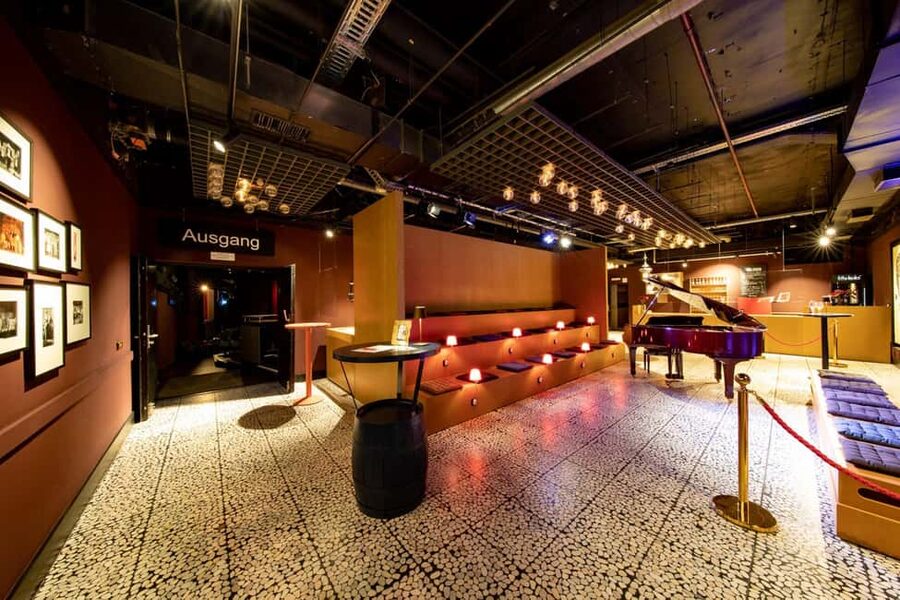
The “what makes it special” part here is that you’re walking into a room built for sharp, political theater. Cabaret works best when the audience feels close enough to hear the nuance in the dialogue and catch the rhythm in the jokes.
Timing and seats: how the 2 hours really plays
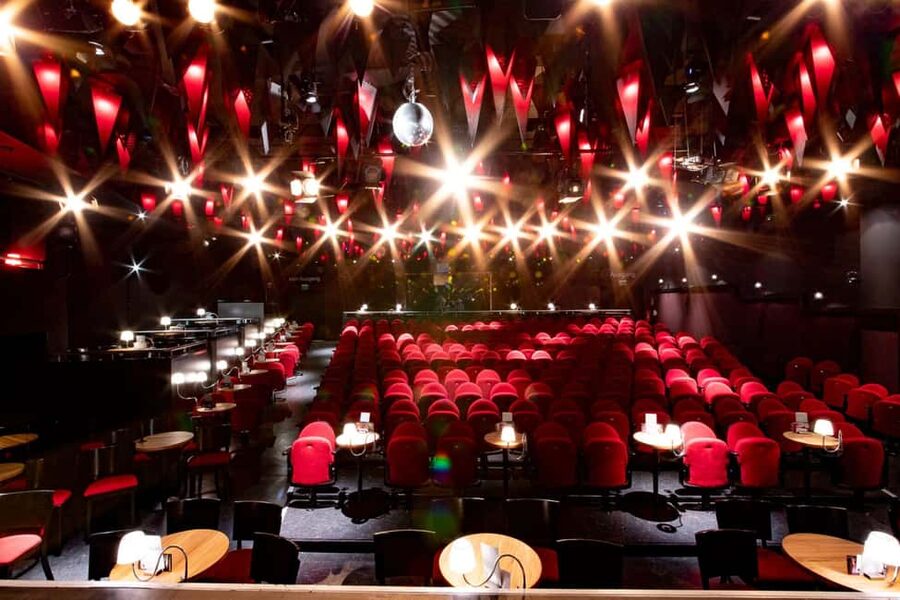
The show is scheduled by start time, and you can check availability to see when it begins. After that, it’s a straightforward plan: you exchange your voucher, choose your seating category, and then the performance takes over for the whole 2-hour window.
Here’s what I think you should expect about seating. You can choose a seating category, but you do not get exact seats. That matters if you are very sensitive to sightlines or you need to sit in a particular spot due to mobility or comfort. In most theater situations, a category choice still gets you into the right zone, but it won’t guarantee a specific seat number.
The room size and the format are the real reason this matters. With a small group limited to 6, you are not blending into a sea of people. The energy is more direct. Cabaret thrives on that sense of “we’re all in this together,” and a smaller audience makes it easier for the performers to steer the emotional temperature of the night.
The plot in plain terms: Tesla, debt, and a 2028 panic
The anniversary program is built as a biting vision of the future in 2028. It starts with political leadership under a financial squeeze, and then follows the logic of austerity, incentives, and corporate power until it turns into something theatrical and darkly funny.
In the story, Chancellor Wagenknecht and Vice-Chancellor Pistorius face mounting pressure because the national debt is advancing inexorably. The satire taps into a handful of specific, memorable economic pressures, like this: a cheese roll costs 14 euros, BASF and Bayer have moved to Asia, and VW and BMW belong to Tesla. Germany’s credit rating has been downgraded to BB, and half of the taxes go to interest payments.
Then Pistorius proposes a single measure meant to fund election promises at once. The plan is the Berlin secret plan version of policy math, mixing big-ticket lifestyle changes like retirement from 55, free public transport, and a rent cap held at 1989 levels.
From there, the story spirals. The script introduces the idea that a well-known electric car developer and an influential microblogging service jump in immediately, and the result is an explosion of unintended consequences. The jokes land because the logic feels like something you’ve heard in real debates, just pushed harder until it breaks into absurdity. And the show’s emotional center stays clear: when everything starts to panic, the message is that nobody intends to sell Berlin.
If you enjoy satire, you’ll probably love how the program uses policy details like props. A rent cap set to 1989 levels is funny on its own, but it also becomes a shorthand for how politics promises stability while bending under pressure.
Cabaret style: fast-paced, political, and still very Berlin
This is cabaret theater, but it’s not “stand-up in a club.” The pacing is structured like theater with musical moments and a clear arc. You get topical social criticism with black humor, delivered in a way that still feels unmistakably Berlin.
The tone is important. Berlin serenity is part of the concept, which sounds contradictory until you see it in action. The performers keep moving, keep switching gears, and keep the atmosphere controlled, even as the storyline gets more chaotic. That contrast is one of the reasons cabaret can feel so alive in Berlin. The city’s humor often comes through as calm delivery of sharp truths.
It’s also why the room matters. When you watch a political satire close up, the meaning changes. You’re not reading a headline and moving on. You’re hearing the phrasing and the timing, and you can feel where the laughter is meant to land versus where it’s meant to make you think afterward.
In short, you get a night that aims to make you laugh and then quietly re-check what you believe about economics, leadership, and public life. And because it’s fast-paced, you aren’t stuck waiting for the show to “start getting good.”


The performers and creative team you’ll want to notice
You’re not just watching “a show.” You’re watching specific artists pull off a staged argument with comedic momentum.
The cast includes Santina Maria Schrader, Mirja Henking, and Sebastian Stert. The writing credits go to Frank Lüdecke and Sören Sieg, and the direction is also Frank Lüdecke. Music is by Luca Fazioli, with arrangements by Martin Rosengarten.
Why does that matter for your decision? Because when the creative team is named and the show mixes music with political theater, you can expect the comedic beats to be integrated into the performance, not added afterward. You’re likely to feel the rhythm of the piece. Music in cabaret often works like punctuation, and in this program it’s part of the structure that keeps the 2028 scenario moving.
Even if you catch only part of the German, you can still read the performance through tone, timing, and staging. But for the full experience, German helps you land the jokes at the exact moment they’re fired.
What makes the political satire land, even if you disagree
Political satire has a risk: it can become preachy, or it can ignore consequences. This program aims for something trickier: it uses a chain reaction.
The story doesn’t just say, “bad things happen.” It shows how debt pressure can drive policy decisions, which then shape everyday costs like food and housing, which then pull corporate and tech forces into the political orbit. When electric cars and microblogging get mixed into policy fantasies, the humor becomes a commentary on how fast influence moves and how quickly blame gets assigned.
For you, the value is not that you must believe the script’s point. The value is that the show gives you a framework to think about how policy, debt, and public life interact. It’s a scenario built for thinking, but it uses comedy to keep you from feeling trapped in a lecture.
So if you like theater that pokes at systems, not just individuals, you’ll probably enjoy the way this one stays focused on the machinery of modern politics.
Price and value: what $45 buys in Berlin theater time
The ticket price is $45 per person for a roughly 2-hour cabaret performance. In Berlin terms, that places it in the “serious cultural night out” category, not a bargain museum ticket, not a generic walking tour.
Where the value shows up for me is the combination of:
- a close-up theater format,
- live performance,
- uncensored, topical political satire,
- and a small group limit that keeps the vibe intimate.
You’re paying for time with artists, not just “an event.” That sounds obvious, but it’s the difference between a stage show and a passive attraction.
Also, because it’s a ticketed show at a recognized cabaret theater, you’re not spending mental energy on logistics beyond getting to the Europacenter basement and exchanging your voucher.
If you’re deciding between a low-cost attraction and this kind of theater night, think about what kind of memory you want. This is the type of evening you’ll still be talking about in the morning, because it pulls ideas into comedy and then leaves you with questions.
Tips for a smooth German-language cabaret night
This show is in German, and knowledge of German is required. That’s not a casual note. It’s the main factor that determines whether the jokes land the way they’re meant to.
Here are practical ways to help yourself:
- If your German is solid but not perfect, focus on the structure of the arguments, not every single word. The storyline is built on recognizable economic themes.
- Plan to arrive ready to listen. Cabaret depends on quick shifts, so even a small distraction can cost you a punchline.
- When you exchange your voucher at the box office, be prepared to choose your seating category. Since you won’t choose exact seats, you’ll want to get your choice done before the performance starts.
- If you need wheelchair access, this activity is listed as wheelchair accessible, so you can plan around your comfort needs with less uncertainty.
One more honest thought: if political humor makes you tense, this show may feel intense. The tone includes black humor and fast criticism. If you can handle that, you’ll get a memorable night. If you want something purely light, you might choose a different evening.
Who this experience is for (and who should skip it)
You’ll probably love this if:
- you enjoy political theater,
- you like satire that mixes everyday details with big ideas,
- you want an authentic Berlin night that feels close and alive,
- and you can follow German-language dialogue.
You might think twice if:
- you do not feel comfortable in German,
- you dislike topical humor or you want a strictly non-political evening,
- or you prefer slower, purely scenic performances over fast-paced cabaret.
The small group format also makes a difference. With limited to 6 participants, this isn’t the kind of outing where you can count on a huge buffer. The room is part of the experience, and you’ll feel it.
Should you book Ich hab noch einen Tesla in Berlin?
I’d book it if you want more than entertainment. This program is theater with an opinion, and it uses a 2028 storyline about debt, corporate power, and policy tradeoffs to make the laughs carry meaning. The combination of uncensored, live political satire and music inside the cabaret format is exactly the kind of Berlin experience that feels like it belongs in Berlin, not just in any city.
I wouldn’t book it if your German isn’t strong enough to follow the dialogue closely. Since German is required, this is not a “works with translation” kind of night.
If you are on the fence, use the decision rule that matters most: can you comfortably follow German political banter for about two hours? If yes, you’ll likely leave with laughter and something to think about. If no, you’ll miss too much of the joke machinery to enjoy it fully.
Everything else we filed on Berlin
- East Berlin: City of Shadows Walking Tour
★ 5.0 · 11 reviews - Berlin: Die Stachelschweine – Frank Lüdecke – Träumt Weiter
★ 4.7 · 11 reviews - Potsdam Day Trip from Berlin with a Local: Private & Personalized
★ 4.0 · 11 reviews - An Introduction to Berlin Walking Tour
★ 5.0 · 11 reviews - DJ for a Day: Learn to Mix Like a Pro in Berlin
★ 5.0 · 11 reviews - 2-H Segway Sightseeing Tour Berlin
★ 4.5 · 11 reviews