
REVIEW · NIGHT WATCHMAN AND COSTUMED TOURS
Medieval city tour with night watchman in Munich in German
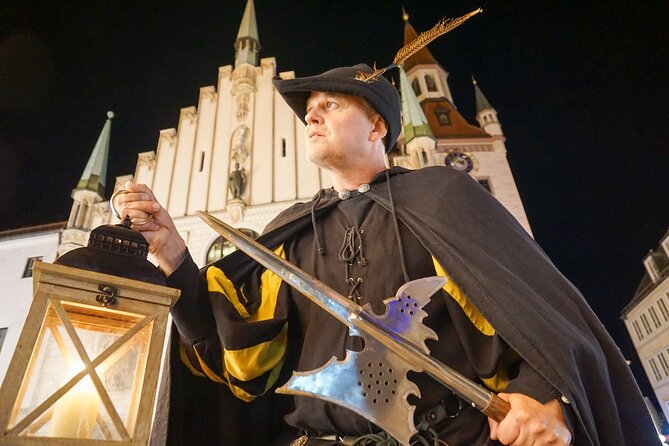
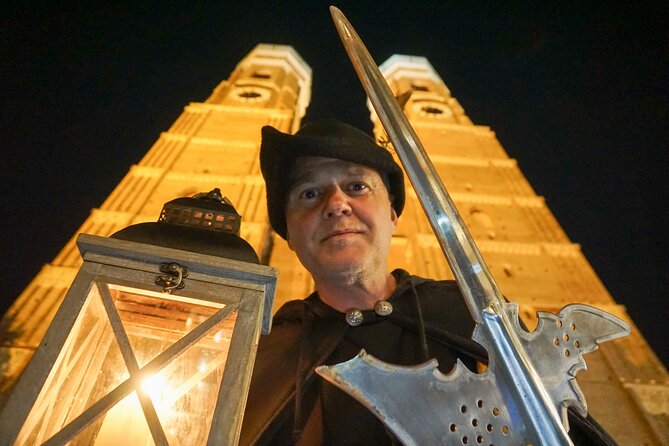
Munich at night turns into a medieval storybook. You meet Wolfram, the original night watchman, and he carries a lantern, halberd, and horn as he explains what his job was really like. It is not just pretty squares, it is practical street knowledge, told as you walk.
I especially love the way the stops connect to real places you already recognize from daytime Munich. You get execution-and-prison details next to landmarks like St. Peter’s Church, Old Town Hall, and the Frauenkirche, plus hands-on medieval flavor like silver pennies and the tally stick for debt.
One thing to consider: the theme leans dark. Expect stories about execution and torture, and since it runs in the evening you will want warm clothes if the weather turns cold.
In This Review
- Key highlights you should know before you go
- Munich’s medieval night watchman tour, told street by street
- Value check: $16.13 for 14 medieval stops
- Starting point at Rathaus Apotheke, then straight to Marienplatz
- St. Peter’s Church: the poor sinner bell and the Marco Bragadino execution
- Petersplatz and the medieval cemetery, close to the altar
- Viktualienmarkt: where the first city wall stood
- Old Town Hall and the Talburg gate, plus a medieval halberd
- Burgstraße and the medieval prison: dungeon, torture, and punishments
- Münzstraße: silver pennies and how Wolfram’s purse tells the story
- Alter Hof: Wittelsbach beginnings, and Duke Ludwig the Strict
- Dienerstraße and Weinstraße: gates, wall remnants, and how addresses worked
- Schäfflerstraße: debt and the tally stick
- Frauenkirche and Frauenplatz: building in 20 years and traces you can still see
- Closing at Kaufingerstraße and the Beautiful Tower
- Who should book this night watchman tour in Munich
- Should you book Wolfram’s medieval night watchman walk?
- FAQ
- What is the price per person?
- How long is the tour?
- What time does the tour start?
- Where do I meet the guide?
- Where does the tour end?
- Is there an admission fee at the stops?
- Is a mobile ticket used?
- What is the group size limit?
- Do I need good weather?
- What is the cancellation policy?
Key highlights you should know before you go
- Wolfram in full role-play gear, with lantern, halberd, and horn
- A small group cap (max 10), which helps the pace feel calmer and more story-focused
- A route built around medieval infrastructure, including city gates and the first city wall line
- Real objects and concepts, like original silver pennies and the tally stick used for debt
- Short, concentrated stops at iconic Old Town sites, keeping you moving without feeling rushed
- Free admission at each listed stop (so you are not paying extra “per attraction” during the walk)
More lantern-lit rounds after dark
- Munich: Night Watchman Walking Tour★ 4.7 · 2,092 reviews
- Munich: Night Watchman Torch Tour in German★ 4.8 · 1,280 reviews
- Munich: Middle Ages Tour with Night Watchman★ 4.9 · 652 reviews
- München: Der Nachtwächter für Kinder – Führung auf Deutsch★ 5.0 · 322 reviews
Munich’s medieval night watchman tour, told street by street
This is the kind of tour that makes the city feel like it has layers you can actually touch. You start in the heart of Old Town and follow Wolfram as he works through medieval Munich’s daily reality: gate duties, nighttime security, punishments, burial customs, and even how money problems could be made official.
The vibe is story-led but not vague. Each time you reach a landmark, you learn what it meant in medieval life, then you walk to the next “chapter.” The tour is about 1 hour 30 minutes, and with stops that are often only a few minutes, the whole experience stays focused.
And yes, it is set up for nighttime walking. The meeting time is 8:30 pm, so you will see Munich under a different light, literally and emotionally. In the reviews, people highlight how Wolfram mixes solid knowledge with humor, which matters when the subject matter turns grim.
Value check: $16.13 for 14 medieval stops
At $16.13 per person, you are paying for a guided night walk that touches a lot of important Old Town points. What makes it feel like good value is that the tour includes a single mobile ticket, and each listed stop is marked as admission ticket free. So you are not budgeting for extra entrances on the fly.
You also get a compact group size, up to 10 people. That is a big deal for story tours. With a smaller group, Wolfram can keep the tone lively and answer questions without everything turning into a slow moving line.
Duration is about 1.5 hours, which fits well into an evening program. You can do this and still have time for a late snack afterward, without feeling like you surrendered your whole night.
Starting point at Rathaus Apotheke, then straight to Marienplatz
Your tour begins at Rathaus Apotheke at Marienplatz 8. From there, Wolfram welcomes you at Munich Marienplatz and sets the stage with the tasks of the night watchman in the Middle Ages. This matters because without that context, the rest of the walk can feel like random trivia. With Wolfram’s explanation first, the later gates and street duties click into place.
From Marienplatz, the pace quickly becomes “walk and learn.” You move through Old Town in short segments, and Wolfram’s gear helps anchor the role. The lantern is the obvious visual. The halberd and horn keep it clear that this was a job, not just a costume.
If you like tours that give you a framework, this opening works. You learn what Wolfram would have been watching for, then you see the city points he links to those duties.
St. Peter’s Church: the poor sinner bell and the Marco Bragadino execution
Next you head to St. Peter’s Church and meet two kinds of medieval storytelling at once: objects and events. Wolfram shows the poor sinner bell, and then you get a demonstration connected to the execution of Marco Bragadino.
This stop is one of the more intense moments on the route. It is also one of the clearest examples of why this tour is valuable for Munich visitors who already know the big names. You leave with more than surface-level architecture. You understand how public order, punishment, and religious practice were braided together.
A practical note: since the discussion is heavy, it helps if you are mentally prepared for grim topics. If you get uncomfortable with execution-related stories, you might still enjoy the rest, but this portion may be the toughest.
The wider Munich sightseeing pile


Petersplatz and the medieval cemetery, close to the altar
From there you move to Petersplatz and step into the idea of a medieval burial wish. Wolfram guides you through a medieval cemetery, and you learn why people wanted to be buried as close as possible to the altar.
This is a different tone than executions and prison stories. It shifts you toward belief, status, and everyday hope, all tied to how the city arranged death. If you like culture-history that is grounded in human choices, this is a stop that lands.
It also helps you see medieval Munich as more than “scary streets.” It had routines, fear, and faith, all in the same urban spaces. And because you are outside, you can take in the surroundings while the story gives them meaning.
Viktualienmarkt: where the first city wall stood
At Viktualienmarkt, the focus turns to the city’s defenses. Wolfram explains exactly where Munich’s first city wall stood.
This is where the tour really gives you something practical for future wandering. Once you understand the wall line, you start noticing street shapes and boundaries that you would otherwise treat like ordinary Old Town layout. It is the kind of mental map you keep after the tour ends.
This stop is short, but it is high impact. It is also a nice pacing change after heavier material. You get a clear geographic idea: the city wall was not an abstract concept, it was a line that shaped where people could go and where the city could control movement.
Old Town Hall and the Talburg gate, plus a medieval halberd
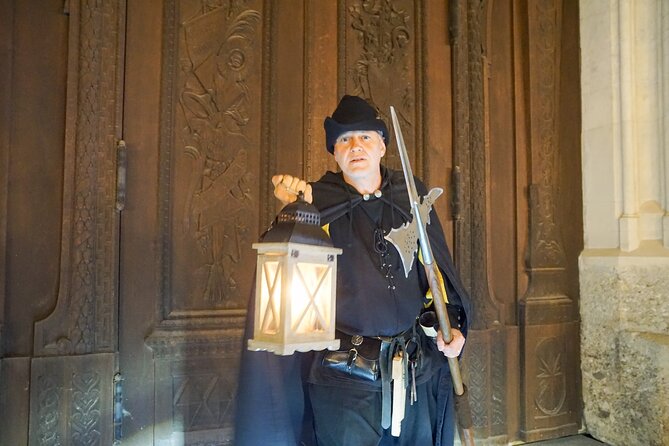
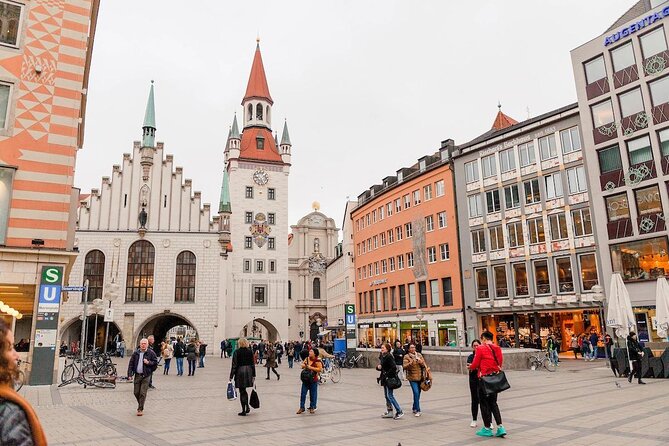
Then you reach the Old Town Hall and the story moves to gates and weapon duty. Wolfram closes the Talburg gate in the tour sequence and shows you a medieval halberd.
This is a good moment if you like tangible details. Instead of just hearing that night watchmen carried tools, you get to see one tied to the period. It also reinforces a key theme of the whole walk: gates were the city’s checkpoint system, and watchmen’s roles were tied to keeping order as people flowed in and out.
If you are into craftsmanship and how objects signaled authority, you will enjoy this stop. The humor Wolfram is known for also helps keep it from turning into a dry museum moment.
Burgstraße and the medieval prison: dungeon, torture, and punishments
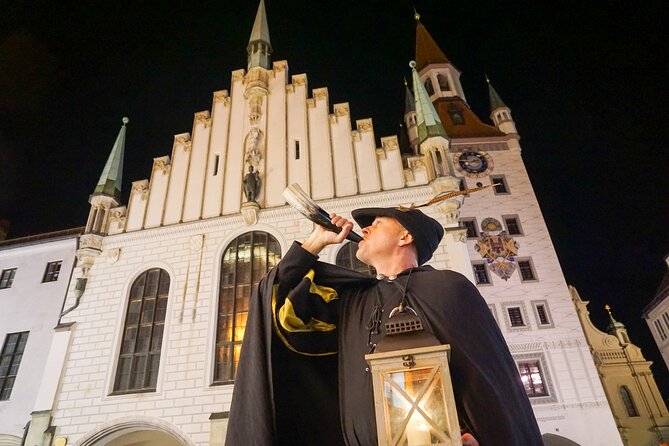
On Burgstraße, the tour gets its most direct “dark history” content: you discover a medieval prison in Munich, with talk of the dungeon, torture, and what punishments existed in the Middle Ages.
This stop is important because it connects the city’s security role to the human consequences. You can think of it as the other side of the gate duties: prevention was one task, punishment was another.
You should also know what you are signing up for. Even with humor in the delivery, the subject matter is not light. If you prefer gentler city tours, you may want to brace yourself mentally here. For others, this is exactly the point: to understand how justice and discipline worked in real medieval life, not just as an idea.
Münzstraße: silver pennies and how Wolfram’s purse tells the story
At Münzstraße, you get a different kind of medieval reality check: money. You can take a look into Wolfram’s purse and see original silver pennies from the Middle Ages.
This is a stop that appeals to people who love material culture. Coins are small, but they connect to taxes, wages, debt, and daily transactions. Seeing actual pennies keeps the lesson from staying theoretical.
Even if you are not a coin collector, this gives you a “wow, that is real” moment. It also breaks up the heavier themes with something more concrete and visual.
Alter Hof: Wittelsbach beginnings, and Duke Ludwig the Strict
At Alter Hof, Wolfram brings you to the first castle built in Munich by the Wittelsbach family. He also explains why Duke Ludwig, the builder, was nicknamed the strict one.
This is a more political stop, but it still fits the tour’s logic. Night watchman duties depend on who ruled, how power was organized, and how the city defended itself. So your walk keeps tying back to practical urban life.
I like that the story names the people, not just the buildings. A nickname like the strict one gives you a human entry point to leadership and control. It makes the medieval city feel less like a set of monuments and more like a place run by real personalities.
Dienerstraße and Weinstraße: gates, wall remnants, and how addresses worked
At Dienerstraße, Wolfram closes the Vorderes Schwabinger Tor and explains what still reminds you of the first city wall. This is one of the tour’s best moments if you want to understand Munich’s layout through its original borders.
Then you move to Weinstraße, where Wolfram closes the Rear Schwabing Gate and explains how addresses used to work.
This pair of stops helps you connect the city’s “where” to the city’s “how.” Knowing gate names and wall remnants gives you orientation. Understanding old addressing systems gives you a sense of how people navigated life before modern street numbers.
If you are the type who loves learning how systems worked, you will feel satisfied here. If you want only architecture photos, it may feel a bit more cerebral. Still, the payoff is that you will walk away with a better mental map.
Schäfflerstraße: debt and the tally stick
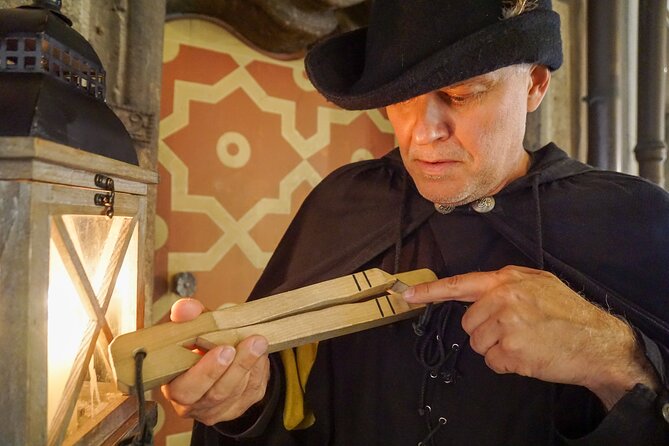
At Schäfflerstraße, Wolfram teaches how people in the Middle Ages could get into debt using the tally stick. He explains his and how it worked to make transactions official.
This is one of those details that makes medieval life feel surprisingly familiar. We have different tech now, but the core problem is the same: people borrowed, relationships broke down, and someone had to record what happened.
This stop also works well because it is short and playful in tone, while still being meaningful. You get a clear mechanism, not just a vague reference to medieval commerce.
If you like stories that connect to modern money habits without turning preachy, this is a great chapter.
Frauenkirche and Frauenplatz: building in 20 years and traces you can still see
Next you reach Frauenkirche. Wolfram shares how people could build this church in just 20 years, and the scale of the building naturally supports the point. You start looking at it differently, not just as a landmark, but as a statement of speed, planning, and will.
Then you go to Frauenplatz, where you can discover which medieval traces still exist in the old town.
This is where the tour earns its “last act” energy. Earlier you learned about gates, prisons, and coins. Here you see how the medieval city still shows up in daily Munich. It is also a gentle emotional shift, away from torture and punishment, toward what survived.
If you enjoy being able to spot clues on your own after a tour, spend a few extra seconds at Frauenplatz. Let the story sharpen your eyes before you move on.
Closing at Kaufingerstraße and the Beautiful Tower
Your final stretch is Kaufingerstraße, where Wolfram completes the symbolism around the route and references the Beautiful Tower. He says goodbye at the tour’s end point near Hirmer Kaufingerstraße 28.
By the time you finish, you should feel like you earned a medieval mental map, not just a list of facts. You have walked a line of gates, you have heard how night watchmen worked, and you have seen how punishment and protection were linked to the city’s authority.
This ending is satisfying because it leaves you with something to test later: when you look back at the old town, you can try to imagine the wall line and the gate rhythm as if Munich was a controlled space after dark.
Who should book this night watchman tour in Munich
This tour is a strong fit if you want:
- A story-driven walk that uses real Old Town landmarks
- A small group evening activity around Marienplatz and the Frauenkirche area
- Medieval details that go beyond “pretty view” photos, especially objects like coins and the tally stick
It is also ideal if humor matters to you. The reviews you will find for this tour repeatedly point to Wolfram’s humor and competence, including clever role moments during the walk. That blend helps when topics turn serious.
You might skip it if you dislike dark themes like execution and torture. Even if the delivery is engaging, you are still choosing a medieval night watchman tour.
Should you book Wolfram’s medieval night watchman walk?
I think you should book this if you like guided storytelling that helps you see a city differently. At $16.13, with about 1.5 hours of walking and a small group size, it is good value. The biggest strength is that it ties medieval concepts to specific places, so the tour leaves you with a usable mental map of Munich’s old defenses and street logic.
If your main goal is only sunshine architecture photos, you may prefer a lighter daytime route. But if you want Munich after dark, with lantern energy and medieval street reality, this is the kind of experience that sticks with you when you go back out on the sidewalks.
FAQ
What is the price per person?
The price is $16.13 per person.
How long is the tour?
The tour lasts about 1 hour 30 minutes.
What time does the tour start?
It starts at 8:30 pm.
Where do I meet the guide?
You meet at Rathaus Apotheke, Marienplatz 8, 80331 München, Germany.
Where does the tour end?
The tour ends at Hirmer, Kaufingerstraße 28, 80331 München, Germany.
Is there an admission fee at the stops?
The stops are listed as admission ticket free.
Is a mobile ticket used?
Yes, this experience includes a mobile ticket.
What is the group size limit?
The tour has a maximum of 10 travelers.
Do I need good weather?
Yes, the tour requires good weather. If it is canceled due to poor weather, you will be offered another date or a full refund.
What is the cancellation policy?
Cancellation is free. You can cancel up to 24 hours in advance for a full refund. Canceling less than 24 hours before the start time is not refunded.
Seeing Munich in One Go
The Night Watchman Goes Again
Everything else we filed on Munich
- Munich Beer and Bavarian Bites Private Tour
★ 5.0 · 11 reviews - Private Day Trip from Munich to Neuschwanstein and Linderhof
★ 4.0 · 11 reviews - Private Munich Old Town Walking Tour – with optional Breakfast
★ 5.0 · 11 reviews - Festive Concert in the All-Saints Court Church
★ 4.6 · 11 reviews - Private Castle Tour from Munich: Neuschwanstein, Hohenschwangau, and Linderhof
★ 4.5 · 12 reviews - Munich: Oktoberfest Big Beer Tent Evening including table reservation
★ 4.8 · 12 reviews
Night Watchman and Costumed Tours, side by side.
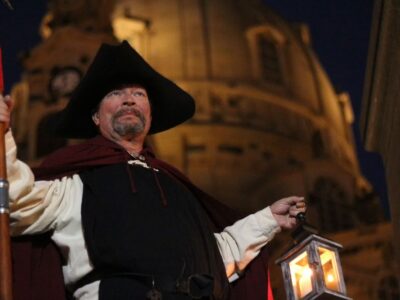 ★ 4.6Dresden: The Original Night Watchman Tour in Lantern LightFrom $176,653 reviews
 ★ 4.7Hamburg: Night Watchman’s Tour of St. Pauli in GermanFrom $234,818 reviews
 ★ 4.6Leipzig: 1.5-Hour Public Tour with Night Watchman BremmeFrom $173,116 reviews
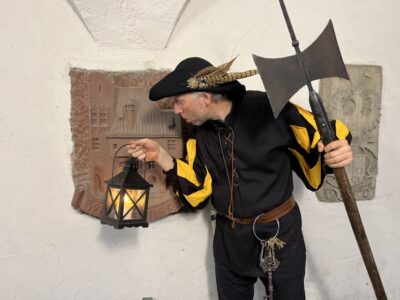 ★ 4.7Munich: Night Watchman Walking TourFrom $5302,092 reviews
 ★ 4.8Dresden: Night Watchman Tour Through The Old TownFrom $171,758 reviews
 ★ 4.6Cologne: The Night Watchman Old Town Walking Tour in GermanFrom $171,395 reviews
 ★ 5.0Medieval Tour in Nuremberg in SpanishFrom $191,374 reviews
 ★ 4.8Munich: Night Watchman Torch Tour in GermanFrom $221,280 reviews
Other lists this tour is on