
REVIEW · HISTORICAL TOURS
Frankfurt – Old Town Historic Walking Tour
Frankfurt feels walkable and smart here. I love starting at the Römer and then learning how the Frankfurt Cathedral signals imperial unity, and I love the stop at the Goethe House where you can see Goethe’s writing desk. In just 1.5 hours, you get a tight route through the parts of Frankfurt that explain the city.
One thing to plan for: entrance fees are not included, so you may want to budget a little extra if you want to go inside more sites on your own. Also, this is a walking tour, so it moves at a friendly but steady pace.
In This Review
- Key moments you will remember
- Getting oriented at the Römerberg, Frankfurt’s medieval heart
- Frankfurt Cathedral, Roman Gothic grandeur with political meaning
- Eiserner Steg across the Main, from 1868 to the 1993 rebuild
- Städel Museum on the walk, plus what you see about German art
- Eurotower and the European Central Bank era, finance as architecture
- Goethe House, where you can picture the work at the writing desk
- St. Paul’s Church, a Protestant symbol tied to 1848
- Kleinmarkthalle, a food stop that feels local, not touristy
- Hauptwache, the baroque guardroom and a natural meeting point
- Alte Oper at Opera Square, drama in stone after the 19th century
- Guide quality and what makes this tour feel easy to trust
- Price and value for $397 per private group up to 20
- Who this Frankfurt Old Town private walk suits best
- Should you book this Frankfurt Old Town Historic Walking Tour?
- FAQ
- How long is the Frankfurt Old Town Historic Walking Tour?
- Where does the tour start?
- Where does the tour end?
- Is this a private tour?
- What is included in the price?
- Are entrance fees included?
- What languages are available?
- Is there free cancellation?
Key moments you will remember
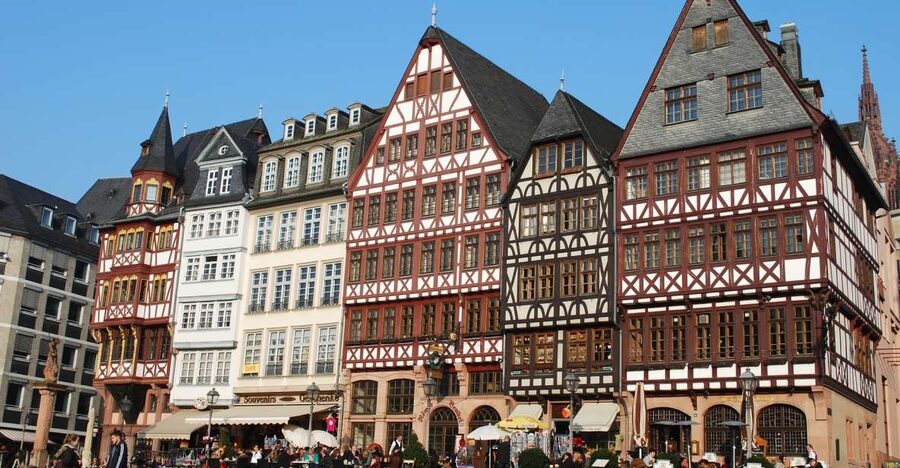
- Römerberg, Frankfurt’s medieval center, with the city hall vibe that still hosts events
- Frankfurt Cathedral, the largest Roman Gothic church in the city, with tower and vaulted interior highlights
- Eiserner Steg (Iron Footbridge), rebuilt after WWII, and running 170 meters across the Main
- Goethe House, where you can see Goethe’s writing desk for his early works
- Kleinmarkthalle, packed with food stalls, including Frankfurt’s famous green sauce
- Alte Oper at Opera Square, an old concert hall icon that still feels dramatic today
Other walking routes through Frankfurt
- Frankfurt Highlights English Walking Tour★ 5.0 · 1,203 reviews
- Frankfurt on Foot Daily Walking Tour in English★ 4.9 · 323 reviews
- Frankfurt: Private or Shared Walking Tour★ 4.8 · 156 reviews
- Frankfurt Self-Guided Historical Walking Tour★ 4.0 · 58 reviews
Getting oriented at the Römerberg, Frankfurt’s medieval heart
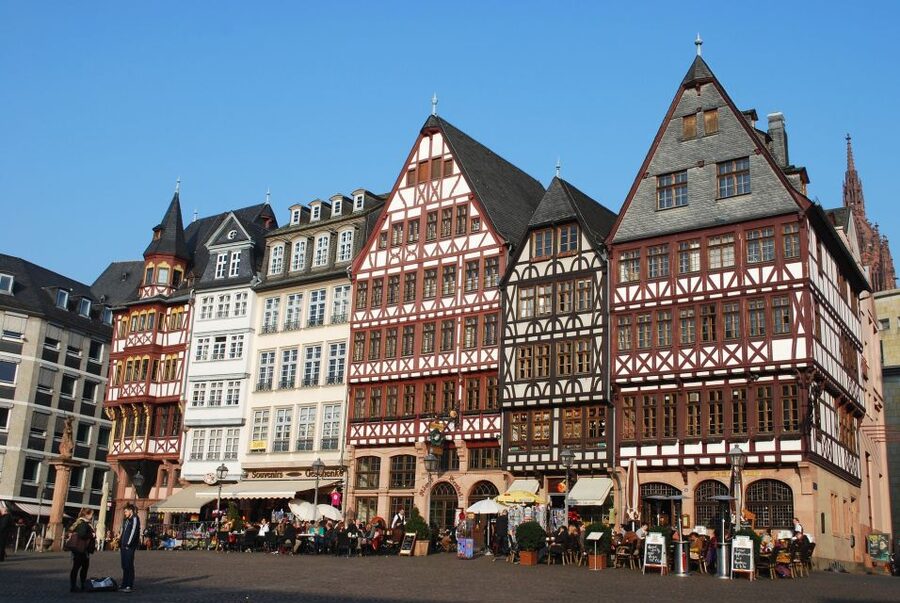
Your tour starts at the Fountain of Justice, then you move straight into Römerberg, the core of Frankfurt’s Old Town. The Römer refers to those nine medieval houses clustered together, and today they serve as Frankfurt’s city hall. Even if you just watch from the square, you feel the feudal atmosphere in how the place still works as a civic stage.
This is one of those stops that’s more than a photo. The value here is context: your guide helps you understand why the Römer matters, not only that it exists. And if you like architecture that tells a story, the mix of old facades and real city life makes this opening instantly useful.
Frankfurt Cathedral, Roman Gothic grandeur with political meaning
Next you get to the Frankfurt Cathedral, formally the Imperial Cathedral of Saint Bartholomew. This church is the largest Roman Gothic church in the city, and it comes with big symbols attached. The Cathedral has a reputation for representing unity during the Empire era, so it is not just a pretty building. It was built to mean something, and your guide does a good job connecting the meaning to the details you can actually see.
Look for the tower, the organ, and the vaulted ceilings. Those features are the sort of things you might skim on your own, but with a live guide, you learn what to notice and why it was designed that way. The drawback is simple: if you expect every moment to be an inside-only visit, plan for extra costs since entrance fees are not included.
Eiserner Steg across the Main, from 1868 to the 1993 rebuild
Then comes one of Frankfurt’s most iconic walking moments: the Eiserner Steg, also known as the Iron Footbridge. You learn that the first version dates to 1868, and that it has been replaced and rebuilt multiple times. There is also a WWII chapter here, with the bridge destroyed in 1946 by the Wehrmacht.
What makes this stop satisfying today is how the modern bridge carries the past. Since 1993, the bridge is 170 meters long, built with rivered steel reinforcements and two piers. Walking it gives you a smooth stretch of views over the Main, and it is also a natural reset after the dense city core.
Tip for this segment: keep your eyes up and outward. This bridge is not just a connector, it is a vantage point, and your guide usually points out the key skyline angles you will miss if you stay focused on your feet.
Städel Museum on the walk, plus what you see about German art
As you continue, you pass by the Städel Museum. Even if you do not go in, you still get useful perspective. The museum was selected as Museum of the Year in 2012 by the AICA, and it is known for strong collections that span major parts of German art.
The scale is impressive: among its holdings, you have 2,700 paintings, but only 600 are displayed. That detail matters because it explains why the museum experience can feel different depending on when you visit. There is also a library on site with more than 100,000 books, which is a great reminder that Städel is not only a gallery space, it is also a research hub.
If you do want to step inside, entrance fees are not part of the tour price, so consider it as an optional add-on. For many people, though, the best value is the way your guide gives you enough to understand what you are seeing from the street.
More history walks in Frankfurt
Eurotower and the European Central Bank era, finance as architecture
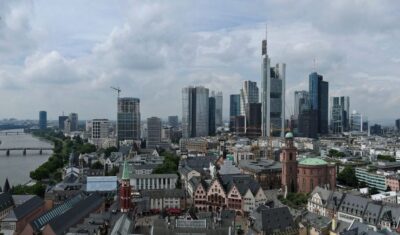
Walking onward, you will also pass the Eurotower, a skyscraper that pulls your attention upward. It stands 148 meters high, and it served as the seat of the European Central Bank for many years until 2015. Designed by the architect Richard Heil, the building is a quick lesson in how Frankfurt shaped itself into a financial center.
This section is useful because it prevents the Old Town from feeling like a museum district only. Frankfurt’s story includes trade and money as well as emperors and poets. The Eurotower stop gives you a bridge between eras, and it helps you understand why the city’s modern identity sits so close to historic landmarks.
Goethe House, where you can picture the work at the writing desk
After the bridge and the skyline hints, the tour shifts into literature with Goethe House. This is the birthplace and childhood home of Johann Wolfgang von Goethe, one of Germany’s major literary figures. If you like authors you can almost meet, this is a strong stop because it is tied to place, not only to books.
The highlight here is the writing desk connected to Goethe’s early works. By entering the house, you get the chance to see it, and that physical object changes how you imagine the early writing process. Without a guide, you might wander room to room. With one, you typically understand why the desk matters and what early works represent.
Again, remember: entrance fees are not included. But even if you decide not to go inside, your guide’s framing still gives you a meaningful stop rather than a quick exterior photo.
St. Paul’s Church, a Protestant symbol tied to 1848
Next you pass St. Paul’s Church, which carries political weight in addition to religious significance. The church was previously identified as a Lutheran church, and later became Protestant. It also served as a significant political symbol, especially as the seat of the first Frankfurt Parliament in 1848.
This is one of those stops where a guide can make the stone feel like it has a pulse. You learn why 1848 mattered and why Frankfurt would host a parliament at all. Even if you only see it from the outside on your route, you walk away with a clearer sense of the city’s role in European political change.
Kleinmarkthalle, a food stop that feels local, not touristy
Then the tour turns practical and delicious at Kleinmarkthall. This market is open six days a week and is made up of at least 156 stalls, so it is not the kind of market where you feel like you have seen everything after ten minutes. Your guide helps you focus on what to notice, including famous Frankfurt foods like green sauce, alongside imported items from around the world.
What I like about including a market in a short 1.5 hour walk is that it changes your pace without slowing you down too much. It also helps you connect the city’s “old” identity to what people actually eat now. Markets are one of the best places to understand daily culture, and Kleinmarkthalle fits perfectly into an Old Town route.
If you are tempted to snack during the tour, treat it like a bonus, not a requirement. Entrance fees are not part of the tour, but market food is its own separate decision, and you can keep the experience flexible.
Hauptwache, the baroque guardroom and a natural meeting point
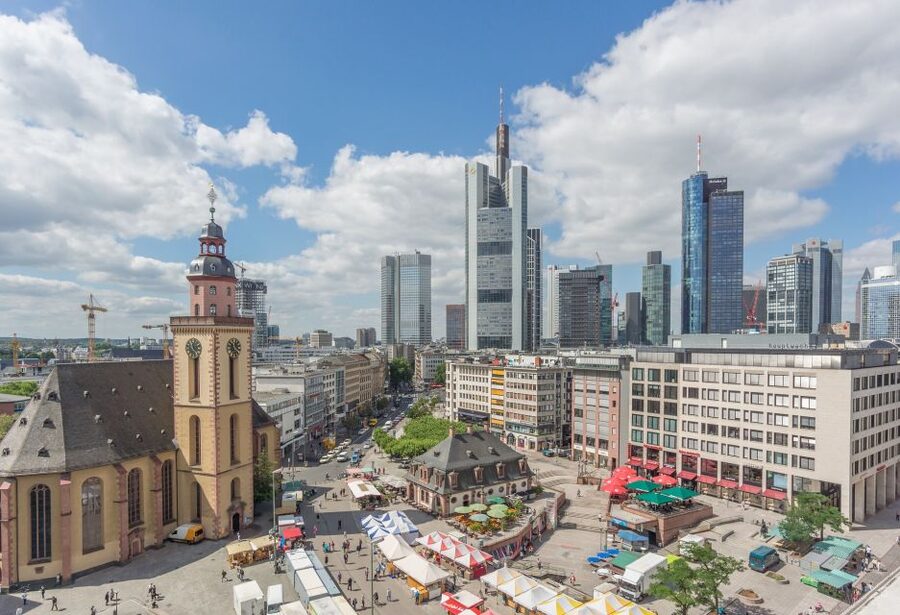
After the market, you pass by the Hauptwach, also known as the Main Guardroom. This is a central spot in Frankfurt where locals meet, which is a great detail because it turns the walk into something living. The building itself is baroque and was built in 1730, and it helps explain how Old Town design shifts from medieval to more formal civic styles.
This stop is short, but it is a good one for getting oriented. In a city like Frankfurt, you want at least one point where you feel you know where you are. Hauptwache gives you that mental anchor, and your guide’s guidance usually helps you map the rest of your day.
Alte Oper at Opera Square, drama in stone after the 19th century
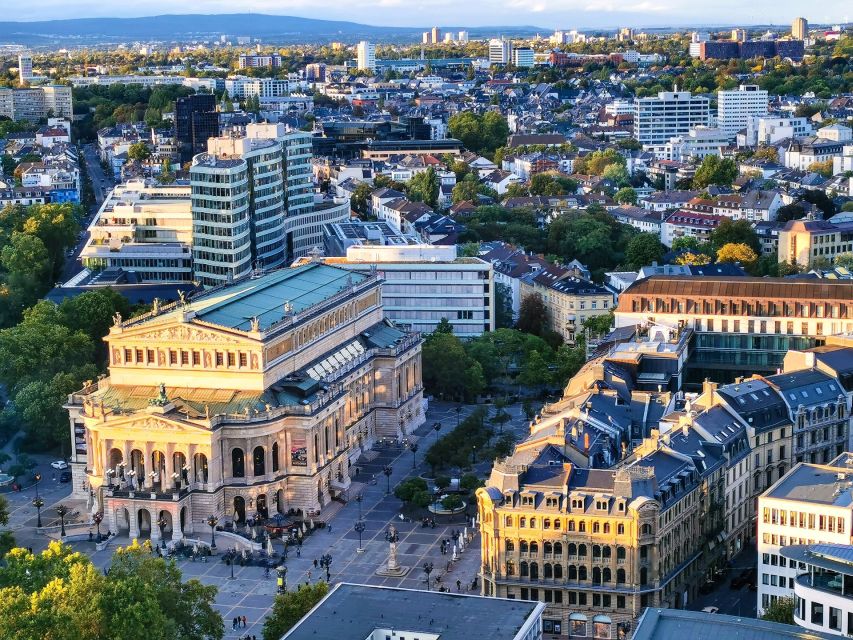
To close, the tour finishes at the Alte Oper, the Old Opera of Frankfurt, on Opera Square. This is a concert hall with serious character, and it has hosted major works like Carl Orff’s Carmina Burana in 1937. You also learn that it was first built at the end of the 19th century, which helps you understand why it still feels grand even in a modern city.
The square in front of it gives you space to breathe, which is a smart finale. You get that moment where you can look back at what you walked through: city hall, cathedral, bridge, poets, politics, and food, all leading to an artistic landmark.
Guide quality and what makes this tour feel easy to trust
A big reason this tour rates highly is the guide experience. In practice, you get a live guide who shares lots of background and uses helpful visuals, not just facts. I also like that the guide usually shares practical suggestions, including dinner ideas, so the tour doesn’t end and leave you stuck guessing what to do next.
Your tour is private, and the live guide is available in multiple languages: English, German, Portuguese, Spanish, Italian, and French. That language flexibility matters because it lets you actually understand the meaning behind details, like why St. Paul’s Church is political or what the Cathedral’s unity symbolism refers to.
If you want a tour where the guide does more than recite dates, this is the right format. A private group also means you can move at a pace that fits your questions.
Price and value for $397 per private group up to 20
This tour is priced at $397 per group for up to 20 people. That sounds simple, but the value depends on how many people are in your group.
- If you fill the full group size, you effectively spread the cost across the group, which can make it a very budget-friendly way to get a guided walk through major sights.
- If it is a smaller group, the per-person cost rises, but you still benefit from the private format and a guide who can tailor the flow to what you care about.
Either way, keep in mind what is included: the private tour guide. Entrance fees are not included, so your total trip cost may go up if you choose to enter Goethe House or other paid interiors. That said, this route is designed so you still get a lot even without every inside visit.
For a first visit to Frankfurt Old Town, I think the value is strongest when you want orientation plus highlights. It is not a multi-day plan, so it gives you a fast, guided “map of meaning” rather than a long list of stops.
Who this Frankfurt Old Town private walk suits best
This tour fits best if you want structure without feeling rushed. The 1.5 hour length is ideal when you are packing a day with other plans and you want the highlights without a whole afternoon disappearing.
It also suits you if:
- you care about how a city’s symbols connect, like empire unity in the Cathedral and political identity in St. Paul’s Church
- you like literature stops that come with physical artifacts, like Goethe’s writing desk
- you want food culture included, not as an afterthought, but as part of the route
If you are the type who wants to spend long minutes inside multiple sites back-to-back, you might find 1.5 hours a bit tight. In that case, treat this as the “get the story first” walk, then return later on your own for deeper time.
Should you book this Frankfurt Old Town Historic Walking Tour?
I would book it if your goal is a focused, guided tour that connects Frankfurt’s landmarks into a readable story. The mix is strong: the Roman Römerberg start, the Frankfurt Cathedral, the Eiserner Steg bridge walk, then Goethe, politics, food, and finishing at the Alte Oper.
Skip it only if you already have a guide you trust for a longer, more inside-heavy day, or if you are certain you want many paid interiors because entrance fees are not included. For most people, this is a smart way to get grounded fast, learn what matters, and still leave time for your own wandering.
FAQ
How long is the Frankfurt Old Town Historic Walking Tour?
The tour lasts about 1.5 hours.
Where does the tour start?
It starts at the Fountain of Justice, where your guide will be waiting with a signboard.
Where does the tour end?
The tour ends back at the meeting point.
Is this a private tour?
Yes, it is a private group tour.
What is included in the price?
The included item is a private tour guide.
Are entrance fees included?
No, entrance fees are not included.
What languages are available?
The live guide is available in English, German, Portuguese, Spanish, Italian, and French.
Is there free cancellation?
Yes, you can cancel up to 24 hours in advance for a full refund.
The Longer History of Frankfurt
Pavements of Frankfurt
Everything else we filed on Frankfurt
- Frankfurt to Prague – Private Transfer with 2 hours of Sightseeing
★ 5.0 · 3 reviews - Castle Braunfels Day Trip from Frankfurt
★ 5.0 · 3 reviews - Frankfurt – Private tour with Licensed guide
★ 5.0 · 4 reviews - Arrival by Luxury Vehicule from Frankfurt Airport to Frankfurt
★ 4.0 · 4 reviews - Frankfurt MAIN TOWER with Tickets, Guide and Old Town Tour
★ 5.0 · 4 reviews - Discover Frankfurt’s most Photogenic Spots with a Local
★ 5.0 · 4 reviews
Historical Tours, side by side.
 ★ 4.7Leipzig: City History Canal Sightseeing Tour on a MotorboatFrom $186,232 reviews
 ★ 4.6Berlin: Natural History Museum Entrance TicketFrom $123,382 reviews
 ★ 4.7Leipzig: 1.5-Hour Historical Walking Tour in GermanFrom $172,217 reviews
 ★ 4.5Berlin: World Heritage Cruise to PotsdamFrom $251,435 reviews
 ★ 4.7Heidelberg: Night Watchman Historic Adventure TourFrom $3051,186 reviews
 ★ 5.0The Local Tour of Hamburg Historic CentreFrom $31,058 reviews
 ★ 4.8Elbfloren: Historical city tourFrom $15819 reviews
 ★ 4.6Bamberg: Guided Beer History Tour with Optional TastingFrom $21772 reviews
Other lists this tour is on