
REVIEW · MUNICH
Munich Walking Quiz: Explore and Discover the City’s Highlights
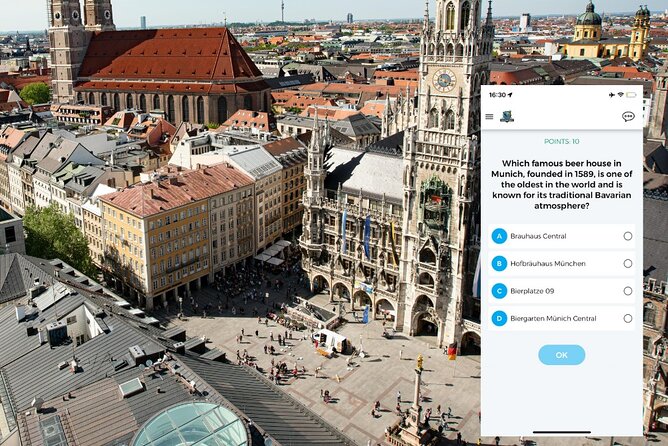
Munich has a knack for turning history into a walk. This Walking Quiz makes you trade wandering for a phone-led game of questions and locations. You start in the middle of it all at Marienplatz, then move around to answer 36 pub-quiz questions tied to what you can see nearby.
What I like most is the way the app points you to where you need to go, so you are not just sightseeing, you are working the city like a puzzle. I also like the format for teams, because up to four people per group can play together, and the race to finish the categories adds real energy without feeling chaotic.
One possible drawback: if you already know Munich extremely well, a few question topics may feel a little general, like you are getting a lighter refresher rather than brand-new facts.
In This Review
- Key Highlights at a Glance
- Marienplatz to Marienplatz: the Simple Route That Still Feels Like an Adventure
- How the Walking Quiz App Runs the Game on Your Phone
- The 36 Questions Strategy: How You Win Each Category
- Landmarks and What You Learn When You Answer Where You Stand
- The Famous and Munich Personalities: Fun Facts with Real City Context
- Sports, Sportsmanship, and Team Banter
- History and Trivia: The Two Parts That Often Take the Longest
- Hidden Gems, but in a Realistic Way
- Team Size, Competition, and Why This Works Better than Standard Tours
- Price and Value: $42.82 per Group for a Phone-Led City Challenge
- Timing Tips: Booking Ahead and Choosing the Right Time of Day
- Who Should Book This Munich Walking Quiz
- Should You Book It?
- FAQ
- How long is the Munich Walking Quiz?
- Where does the quiz start and end?
- How much does it cost?
- How does the game work?
- What kinds of questions are included?
- Can I cancel if my plans change?
Key Highlights at a Glance

- Phone-map navigation keeps the walk focused and stops the guesswork
- 36 pub-quiz questions across multiple topics, including landmarks and history
- Team format up to four with a friendly competition to finish first
- Categories scored by accuracy (you must answer correctly to complete each one)
- Start and end at Marienplatz, so you can fold it into a normal day easily
- 3 hours typical, up to 4, so it fits most sightseeing schedules
More laps of the Munich old town
- Munich: Old Town & Viktualienmarkt City Walk in German★ 4.7 · 2,304 reviews
- Munich Old Town Walking Tour★ 4.5 · 1,287 reviews
- Munich City Hop-on Hop-off Tour★ 3.5 · 1,233 reviews
- Munich: Viktualienmarkt Food Tour★ 4.5 · 1,127 reviews
Marienplatz to Marienplatz: the Simple Route That Still Feels Like an Adventure
You begin at Marienplatz, one of the most practical starting points in Munich. It is central, easy to reach with public transportation, and it puts you right in the thick of classic city scenes from minute one. Then you finish back at the same meeting point, which is great when you do not want to plan a second walk home after the game.
The duration works like this: plan on about 3 hours, but the experience can run up to 4 hours. In other words, it is long enough to feel like an actual activity, not just a quick gimmick, but short enough to still leave room for dinner, a beer hall stop, or a museum visit afterward.
If you like a plan but hate rigid schedules, this is a nice middle ground. You are walking the city under your own steam, but the quiz gives you structure so you do not end up doing the sightseeing version of aimless drifting.
How the Walking Quiz App Runs the Game on Your Phone
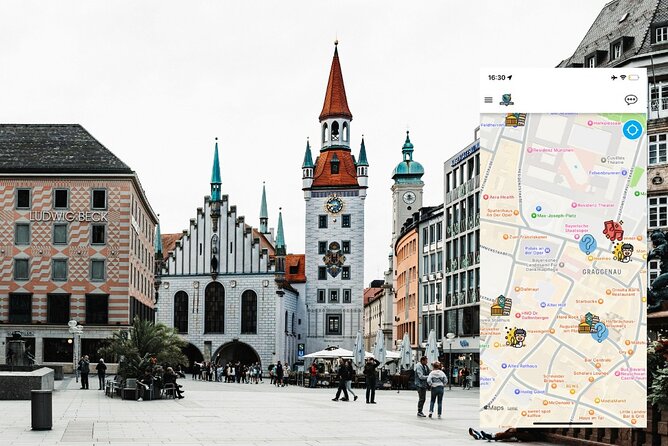
This is not a trivia game you play while sitting still. The whole point is that to answer, you have to navigate to a location using your smartphone. The location shows up on the map inside the app, which makes it feel more like an urban scavenger hunt than a traditional quiz.
That matters for how you experience Munich. Instead of reading plaques or hoping you notice details, you are actively searching for answers tied to the places you are standing near. The app-driven stops also help if you are not confident navigating around town, because you always know the next target.
Compatibility is straightforward. The quiz uses an app that works on both iOS and Android. So you just need your phone, a working connection, and the basic willingness to walk between points without complaining too much to your team.
One practical note: because it is location-based, your phone battery becomes part of your strategy. If your battery tends to die after heavy map use, bring a small power bank. It is the difference between finishing strong and spending the last category hunting for outlets.
The 36 Questions Strategy: How You Win Each Category
The game is built around six categories, each with six questions, for a total of 36 pub-quiz questions. The named topics include Landmarks, The Famous, Sports, History, and Trivia. There is one additional category, but the important thing for you is how scoring works across all of them.
To complete a category, a team needs to answer three questions correctly from that category. So you are not just rushing to the first answer you think might be right. You are balancing speed with accuracy, because wrong answers slow you down and can cost you momentum.
The primary goal is simple: be the first team to finish all categories. Points for correct answers stack along the way, so even if you do not win the whole race, you can still end up with a satisfying scoreboard.
This scoring design is one of the best reasons to do it. It pushes you to keep moving and makes learning feel like part of the fun, not like homework. You also get natural team talk, because in a small group of up to four, someone is always checking the map and someone else is guessing, debating, and piecing things together.
Landmarks and What You Learn When You Answer Where You Stand
One of the categories is Landmarks, and this is where the quiz feels most tied to real Munich rather than random facts. Because answers are tied to the places you are navigating to, you tend to notice things you would otherwise skip. It is the difference between seeing a landmark once and actually registering why it matters.
If you are visiting for the first time, Landmarks helps you get a more complete picture of the city’s identity. If you are returning, it still works because it tests what you think you know, and that can highlight gaps fast.
A small warning in spirit only: do not expect every question to be the kind of detail you can Google instantly on the spot. Some are meant to make you think. The upside is that when you get one right, it sticks.
Other walking routes through Munich



The Famous and Munich Personalities: Fun Facts with Real City Context
The The Famous category is designed to connect famous people and well-known themes back to what you are seeing around the city. That is a smart way to avoid the classic problem of sightseeing where you collect names but not context.
In practice, you will feel the difference between reading a list and answering questions tied to location. The game nudges you to connect personality, place, and story as you move.
This is especially good for first-time visitors who want a shortcut into how Munich talks about itself. And it is also a good match if you like trivia but dislike trivia that feels detached from where you are standing.
Sports, Sportsmanship, and Team Banter
Sports is one of the categories, and it changes the mood. This is not always where the facts are the most serious. It tends to be where team banter gets loudest, because sports questions often land in that sweet spot between widely known and oddly specific.
This matters because a walking quiz only works if the energy stays up. Adding sports keeps the pace lively and gives you a different mental gear than history or landmarks.
If you have teens, this category can be a win. It also helps older kids and adults who do not want the whole game to feel like a history lecture on sidewalks.
History and Trivia: The Two Parts That Often Take the Longest
For many groups, the hardest time is when you hit History and Trivia. History questions likely require more careful thinking, and Trivia can be tough in a way that still feels fair.
One reviewer described the trivia as tough, but still fun, with questions that were doable overall. That matches what you should expect: you may not always know the answer, but the quiz is structured so you can get there by paying attention to the city and using team logic.
The best part is that history and trivia do not just ask for dates and names. Because the answers are location-linked, you are practicing how to read a city. You learn to look for clues that connect places to stories, rather than collecting random facts.
If you are a Munich regular, you might notice you learn fewer brand-new things than someone seeing the city fresh. That is not a failure of the game. It just means you already have the baseline knowledge, so the quiz becomes more of a fun test than a discovery tool.
Hidden Gems, but in a Realistic Way
The quiz is designed to take you beyond the most obvious spots. The experience guides you toward both well-known landmarks and less obvious places. The key here is that you get variety without having to research routes in advance.
In real life terms, this is helpful because Munich is pretty walkable, but the “right” places depend on what you are interested in. The game adapts your attention based on the quiz categories, so your route ends up feeling personal.
Also, because you are guided by the app map, you are less likely to wander into the wrong area just because you missed a turn. It keeps the walk efficient.
Team Size, Competition, and Why This Works Better than Standard Tours
This is a private tour/activity for your group, and it supports competing teams of up to four. That matters more than it sounds. In a normal walking tour, everyone is in a long line following a guide. Here, you compete, you talk, you decide, and you move together.
That format also helps families. One family approach worked well by splitting into two teams, with kids taking the win. Even if your kids do not win, the team structure gives them a reason to stay engaged instead of just tagging along.
And because it is private, you can play at your group’s pace. You are still moving to answer, but you are not stuck with awkward pacing caused by strangers slowing each other down.
If you are traveling with friends, it is also a good option when you cannot agree on what to prioritize. One person might care about sports questions, another about history, and the route reflects that.
Price and Value: $42.82 per Group for a Phone-Led City Challenge
The price is $42.82 per group, up to 4 people. That is how you should judge value. If you split it four ways, the cost per person drops quickly. You are basically buying a structured 3-hour activity with a built-in game format.
What you get for that money is not just walking. You get 36 questions, six categories, and an app that drives navigation. You also get a clear start and finish at Marienplatz, which means you can plan the rest of your day with confidence.
You also get a learning payoff that feels natural. Instead of reading facts and forgetting them later, you are recalling answers while walking near the places connected to those answers. That connection is what makes the quiz feel worth doing, not just paying for.
One tradeoff: you need your smartphone and you need to be comfortable using an app while walking. If that is not your thing, the value might feel lower, because the game depends on the phone map.
Timing Tips: Booking Ahead and Choosing the Right Time of Day
On average, this gets booked about 10 days in advance. So if you have fixed travel dates, it is smart to book earlier rather than assuming you can grab a last-minute slot.
As for timing, think about how you like to walk. The quiz lasts about 3 hours, can run up to 4, and it is city walking. A sunny Saturday works for many people, but really, it is about your comfort in weather. Bring a light layer, and plan your sightseeing meals around the quiz window so you are not racing the clock while hungry.
If you are doing it on a day when you also want to visit a museum or beer hall, treat it like your main event. It can set the tone for the whole day.
Who Should Book This Munich Walking Quiz
I think it fits best if you want a city activity that is:
- Interactive rather than passive
- Structured without feeling like a strict tour
- Team-friendly, especially with friends or family
- A mix of Landmarks, history, sports, and trivia, not only one theme
If you are a first-time visitor, you will appreciate the built-in learning and the way the app takes you to different kinds of locations. If you are a returning visitor, it can still be fun as a test of what you remember and as a way to see corners you might have skipped.
It is also a strong pick if you want a break from long guided talking. You are getting information because you earned it through the game, not because someone lectured you for hours.
Should You Book It?
If you like games, walking, and a little friendly competition, I would book it. The Marienplatz start, the app-led route, and the mix of Landmarks, Famous people, Sports, History, and Trivia make it a practical way to spend half a day in Munich.
I would skip it only if you strongly dislike phone-based navigation or you hate quizzes in general. Also, if you are a Munich expert with very deep local knowledge, you may not feel as much new learning as someone brand new to the city.
For most visitors, though, this is a smart value. You end up seeing Munich in motion, answering questions you care about, and leaving with facts that feel connected to real places.
FAQ
How long is the Munich Walking Quiz?
It lasts about 3 hours on average, with a maximum duration of 4 hours.
Where does the quiz start and end?
The meeting point and start location is Marienplatz, 80331 München, Germany, and the activity ends back at the same meeting point.
How much does it cost?
It costs $42.82 per group, for up to 4 people.
How does the game work?
You answer 36 pub-quiz questions by navigating to specific locations in the city using your smartphone. The locations appear on a map in the app.
What kinds of questions are included?
The quiz uses six categories, including Landmarks, The Famous, Sports, History, and Trivia. Each category has six questions, and teams need three correct answers to complete a category.
Can I cancel if my plans change?
Yes, you can cancel for a full refund up to 24 hours before the experience starts. If you cancel within 24 hours of the start time, the amount paid is not refunded.
Seeing Munich in One Go
Pavements of Munich
Munich Old Town, Street by Street
Everything else we filed on Munich
- Paul’s Private Tour Munich Highlights
★ 5.0 · 3 reviews - Private Linderhof Castle, Entry-Ticket – optional Toboggan Run
★ 5.0 · 3 reviews - Paul’s Private Tour in the Alte Pinakothek Munich
★ 5.0 · 3 reviews - Private Tour at Neuschwanstein And Linderhof Palaces From Munich
★ 4.5 · 3 reviews - Private Highlights of Munich Bike Tour with Beer Garden Stop
★ 5.0 · 3 reviews - Munich WWII and Dachau Concentration Camp Private Tour with Licensed Guide
★ 5.0 · 3 reviews
Munich Old Town and Marienplatz Tours, side by side.
 ★ 4.7Munich: Old Town & Viktualienmarkt City Walk in GermanFrom $232,304 reviews
 ★ 4.5Munich Old Town Walking TourFrom $271,287 reviews
 ★ 3.5Munich City Hop-on Hop-off TourFrom $311,233 reviews
 ★ 4.5Munich: Viktualienmarkt Food TourFrom $501,127 reviews
 ★ 4.7Munich: Walking Tour Old Town and ViktualienmarktFrom $282839 reviews
 ★ 5.0Munich City Walking Tour, includes Third Reich & ViktualienmarktFrom $31458 reviews
 ★ 5.0Lunch Like a Local: Munich’s ORIGINAL Viktualienmarkt Food TourFrom $163416 reviews
 ★ 4.7Munich: Viktualienmarkt Food Tasting Tour in GermanFrom $647394 reviews
Other lists this tour is on