
REVIEW · HISTORICAL TOURS
Augsburg – Private Historic Tour
Augsburg rewards slow walking. This private 3-hour Augsburg historic tour gets you up to speed fast, with key sights like Rotes Tor and the baroque highlights that would take forever to research on your own.
I love how the guide turns landmarks into stories you can actually follow, and how the route hits big-ticket stops without feeling rushed, including Fuggerei, the world’s oldest social housing complex still in use. A small catch: two popular interiors cost extra, so you’ll want to budget for Schaezlerpalais and the Goldener Saal.
In This Review
- Key Highlights You Will Care About
- Augsburg Feels Old, But the Tour Makes It Make Sense
- Start at Augsburg Town Hall, Then Let the Streets Do the Work
- Rotes Tor and Basilica of St. Ulrich and Afra: Augsburg’s Big Opening Moves
- Schaezlerpalais: Where Augsburg Shows Off Its Baroque Side
- Hercules’ Fountain and the Town Center Fountains Trick: Look Twice
- Goldener Saal in the Town Hall: Civic Glamour With Wartime Scars
- Perlach Tower: A 10th-Century Watchtower That Still Anchors the City
- St. Anne’s Church and Augsburg Cathedral: Gothic Interiors With Distinct Personalities
- Fuggerei: The World’s Oldest Social Housing Complex Still in Use
- Private Guide Value: What You Get for $417.72 Per Group
- What the 3-Hour Timing Feels Like on Your Feet
- Who This Augsburg Tour Fits Best
- Should You Book This Augsburg – Private Historic Tour?
- FAQ
- How long is the Augsburg private historic tour?
- How much does the tour cost?
- Is this tour private?
- What entrance fees are not included?
- Where does the tour start and end?
- Is the meeting point near public transportation?
- When should I book?
- Can I get a refund if I cancel?
Key Highlights You Will Care About
- Private guide, flexible pace: Ask questions as you walk, not at the end of a spreadsheet.
- Fuggerei (1516) without the detours: You’ll see why the Fugger name is tied to charity and design.
- Baroque and civic art in one loop: Schaezlerpalais plus the town hall’s ceremonial Goldener Saal.
- Big city landmarks, compact walking: From the Perlach Tower to major churches, all in one focused visit.
- Fountains with myth and dates: Hercules killing the hydra, plus Augustusbrunnen from the late 1500s.
More history walks in Augsburg
- Classic city tour in the World Heritage City of Augsburg★ 4.0 · 41 reviews
- Historical Walking Tour of Augsburg★ 4.9 · 10 reviews
- Augsburg: Historical Highlights Private Walking Tour★ 4.9 · 9 reviews
Augsburg Feels Old, But the Tour Makes It Make Sense
Augsburg is one of Germany’s oldest cities, and it shows. The challenge is that the deeper you go, the more names, dates, and buildings start to blur together. This tour helps you sort it all quickly, with a real guide steering the story from stop to stop.
You’ll love that you are not just “seeing things.” You are getting the why behind them. A red gate, a church linked to early Christian martyrdom, and a charity housing complex all fit together when someone explains how they connect.
One reason the experience works so well is the private format. Only your group participates, so you can ask practical questions as you go, and timings can bend around what you care about most. If you want more time at a church interior, or you’re happier moving briskly, it’s easier to adjust.
Start at Augsburg Town Hall, Then Let the Streets Do the Work
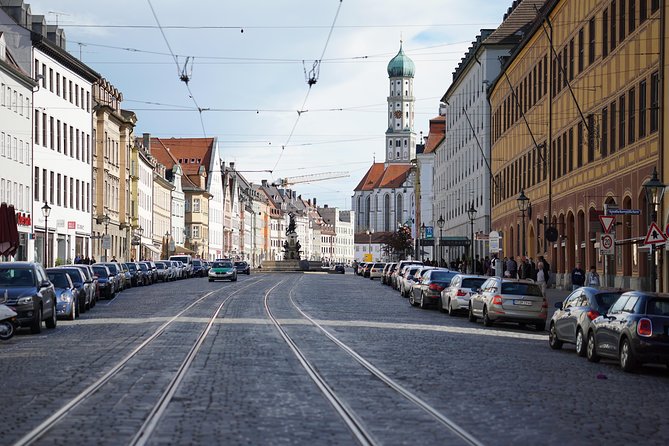
The tour begins at Augsburg Town Hall on Rathausplatz 2, right where the city feels most centered. Meeting at a landmark square matters because you can orient immediately, then follow your guide on foot without playing “find the right corner.”
You’ll also be walking in an area that is near public transportation. That is helpful if you plan to arrive from another German city, or if you want to pair this with a longer day in Augsburg. The experience runs about 3 hours, which is long enough to feel like you learned the city, but short enough that you won’t spend the rest of the evening stuck in a museum-caffeine crash.
The group size is up to 15, but because it is private, it still feels like your walk. Based on past guide styles for this tour (including hosts named Kristen and Stephanie), you can expect a friendly, welcoming approach and a willingness to adapt to what you need.
Rotes Tor and Basilica of St. Ulrich and Afra: Augsburg’s Big Opening Moves
Your first stop is Rotes Tor, the Red Gate tower, renovated in the 20th century. Even if you have never heard of Rotes Tor before, it’s the kind of landmark that gives you instant context. A gate tower like this is basically the city saying, We built walls for a reason, and we still want you to notice.
Next comes the Basilica of SS. Ulrich and Afra, a Catholic parish with gothic architecture. This church traces its origins to the Roman tomb of St. Afra, who was martyred in the year 304. That detail changes how you look at the place, because you are not just admiring medieval building style, you’re touching a timeline that reaches back to Roman-era Augsburg.
Both of these stops are listed as free, so they are perfect early on if you are trying to keep costs down while still getting major orientation benefits. They also set you up for the later blend of church, civic power, and family wealth that defines Augsburg.
Schaezlerpalais: Where Augsburg Shows Off Its Baroque Side
Schaezlerpalais is one of the big “you’re in Augsburg, not just passing through” moments. This baroque palace, from 1765, is an important historical monument and an artistic stop worth planning around.
The interior is not included in the standard price, so you’ll pay an entrance fee of €7 per person. If you’re trying to keep your spending tight, think of that €7 as buying you access to a high-impact interior, not just another street view.
From a practical perspective, this stop is a nice pacing break too. After the early towers and churches, a palace interior gives your eyes something new: ornate details, a different sense of scale, and a feel for how art and power sat together in the 1700s. If your travel style is more “make it real” than “read every plaque,” this is still a good fit, because the space itself does the work.



Hercules’ Fountain and the Town Center Fountains Trick: Look Twice
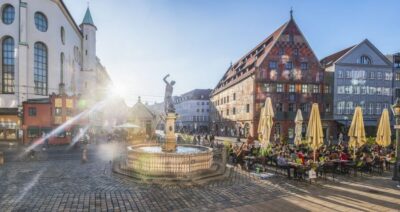
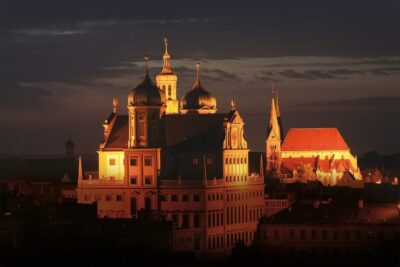
Augsburg has famous fountains, and one of them is Hercules’ Fountain. Built in 1597, it includes a bronze sculpture showing Hercules killing the hydra, the seven-headed monster from Greek mythology. Yes, it’s myth, but it’s also an easy way to understand Renaissance and post-Renaissance taste: classical stories in public art.
You’ll also pass by Augustusbrunnen, cast between 1588 and 1594, located near the town hall square. These fountain dates are more than trivia. They help you see how quickly different styles and ideas moved through the city. Fountains are public statements, so they often reflect the civic mood and who had the means to sponsor art.
This part of the tour is especially good if you like wandering with a purpose. The stops are short and mostly free, and the guide helps you spot what matters. You’re not stuck staring at stones and hoping you understand them.
Goldener Saal in the Town Hall: Civic Glamour With Wartime Scars
The Goldener Saal is the ceremonial room in Augsburg town hall, known for ceiling paintings and golden wall decoration. It was completed in 1643, then destroyed in an air raid in 1944, and reconstructed after the war. That history makes it more than a pretty room, because it carries the weight of loss and rebuilding.
Like Schaezlerpalais, entry is not included. You’ll pay €2.50 per person. That price is low enough that you should strongly consider it, especially if you want to see how Augsburg’s public life looked at its most formal.
One of the best ways to experience a place like this is not to rush. Your guide can help you focus on the ceiling paintings and the golden wall details so you understand the room’s visual design, not just its theme. It’s also a moment where the tour shifts from “outdoor landmarks” into “interpret what you’re looking at.”
If you’re the type who usually skips interiors, this is still a place worth paying for. The Goldener Saal is small enough to manage during a half-day walking schedule, but it has enough impact to make the cost feel sensible.
Perlach Tower: A 10th-Century Watchtower That Still Anchors the City
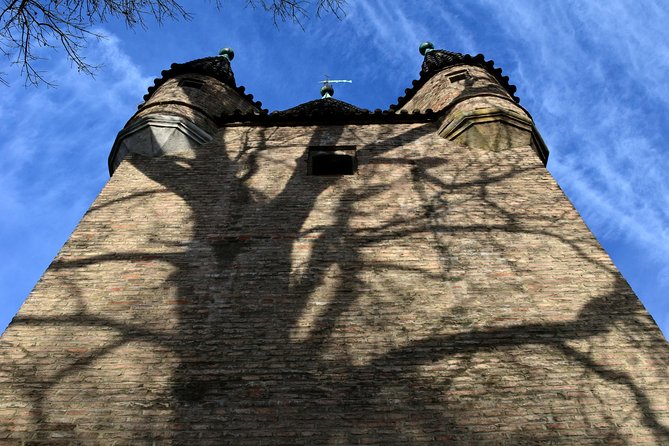
Next you visit the Perlach Tower, also called Perlachturm. It stands about 70 meters tall and sits in central Augsburg. The tower originally began as a watchtower in the 10th century.
This is one of those stops where the guide matters most. You might see a tall tower and think, Okay, that’s old. But with context, you start to understand how watchtowers worked as the city’s early warning system, and why Augsburg would build up that kind of height in the first place.
The tower stop is listed as free, which makes it an easy win if you’re balancing paid interiors with free highlights. It’s short too, so it doesn’t steal time from bigger moments like churches and Fuggerei.
St. Anne’s Church and Augsburg Cathedral: Gothic Interiors With Distinct Personalities
Augsburg is not just about one style. You’ll see that when the tour moves to St. Anne’s Church and then Augsburg Cathedral.
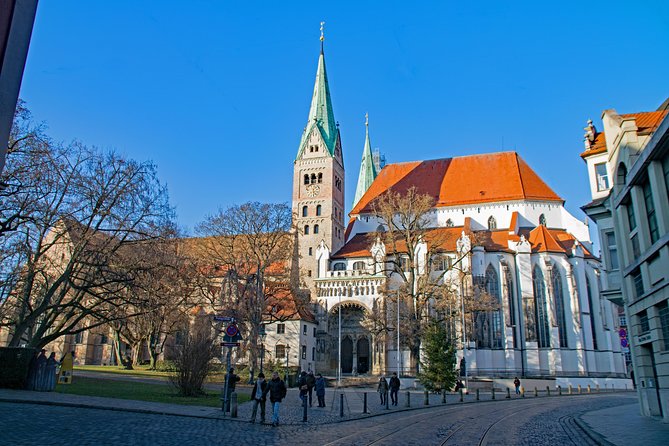
St. Anne’s Church began in 1321 and was originally part of a monastery. It is known for elaborate interior decoration, so it’s a good choice if you like spending time where the details are actually worth hunting for. The church entry is listed as free, so it gives you a lot of visual reward without extra cost.
Augsburg Cathedral follows, a Roman Catholic church founded in the 11th century with Gothic additions in the 14th century. The tower is about 62 meters high. This is a “you feel the scale” kind of stop, and the mix of centuries makes it satisfying even if you are not a serious architecture person.
Practical tip: plan to look up. With gothic churches, the space is designed to pull your eyes upward, and a guide can point out what you’re likely to miss if you are just walking through quickly.
Fuggerei: The World’s Oldest Social Housing Complex Still in Use
The final highlight is Fuggerei, named after the Fugger family and founded in 1516. It is described as the world’s oldest social housing complex still in use. That last part is key, because you are not touring a closed museum village. You are walking through a place that still serves a purpose.
This stop is free, and it ends the tour near the Jakobskirche area. It also gives you an emotional payoff. Early in the tour you saw gates, churches, and civic rooms tied to power and aesthetics. Here you see how wealth was used to create shelter and social structure.
If you remember only one theme from the whole experience, let it be this: Augsburg’s story is not just about art and architecture. It’s also about how people organized community support. Fuggerei makes that idea concrete in a way that a book never does on a single page.
Private Guide Value: What You Get for $417.72 Per Group
The price is $417.72 per group, up to 15 people, for about 3 hours. That may sound steep at first glance, until you think about what you are buying: time saved, guided context, and a private walking route that hits high-value stops efficiently.
If you are traveling as a family or a small group, it can work out quite reasonably because the cost is per group, not per person. Also, the private format means you are not stuck with a fixed pace. You can ask questions without feeling like you’re holding up a large crowd.
Most importantly, this is not a “look at this, next” tour. The guide gets you up to speed on key historical information so you can connect the dots between buildings. That matters a lot in Augsburg, where many landmarks are close together but conceptually different.
Two small budget line items help you avoid surprises: Schaezlerpalais (€7 per person) and the Goldener Saal (€2.50 per person). Everything else on the route is listed as free. So, the tour price covers the guide and the big walk, while you only pay for a couple of interiors that are worth it.
One more practical note: this experience is non-refundable and cannot be changed for any reason. If your dates are even slightly uncertain, plan carefully before you lock it in.
What the 3-Hour Timing Feels Like on Your Feet
Three hours is just about right for this kind of route. You’ll spend short stretches at each major point, with enough time to look and enough time to ask questions. The stops feel balanced between outdoor landmark views and indoor art or architecture.
The tour also gives flexibility based on preferences, which is rare in tightly scheduled group tours. If you care most about church interiors, you’ll probably spend a little longer on those. If you prefer civic Augsburg and artistic spaces, you’ll naturally focus more on the town hall and palace stops.
Because the tour is private, your guide can also tailor the walk to your needs. Past guide experiences with names like Kristen and Stephanie include meeting guests at convenient locations like a train station or hotel, and adjusting around personal pace and priorities.
Who This Augsburg Tour Fits Best
This tour is a strong match if you want a guided loop through Augsburg’s core landmarks without getting lost in research. It works well for history-minded travelers who also want their time to feel efficient.
It’s also great for travelers who like asking questions. The private setting means you can go beyond the basics and get explanations that match what you’re noticing right then, not what you guessed you’d care about at home.
If you are traveling with kids, the short stops and visual highlights like fountains and towers can keep attention. If you are a mobility-limited traveler, the tour notes that most travelers can participate, but you should still consider how much walking you personally handle.
Should You Book This Augsburg – Private Historic Tour?
If you want to understand Augsburg without turning your vacation into a history project, I think this is a smart booking. You get a focused 3-hour route that hits major landmarks, including Fuggerei, plus context that makes the whole city feel coherent.
Book it if:
- You’d rather spend 3 hours with a guide than spend days building your own route.
- You like churches, civic buildings, and public art, not just one type of attraction.
- You’re traveling in a small group where the per-group price makes sense.
Skip it only if:
- You are perfectly happy wandering without explanations.
- You do not want any paid interiors at all, since Schaezlerpalais and the Goldener Saal cost extra.
If your goal is to leave Augsburg feeling like you truly understood it, this private tour is one of the better value ways to do it. You’ll see the sights, but you’ll also understand why those same streets matter.
FAQ
How long is the Augsburg private historic tour?
It lasts about 3 hours.
How much does the tour cost?
The price is $417.72 per group, up to 15 people.
Is this tour private?
Yes. It is private, so only your group participates.
What entrance fees are not included?
Schaezlerpalais costs €7 per person, and the Goldener Saal costs €2.50 per person.
Where does the tour start and end?
It starts at Augsburg Town Hall, Rathausplatz 2, 86150 Augsburg, Germany. It ends at the Fuggerei area near Jakobskirche, 86152 Augsburg, Germany.
Is the meeting point near public transportation?
Yes, it is listed as near public transportation.
When should I book?
On average, it is booked about 13 days in advance.
Can I get a refund if I cancel?
No. This experience is non-refundable and cannot be changed for any reason.
The Longer History of Augsburg
Everything else we filed on Augsburg
- Augsburg: Historical Highlights Private Walking Tour
★ 4.9 · 9 reviews - LETTL Museum of Surreal Art Entry Ticket
★ 5.0 · 9 reviews - Historical Walking Tour of Augsburg
★ 4.9 · 10 reviews - Pubcrawl Augsburg: Tour through best Bars and Clubs in Town
★ 4.4 · 13 reviews - Classic city tour in the World Heritage City of Augsburg
★ 4.0 · 41 reviews - Augsburg: Illuminated Guided Evening Walking Tour
★ 4.6 · 67 reviews
Historical Tours, side by side.
 ★ 4.7Leipzig: City History Canal Sightseeing Tour on a MotorboatFrom $186,232 reviews
 ★ 4.6Berlin: Natural History Museum Entrance TicketFrom $123,382 reviews
 ★ 4.7Leipzig: 1.5-Hour Historical Walking Tour in GermanFrom $172,217 reviews
 ★ 4.5Berlin: World Heritage Cruise to PotsdamFrom $251,435 reviews
 ★ 4.7Heidelberg: Night Watchman Historic Adventure TourFrom $3051,186 reviews
 ★ 5.0The Local Tour of Hamburg Historic CentreFrom $31,058 reviews
 ★ 4.8Elbfloren: Historical city tourFrom $15819 reviews
 ★ 4.6Bamberg: Guided Beer History Tour with Optional TastingFrom $21772 reviews
Other lists this tour is on