
REVIEW · HISTORICAL TOURS
Historical Walking Tour of Augsburg
A 2.5-hour walk can change how you see a city. Augsburg’s old streets connect big Renaissance power, merchant money, and major arts families, all in one clear route with stops you can actually picture. I like that the tour leans on standout sights like the Rathausplatz area and the Renaissance Augsburg Town Hall.
Second, I really enjoy how the walk moves from politics and wealth to creativity, including the Brechthaus and Leopold Mozart Haus. It’s a smart mix of Augsburg’s civic pride and the people who shaped European culture.
One drawback to plan for: the pace is moderate and the route is not suitable for wheelchair users or people with mobility impairments.
In This Review
- Key highlights worth your attention
- Meeting at Rathausplatz with a clear plan
- Rathausplatz and the Augsburg Town Hall, with Elias Holl’s Renaissance
- Perlach Tower: a former watchtower and modern city views
- Fugger Square and the merchant families that drove Augsburg
- Little Venice canals: taking a softer turn through town
- Brechthaus: where Bertolt Brecht began writing
- Leopold Mozart Haus: Mozart’s father, and musical roots in Augsburg
- Augsburg Cathedral (Dom): Romanesque and Gothic, plus 12th-century glass
- Price and logistics: why $20 can feel like a bargain
- How to get the most out of this walk
- Should you book the Historical Walking Tour of Augsburg?
Key highlights worth your attention
- Rathausplatz launch point: Start in the city core, right where Augsburg’s civic story begins.
- Augsburg Town Hall and the Goldener Saal: A Renaissance set-piece designed by Elias Holl.
- Perlach Tower views: A former watchtower that helps you read the city’s layout.
- Fugger family focus: You get the big picture of how merchant power ran Augsburg.
- Brecht and Mozart birthplaces: Two major arts connections, both turned into museums.
Other walking routes through Augsburg
- Augsburg’s Water Management System – City Walking Tour★ 4.5 · 168 reviews
- Augsburg: Illuminated Guided Evening Walking Tour★ 4.6 · 67 reviews
- Historical Walking Tour of Augsburg★ 4.9 · 10 reviews
- Augsburg: Historical Highlights Private Walking Tour★ 4.9 · 9 reviews
Meeting at Rathausplatz with a clear plan
Your tour starts at Rathausplatz in Augsburg, meeting at 11:00 am. Look for the yellow umbrella, then you are set up for an easy flow through the historic center. The nice part is that the route stays practical: you’re walking between major landmarks without needing transit, and the tour ends back at the same meeting spot.
This format matters more than it sounds. Augsburg’s highlights are spread out just enough that a self-guided walk can feel scattered if you do not have a sequence. Here, you get a logical order that helps you connect what you see, why it happened, and how it relates to the next stop.
Also, the tour runs with live English guidance, so questions make sense as you go. If you like your city history straight, with a bit of personality, this is the kind of tour that tends to work well.
Rathausplatz and the Augsburg Town Hall, with Elias Holl’s Renaissance
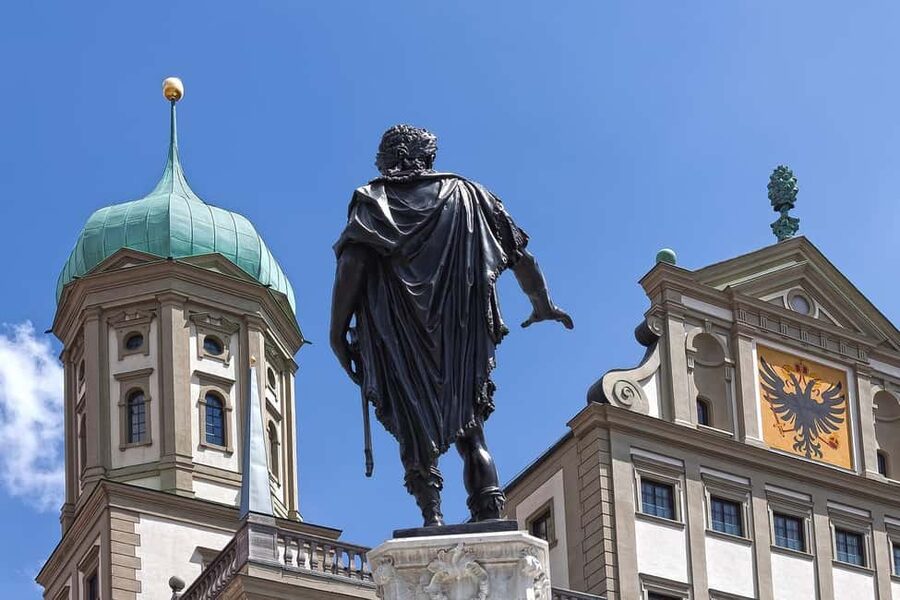
The heart of the start is the Augsburg Town Hall, a Renaissance masterpiece designed by Elias Holl. This is not just a pretty building to pass by. It’s the kind of landmark that tells you how Augsburg wanted to present itself, powerful but polished.
You’ll be looking at the Town Hall’s famous interior feature, the Goldener Saal. Even if you only catch it from outside, the point is clear: Augsburg’s leadership put serious effort into civic prestige. In a city where merchant families shaped much of the outcome, this is the public face of that influence.
Why I think this stop is a value moment for you: a guided explanation can turn architecture into a story you remember. Instead of memorizing facts, you start noticing patterns, like how civic spaces were designed to project authority.
Practical tip: take a few seconds to orient yourself before you move on. Look back at the Town Hall area so later, when you hit viewpoints like Perlach Tower, you can connect the dots faster.
Perlach Tower: a former watchtower and modern city views
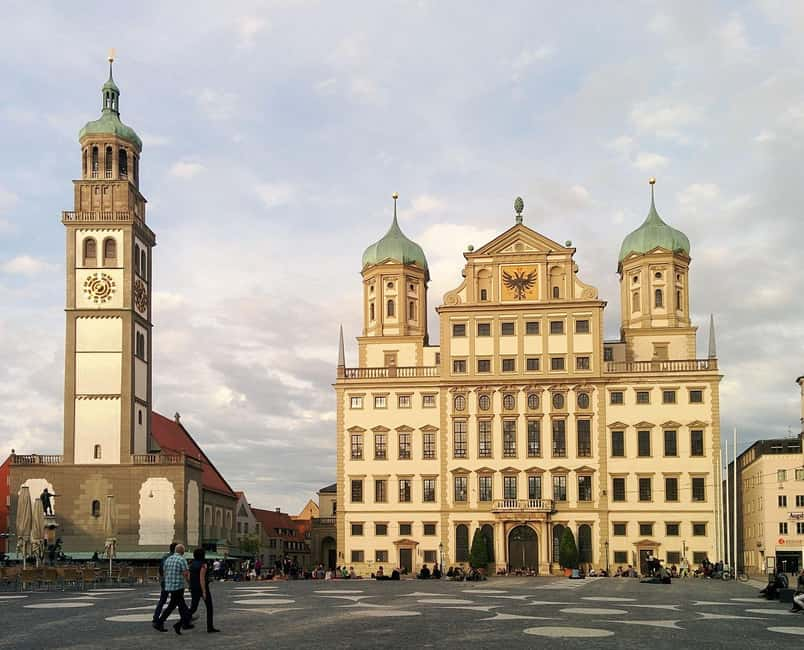
From Rathausplatz, you head toward Perlach Tower, a former watchtower. The key idea here is that towers were tools for survival, not just decorations. From higher ground, watch systems and city control made sense.
For you as a walker, Perlach Tower is also a mental reset. After absorbing the Town Hall’s civic statement, you get a perspective that helps you understand where the old town sits and how the streets likely connected. It’s the kind of stop that makes photos more useful, because you can later recognize what you were seeing.
One consideration: this is a walking tour with a moderate amount of pace. If you prefer to sit often or you need frequent breaks, plan for that up front by bringing water and wearing shoes that can handle cobblestones or uneven ground.
Fugger Square and the merchant families that drove Augsburg
Next up is Fugger Square, where the tour zeroes in on the Fuggers, described as Europe’s most powerful merchant families. This is where Augsburg’s story becomes less about monuments and more about money, trade, and influence.
The Fuggers are not just a name to memorize. Your guide’s job is to show you how merchant power can shape an entire city, from big civic buildings to the social ideas tied to wealth. If you want the reason Augsburg feels different from other German cities, this stop is one of the biggest clues.
Why this matters for your trip: when you understand the merchant families behind the scenes, the rest of the landmarks start clicking into place. The town hall becomes more than a building. The art museums and cathedral details feel less random, more like parts of a bigger system.
A small piece of advice: listen closely here, because later stops about Brecht and Mozart land better when you understand who had resources, who supported culture, and how cities in that era attracted talent.
More history walks in Augsburg
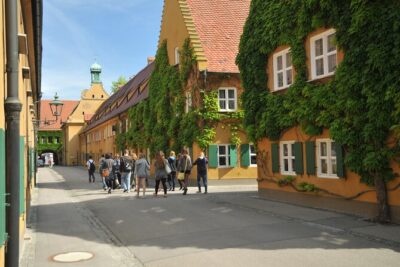
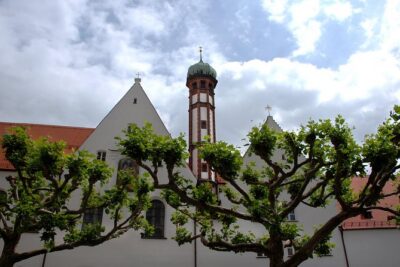
Little Venice canals: taking a softer turn through town
After the power-and-wealth section, the route heads to little Venice, a picturesque district with canals that echo the mood of Venice. This is the tour’s change of pace, and it’s more than a photo stop.
For me, the best part of little Venice is the contrast. You move from formal civic power into a quieter, more human street scene. You can slow down, watch water and bridges, and feel how old towns often carried everyday life right next to the grand buildings.
If you tend to rush through cities, this section helps you pace yourself. It also gives your eyes a break after longer architecture-focused viewing.
Brechthaus: where Bertolt Brecht began writing
Then you reach the Brechthaus, the birthplace of playwright Bertolt Brecht, now operating as a museum dedicated to his life and works. This stop changes the story again, from civic and financial influence to art and ideas.
If you know Brecht’s work, this is a satisfying connection point. If you do not, the museum setup usually still gives you a clear sense of why his voice mattered, and how place can shape a creator.
I like that the tour does not treat this as a detour. It feels like Augsburg presenting a different kind of power: cultural impact. You get to walk from the Fuggers’ world into the world of theater and writing, all while staying inside the same compact old-town area.
Leopold Mozart Haus: Mozart’s father, and musical roots in Augsburg
From Brechthaus, your next stop is the Leopold Mozart Haus, the birthplace of Leopold Mozart, father of Wolfgang Amadeus Mozart. This building is now a museum centered on the Mozart family’s musical history.
This is one of those stops that rewards curiosity. Even if you are not a deep classical-music fan, it helps you understand that musical talent and musical training were not created out of nowhere. You see how a family environment and early life connections can shape what later becomes famous.
For you, it also provides a smooth thematic match to the Brecht stop. Both are about influential figures tied to Augsburg, but one speaks through theater and the other through music. That rhythm makes the route feel coherent.
Augsburg Cathedral (Dom): Romanesque and Gothic, plus 12th-century glass
The tour finishes with the majestic Augsburg Cathedral, called the Dom. Outside and in, you’ll see Romanesque and Gothic elements, which is a big clue that Augsburg’s religious architecture developed over time rather than in a single moment.
Inside, the included visit is built around details that make the cathedral worth your attention:
- 12th-century stained glass windows
- A detailed bronze door
Those are the kinds of features you can miss when you walk in on your own. Guided access helps because someone points out what to look for, and why it matters.
Why you should care: stained glass and bronze doors are not just decoration. They are visible craftsmanship and messaging from a long time ago. When you see them with context, you get a stronger sense of the cathedral as part of Augsburg’s identity, not just a stop to check off.
Practical note: the tour includes access to the cathedral, so you are not scrambling to figure out timing on your own.
Price and logistics: why $20 can feel like a bargain
The tour costs $20 per person and lasts 2.5 hours. That price gets you a live English guide, guided walking between key landmarks, and access to the Augsburg Cathedral.
That’s the value equation I’d use when you decide:
- If you want an efficient overview of Augsburg’s center in one shot, 2.5 hours is a good length.
- If you care about explanation, not just photos, the guided format matters.
- If you also want cathedral access handled for you, that’s part of the value.
What can lower the value for you: if you already know Augsburg deeply and you enjoy building your own route, you might find you can replicate parts of this with a map. But if you want context without spending time researching every building, the guided approach is the point.
The tour is designed for people who can handle moderate walking and want to see multiple landmarks without long breaks. Also, it is not suitable for wheelchair users, so plan alternatives if accessibility is a priority.
How to get the most out of this walk
A few small choices will make your experience smoother.
Wear comfortable shoes. This is a walking tour, and old town surfaces can be uneven.
Bring water and weather-appropriate clothing, since the route runs when it is not raining or snowing.
Use your camera, photography is allowed.
Arrive a few minutes early so the start at Rathausplatz feels stress-free, especially since the meeting point is marked by a yellow umbrella.
If you like interaction, keep an eye out for how the guide handles questions. On English tours led by guides such as Michael, including a version of the name Mike, the style you can expect is friendly, funny, and adaptive. That kind of guide tends to make the facts stick, and it also helps when your group has different interests.
Should you book the Historical Walking Tour of Augsburg?
Yes, if you want a focused old-town introduction that connects Augsburg’s civic power, its merchant roots, and its major cultural figures in one tidy route. The mix is smart: Town Hall and tower views for structure, Fugger Square for the political economy, then Brechthaus and Leopold Mozart Haus for the human stories, and finally the cathedral for a strong finish.
I would skip it (or look for another option) if you need wheelchair-friendly access or you know you cannot manage moderate walking. Also, if you strongly prefer long, slow museum time over street walking, you may want to pair this with separate, self-paced stops afterward.
If you like practical guidance, clear landmark order, and a city tour that does not waste your time, this one is an easy yes.
The Longer History of Augsburg
Pavements of Augsburg
Everything else we filed on Augsburg
- Augsburg: Historical Highlights Private Walking Tour
★ 4.9 · 9 reviews - LETTL Museum of Surreal Art Entry Ticket
★ 5.0 · 9 reviews - Historical Walking Tour of Augsburg
★ 4.9 · 10 reviews - Pubcrawl Augsburg: Tour through best Bars and Clubs in Town
★ 4.4 · 13 reviews - Classic city tour in the World Heritage City of Augsburg
★ 4.0 · 41 reviews - Augsburg: Illuminated Guided Evening Walking Tour
★ 4.6 · 67 reviews
Historical Tours, side by side.
 ★ 4.7Leipzig: City History Canal Sightseeing Tour on a MotorboatFrom $186,232 reviews
 ★ 4.6Berlin: Natural History Museum Entrance TicketFrom $123,382 reviews
 ★ 4.7Leipzig: 1.5-Hour Historical Walking Tour in GermanFrom $172,217 reviews
 ★ 4.5Berlin: World Heritage Cruise to PotsdamFrom $251,435 reviews
 ★ 4.7Heidelberg: Night Watchman Historic Adventure TourFrom $3051,186 reviews
 ★ 5.0The Local Tour of Hamburg Historic CentreFrom $31,058 reviews
 ★ 4.8Elbfloren: Historical city tourFrom $15819 reviews
 ★ 4.6Bamberg: Guided Beer History Tour with Optional TastingFrom $21772 reviews
Other lists this tour is on