
REVIEW · TRIER
e-Scavenger hunt Koblenz: Explore the city at your own pace
Koblenz feels made for wandering. This e-Scavenger hunt gives you a self-paced walking game, with small challenges that nudge you to real landmarks instead of random photo stops. I especially like the pause option so you can slow down for views and details. One thing to keep in mind: if your phone navigation is temperamental, you may need to use street signs and your own sense of direction.
You’ll spend about 2 to 4 hours moving through the old center, starting and ending at Münzpl. 15. It’s a mobile ticket app experience in English, and it’s set up for groups up to 6, so the cost stays reasonable if you’re traveling with friends or family.
In This Review
- Key takeaways
- How the app-led game turns Koblenz into an easy walking loop
- Price and time value for groups up to 6
- Where you start at Münzpl. 15, and why Münzplatz sets the mood
- Stop 1: Basilica of St. Kastor, built for the river-town rhythm
- Deutsches Eck: the most important river meeting point you can actually walk to
- The fountain column: a 2,000-year story told in stone and water
- Electoral Palace and the Prussian government building, power made visible
- A bronze boy and Josef Cornelius: small detail, memorable stop
- The 1609 level house: from Rhine crane to gauge house station
- Vier Türme and the silhouette effect of Church of Our Lady
- Münzplatz and the old-town squares where terraces actually make sense
- Town hall in the former Jesuit college: religion repurposed
- St. Florin’s Church, Romanesque charm, and the Moselle stone bridge finish
- Practical tips to keep the phone game from becoming a phone headache
- Who this Koblenz scavenger hunt is best for
- Should you book the e-Scavenger hunt Koblenz?
- FAQ
- How long does the e-Scavenger hunt in Koblenz take?
- Where do I start the hunt, and where does it end?
- What language is the experience offered in?
- Do I need a smartphone or data?
- Is this a private activity?
- Can I get a refund if I cancel?
Key takeaways

- Self-paced city game that guides you without locking you to a schedule
- Pause mode helps you linger when the view, fountain, or facade catches your eye
- Landmarks packed in one walk, from Deutsches Eck to churches, palaces, and squares
- Family-friendly challenge level, with an easy-to-follow format for most people
- Navigation can be hit-or-miss, so bring a charged phone and consider having a backup map
More Roman stone and river corners
- Koblenz: Rhine Valley Castles and Palaces Boat Tour★ 4.4 · 1,824 reviews
- Koblenz: 2-Hour Sightseeing Cruise on the Rhine★ 4.6 · 839 reviews
- Koblenz: Old Town Sightseeing Cruise along the Rhine★ 4.5 · 305 reviews
- Koblenz: Panoramic Cruise on Moselle River to Winningen★ 4.4 · 283 reviews
How the app-led game turns Koblenz into an easy walking loop
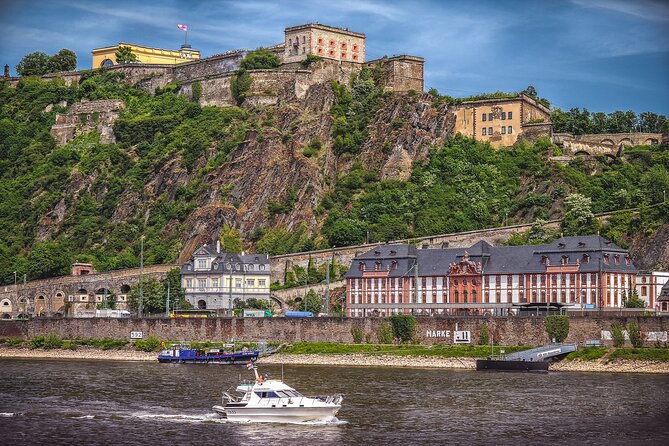
This is not a sit-there-and-listen tour. You’ll move through Koblenz at your own pace while the app delivers prompts, questions, and little “find this, check that” tasks. The goal is simple: keep you walking smart, and make each stop feel purposeful.
What makes this style of touring work well in a compact city is that you are not constantly asking, Where do we go next? The app basically hands you the next waypoint, then lets you choose how long to linger. And if you want to slow down, pause, and actually look, that flexibility matters. In a place like Koblenz, where rivers and historic facades do a lot of the talking, the ability to control your own tempo is a big deal.
Price and time value for groups up to 6
The price is $37.33 per group for up to 6 people, and the walk takes about 2 to 4 hours. For a city stroll that covers a bunch of named sights, that group pricing can be a strong deal, especially if you split the cost.
Two extra value points to factor in. First, you get the structure of a route without paying for a full guided tour. Second, you’re not rushing through highlights, because the game is designed around your movement pace rather than a strict group pace.
The only cost that can surprise people is the tech side. The tour does not include smartphone use or data, so plan to rely on your own phone and connectivity plan.
Where you start at Münzpl. 15, and why Münzplatz sets the mood
You begin at Münzpl. 15, 56068 Koblenz. The route is built around the old center, and it helps to start near the Münzplatz area, a square whose name reflects the former electoral coin. That clue matters because it hints at what you’re walking through: power, money, and church influence all layered onto the same streets.
The experience also ends back at the starting point. That makes it easier to plan other parts of your day. You can pair it with a meal nearby, or keep your schedule simple without a complicated meetup point.
Stop 1: Basilica of St. Kastor, built for the river-town rhythm
The first big sight in the flow is the Basilica of St. Kastor, a Roman Catholic church in Koblenz’s old town. It was built around 817 to 836, which makes it one of those places where the scale is less about height and more about age and continuity.
Why it’s a smart early stop in the hunt: it gives you a “time anchor” at the start. You’re immediately reminded that Koblenz is not just a pretty waterfront. It’s a town with deep roots, and St. Kastor sits right in the historic geography of the rivers.
If you’re doing this with kids, churches can be a tough sell. Here, the game format helps, because you’re not just staring at stone. You’re solving and looking for specific details tied to the location.

Deutsches Eck: the most important river meeting point you can actually walk to
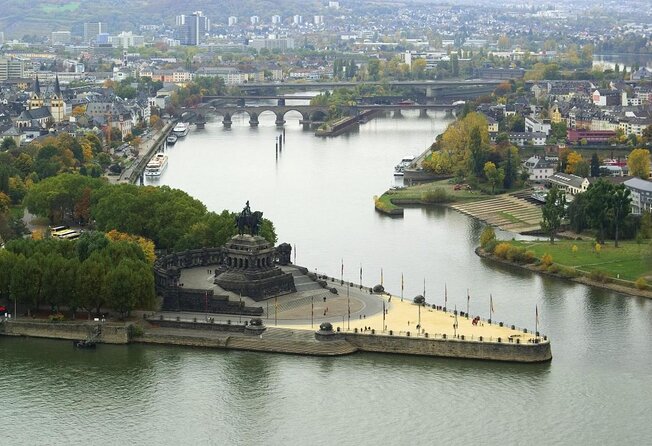
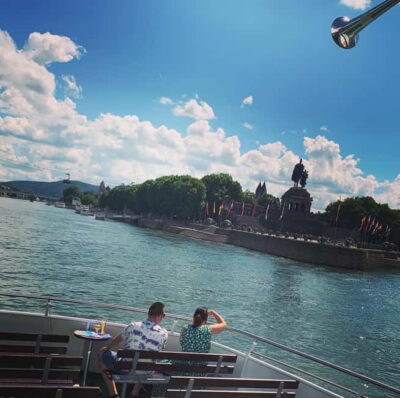
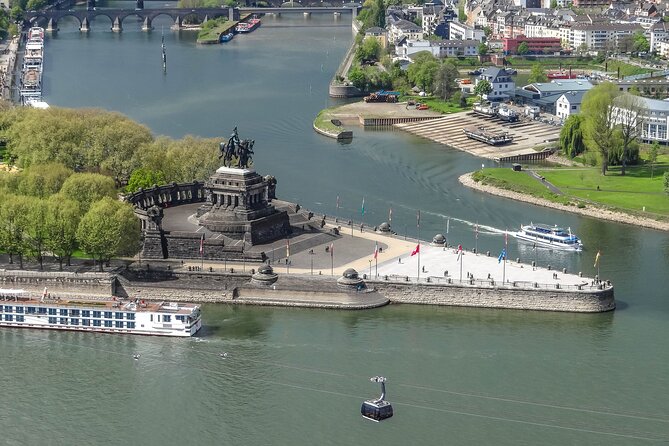
From St. Kastor, the route moves to Deutsches Eck, the headland that marks where the Moselle meets the Rhine. This is also the home of a national monument to German unity, so even if you’re not into monuments, the site has a strong sense of place.
What I like about this stop in a self-guided format is the view control. You can step back, look across the water, then move to another angle when you feel like it. The app’s task structure gets you to the right spot, and then you get to do the slow part yourself.
One practical note: this is a famous place, so plan for crowds at peak times, especially with tourist boats around.
The fountain column: a 2,000-year story told in stone and water
Next up is a fountain with a large column that tells the past of 2000 years of Koblenz. It’s one of those “looks simple, means a lot” landmarks. You’ll see it because the game leads you there, and it’s also a natural break point to catch your bearings.
Yes, lots of tourists come here, including passengers from big tour boats. That means it can feel busy, but it also means you’ll have easy surroundings for reading, photos, and resetting your phone screen before the next set of clues.
Electoral Palace and the Prussian government building, power made visible
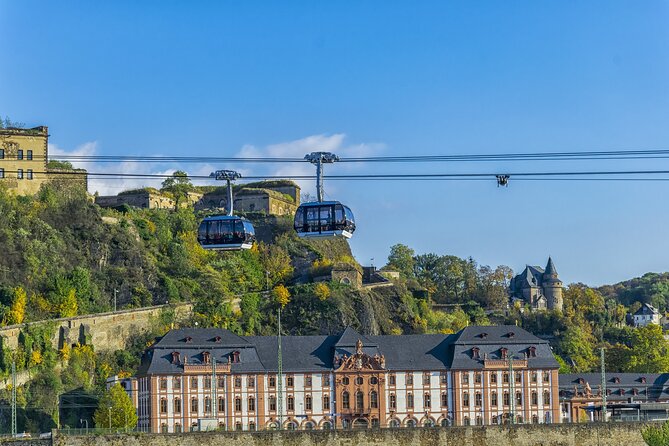
The route also includes the Electoral Palace in Koblenz, known as the residence of the last Archbishop and Elector of Trier. Nearby, you’ll also pass the Prussian government building in the Rhine Park, which served as the seat of the Prussian government for the Koblenz administrative district of the Rhine Province.
These stops do something useful for your walk. They turn the city from “nice facades” into a place with real governance layers. Even if the app content stays fairly high level, the buildings themselves give you the visual context. You start to notice symmetry, formality, and how authority wanted to look in public space.
If you want deeper political storytelling, you might still do a little extra reading after your game. But as a way to get oriented, this mix of religious and governmental architecture works well.
A bronze boy and Josef Cornelius: small detail, memorable stop
Then there’s a more playful waypoint: a fountain with a bronze statue of a boy, made by Carl Burger, and dedicated to poet Josef Cornelius.
This kind of stop is why I like scavenger games. Big monuments can blur together. A small, specific artwork like this sticks in your mind. It also gives you an easy “photo and move on” rhythm when your feet start asking questions.
The 1609 level house: from Rhine crane to gauge house station
One of the more interesting practical history stops is the level house, built around 1609. It originally served as a Rhine crane. Then, in 1839, it became a gauge house station.
The details keep coming. The crane on the roof was removed around 1900, and the building was expanded by adding another floor for the 2011 Federal Horticultural Show.
This is the kind of stop that helps you understand Koblenz as a working river city. It’s not only about churches and statues. It’s about measurement, transport, and adapting buildings to new needs over time. Even if you’re not reading every word on the app screen, you’ll recognize the story because the function changed across centuries.
Vier Türme and the silhouette effect of Church of Our Lady
The route includes Vier Türme, an ensemble of four historic buildings at the crossing of Am Plan, Löhrstraße, and Altengraben. This is a strong old-town visual marker. When you reach it, you feel like you’re in a designed streetscape rather than a random sidewalk stretch.
From there, you’ll walk toward the Church of Our Lady, a Roman Catholic church at the highest point of the city. The app’s prompts connect it to the overall skyline, since it defines the silhouette of the old city center alongside St. Kastor and St. Florinus.
This kind of stop is great in a game format because it encourages you to look outward and not just down at street level. You can keep walking, but you’ll also pause to take in the overall shape.
Münzplatz and the old-town squares where terraces actually make sense
Back in the square area, you’ll hit Münzplatz again as a landmark within the old town. The name ties to the former electoral coin, which is a neat detail when you’re standing in a city-center square.
You’ll also pass a photogenic square with a cozy atmosphere, attractive facades, and terraces. That’s an ideal place to take a break without losing your route logic. In my view, these squares are where self-guided tours score. A traditional tour might rush through them. Here, you can pause, grab a drink, and rejoin the game when you’re ready.
Town hall in the former Jesuit college: religion repurposed
The tour brings you to the city hall of Koblenz, which is now located in a former Jesuit college. That’s a practical and symbolic change in one spot. You see how institutions shift over time, and you also get a building that likely has a strong street presence.
Even if you only skim the app explanation, the fact that the building’s role has changed helps you read Koblenz like a living city instead of a museum.
St. Florin’s Church, Romanesque charm, and the Moselle stone bridge finish
Staying in the center, the route includes St. Florin’s Church, an evangelical church in Koblenz’s center. It was built around the year 1100 and belonged to the Florinusstift.
The church is also described as one of the most important Romanesque church buildings in Germany, and it has been on the World Heritage List since 2002. That means your stop is not just local. It’s tied to a larger preservation story.
From there, the hunt moves toward the Old Castle area. This was a substantial moated castle owned by the Elector, founded in the 13th century. Today, it has been reduced to the later Burghaus, where the city archive is located.
Finally, you reach a 14th-century stone bridge over the Moselle, described as the oldest surviving bridge in Koblenz. It connects the old town with the Lützel district. This is a great way to end your walk because bridges naturally give you movement, photos, and a sense of finishing the loop.
Practical tips to keep the phone game from becoming a phone headache
I’ll say it plainly. Self-guided app tours work best when you treat your phone like a tool, not a miracle. Bring a fully charged device. Keep your screen brightness reasonable so you can read prompts on the move.
A few other tips based on common friction points in game-style navigation:
- If you run into a question that feels odd or too specific, don’t spiral. Focus on locating the landmark or object the prompt is tied to, then keep moving.
- If GPS on your phone is weak, street signs become your best friend. Take a moment to confirm which street you are on before you panic.
- Give yourself a small buffer. Starting the game should not be a race. Plan for a few minutes to get set up so you don’t start stressed.
If you need help, there’s a helpdesk chat available around the clock, so you’re not stuck alone if something doesn’t load right.
Also worth knowing: the experience is offered in English, and it is described as user-friendly for the hearing impaired. Service animals are allowed, and it’s near public transportation, which is handy if you want to jump back into the city at any point.
Who this Koblenz scavenger hunt is best for
This fits well if you want a structured walk but not a strict group tour. I also like it for mixed groups, because it can work for friends, families, and groups of different ages.
The challenge level is set up to be accessible. If you’re traveling with kids, you’ll likely find the tasks manageable without needing to explain everything for an hour straight. And if you’re traveling with friends, the game format gives you something light to talk about as you walk.
If you’re the type who wants a deep lecture on architecture, politics, and church art, you might feel the app info is more “starter facts” than a full education. In that case, treat it as a route plus a prompt to look, then do extra reading after.
Should you book the e-Scavenger hunt Koblenz?
I’d book it if you want an easy, self-paced way to cover a lot of Koblenz landmarks in one outing, and you like learning through tasks rather than a live script. The group price is a big plus, and the route hits both “river-view must-sees” and less obvious details like fountains, functional history buildings, and ensemble architecture.
I’d hesitate only if you know you hate app-based navigation or you’re arriving with a low-battery phone and no backup plan. If you’re the type who depends on perfect GPS, bring offline support from your side.
If plans change, you can cancel for a full refund up to 24 hours in advance, so it’s a low-risk trial for a flexible half-day.
FAQ
How long does the e-Scavenger hunt in Koblenz take?
The experience lasts about 2 to 4 hours.
Where do I start the hunt, and where does it end?
You start at Münzpl. 15, 56068 Koblenz, Germany, and the activity ends back at the same meeting point.
What language is the experience offered in?
The mobile ticket game is offered in English.
Do I need a smartphone or data?
Use of a smartphone and data are not included, so you’ll need your own phone and a way to use the app.
Is this a private activity?
Yes, it is a private tour or activity, and only your group will participate.
Can I get a refund if I cancel?
You can cancel up to 24 hours in advance for a full refund. If you cancel less than 24 hours before the start time, the amount paid will not be refunded.
Seeing Koblenz in One Go
Trier, Koblenz and the Saarland
Everything else we filed on Koblenz
- Koblenz: The Living Vineyard, Nature & Wine Enjoyment
★ 5.0 · 14 reviews - Koblenz – Old Town including the Deutsches Eck
★ 4.5 · 16 reviews - e-Scavenger hunt Koblenz: Explore the city at your own pace
★ 4.0 · 20 reviews - Discovery tour – cellar tour with wine tasting
★ 4.2 · 26 reviews - Winetasting / Weinprobe Koblenz
★ 4.3 · 31 reviews - Koblenz: Christmas Boat Tour with Mulled Wine
★ 4.3 · 35 reviews
Trier Koblenz and the Saarland, side by side.
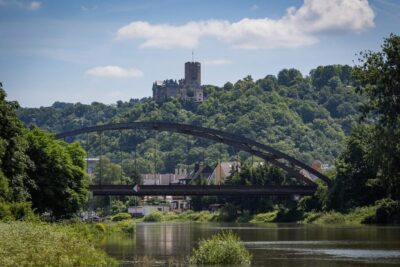 ★ 4.4Koblenz: Rhine Valley Castles and Palaces Boat TourFrom $211,824 reviews
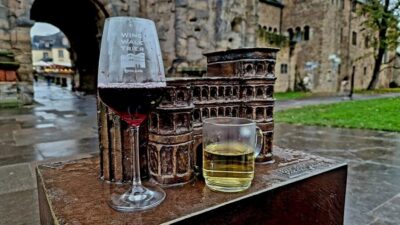 ★ 4.8Trier: Guided City Walk with Wine TastingFrom $43979 reviews
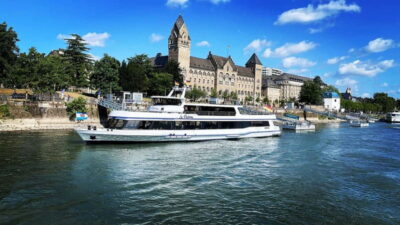 ★ 4.6Koblenz: 2-Hour Sightseeing Cruise on the RhineFrom $20839 reviews
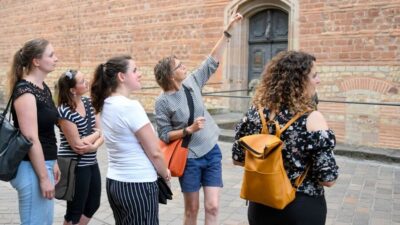 ★ 4.7Trier: Guided Old Town Highlights and History Walking TourFrom $16687 reviews
 ★ 4.5Koblenz: Old Town Sightseeing Cruise along the RhineFrom $16305 reviews
 ★ 4.4Koblenz: Panoramic Cruise on Moselle River to WinningenFrom $22283 reviews
 ★ 4.7Trier: Discovery Tour – Germany’s Oldest Wine CellarFrom $20218 reviews
 ★ 4.6Trier: City Walking TourFrom $17118 reviews
Other lists this tour is on