
REVIEW · TRIER
Koblenz – Old Town including the Deutsches Eck
Koblenz is small enough to fall in love fast. This private Old Town tour is a smart first stop because it strings together the city’s key landmarks with clear, story-driven context, from Roman origins to the Deutsches Eck headland. I like that it’s designed for quick orientation, and you get a plan that actually makes the history feel usable.
I especially like how the stops connect. You move from Münzplatz to the Liebfrauenkirche onion domes, then into St. Castor’s Carolingian world, and finish at Deutsches Eck where the river setting turns into real perspective. I also like the plain-language guide approach I’ve heard described as lively and easy to follow.
One possible drawback: it’s a tight 2-hour walk with about five short stops, so if you want lots of inside time in churches or a slow pace, you may feel a little rushed.
In This Review
- Key Things to Know Before You Go
- Why Münzplatz Sets the Tone for Old Town Koblenz
- Quick tip for your arrival
- Liebfrauenkirche and the Two-Church Street Mood
- What to watch for
- Basilica of St. Castor: Carolingian Origins You Can Feel
- Small consideration
- Schangelbrunnen at City Hall, and the Meaning Behind the Name
- How to use this stop during your visit
- Deutsches Eck: Ending at the German Corner for the River View
- Practical note
- Price and Value for a Private 2-Hour Old Town Introduction
- What You’ll Actually Learn From Each Stop (And Why It Matters)
- Who This Tour Is Best For (And Who Might Want Something Different)
- Should You Book This Koblenz Old Town and Deutsches Eck Tour?
- FAQ
- How long is the Koblenz Old Town tour including Deutsches Eck?
- What is the price for this private tour?
- Is the tour offered in English?
- Where does the tour start and end?
- Are there admission fees for the stops?
- Is this a private tour?
- Do I need a paper ticket?
- Where is the meeting point located?
- Can I cancel for a refund?
Key Things to Know Before You Go
- Roman beginnings at Münzplatz: “Castellum apud confluentes” ties directly to the city’s name and location at the rivers’ meeting point.
- Liebfrauenkirche’s onion domes and scars of war: built in the 17th century, destroyed in 1944, rebuilt in 1955.
- St. Castor as the oldest anchor: a Carolingian proprietary church tied to Archbishop of Trier and Emperor Louis the Pious (817 to 836).
- Schangelbrunnen’s city identity: the Schängel nickname connects to Koblenz’s 1794 to 1813 allegiance to France.
- Deutsches Eck finishes with big views: a headland memorial area that helps you see why Koblenz matters.
- Private, English, and timed: multiple daily start times and a group up to 15, with a mobile ticket.
More Roman stone and river corners
- Koblenz: Rhine Valley Castles and Palaces Boat Tour★ 4.4 · 1,824 reviews
- Koblenz: 2-Hour Sightseeing Cruise on the Rhine★ 4.6 · 839 reviews
- Koblenz: Old Town Sightseeing Cruise along the Rhine★ 4.5 · 305 reviews
- Koblenz: Panoramic Cruise on Moselle River to Winningen★ 4.4 · 283 reviews
Why Münzplatz Sets the Tone for Old Town Koblenz
Your tour begins at Münzplatz, a square in the Old Town that feels like a history kickoff button. The name comes from the electoral coin called Münz, minted back in the 11th century. That matters because Koblenz has always been about more than pretty streets, it was a place where power, trade, and control met.
Next, you’ll look at the fountain that was added in 1992 for the city’s 2000-year anniversary. It was built by Willi Heinzen and given to Koblenz and its citizens by Sparkasse Koblenz. Even if you never care about coin dates, this is the kind of local detail that makes the city feel specific instead of generic.
This stop also ties to a bigger idea you’ll carry through the rest of the walk: the Romans founded their Castellum apud confluentes here, meaning fort at the confluence. Koblenz’s whole layout makes sense once you understand the rivers are the reason the place exists in the first place.
Quick tip for your arrival
Give yourself a few minutes to orient at Münzplatz before the tour starts. You’ll appreciate how the rest of the Old Town route aligns with the river geography.
Liebfrauenkirche and the Two-Church Street Mood
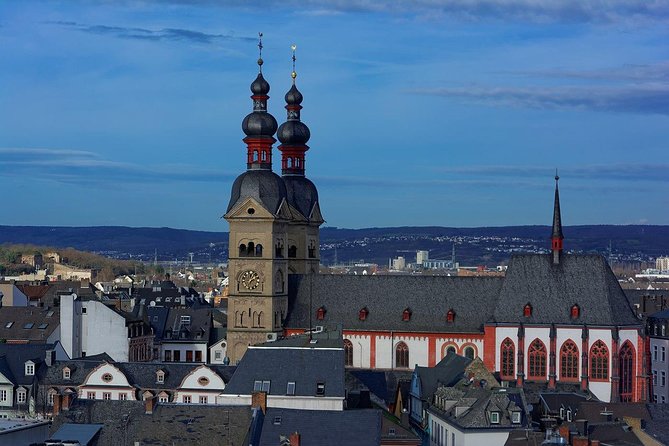
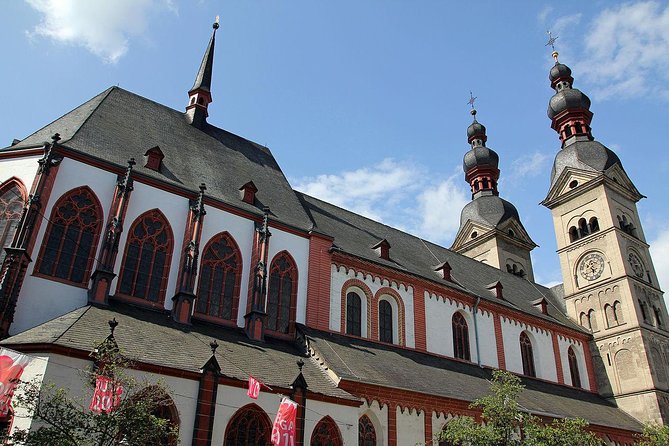
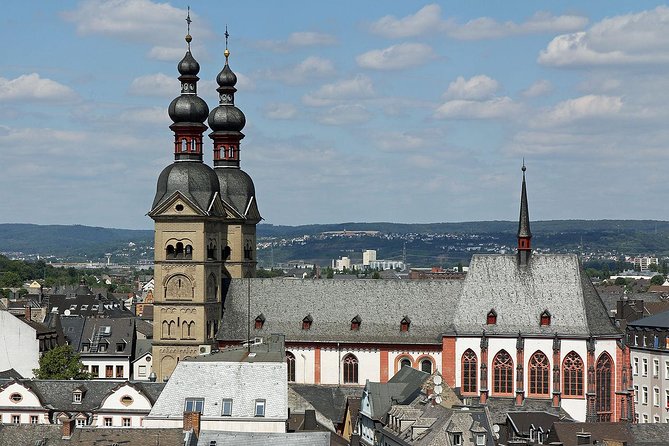
From Münzplatz, you head to Liebfrauenkirche, known for its onion domes and its prominent position on the highest point of the city. That elevated spot isn’t just a nice photo angle, it historically made the church a visual anchor.
This is also a church with layered chapters. It was constructed in the 17th century, then during the French Revolution it served as one of the main parish churches. That’s a reminder that religious buildings often became civic stages when politics shifted. Then came the heavy part: it was destroyed in 1944 and rebuilt in 1955.
If you like architecture but hate guessing what you’re looking at, this stop is efficient. You get enough background to notice the domes, the skyline placement, and the way war and rebuilding shaped what you see today. The tour time here is short, so you’re getting the big story beats without getting stuck in a lecture.
What to watch for
Stand where you can take in the dome shapes and the church silhouette against the surrounding streets. The way the tour frames this stop helps you see it as part of Koblenz’s visual system, not just an isolated monument.

Basilica of St. Castor: Carolingian Origins You Can Feel
Next is the Basilica of St. Castor, and this is a highlight if you enjoy older roots. It’s the oldest church in Koblenz, and it dates back to a period when the Carolingians were shaping much of Western Europe.
The church was constructed by the Archbishop of Trier between 817 and 836, with support from Emperor Louis the Pious. The tour’s framing matters here. Instead of treating the basilica like a random antique building, it places it as a Carolingian proprietary church, meaning it was tied to elite structures and political-religious power.
You’re not likely to spend long inside on this kind of route, but you’ll come away with a stronger sense of why this spot earned the title oldest. Old buildings often survive for a reason: the location, the community importance, and the fact that later generations kept choosing to build around them.
Small consideration
Since the stop is brief, bring your interest. If you want a deep indoor church study session, plan to return later on your own after the tour.
Schangelbrunnen at City Hall, and the Meaning Behind the Name
At Schangelbrunnen, you’ll get one of those moments where a city nickname turns into a real physical landmark. The tour explains that “Schängel” comes from Koblenz’s 20-year allegiance to France from 1794 to 1813. That’s the kind of detail you don’t guess by looking at a fountain, and it’s exactly why these guided stops work.
The fountain sits near the city hall area and is regarded as a symbol of Koblenz. In 1940, it was designed by Carl Burger and dedicated to the famous poet Josef Cornelius. That gives you two angles to appreciate it: local identity through the Schängel name, and cultural memory through the poet dedication.
This stop also helps you understand something practical about city centers. People gather where symbols are. Even if you don’t sit down here for long, you’ll understand why this particular square belongs to daily life as much as tourism.
How to use this stop during your visit
Take a quick moment to look around before you move on. You’ll start noticing where municipal buildings, churches, and public art cluster. That makes the rest of your self-guided exploring far easier.
Deutsches Eck: Ending at the German Corner for the River View
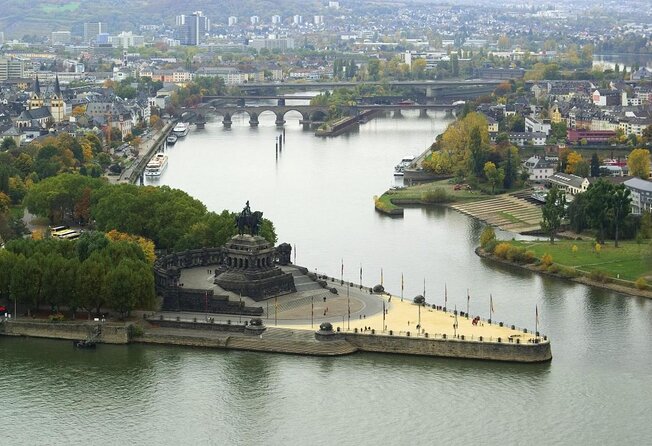
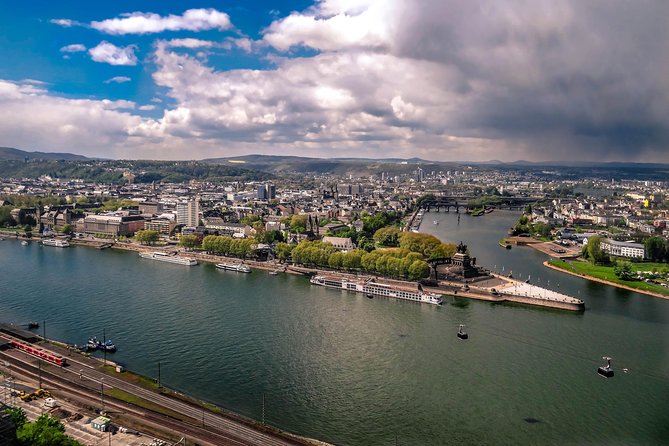
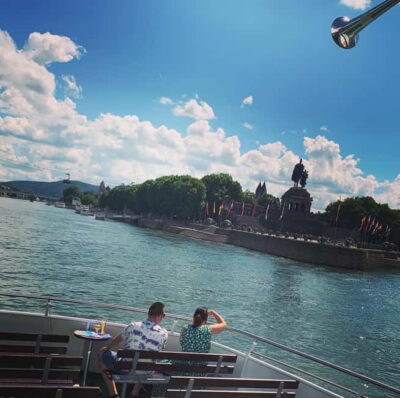
The finale is Deutsches Eck, the Kaiser Wilhelm memorial area on the headland. The tour calls Deutsches Eck the name for the landform in Koblenz, and that geography is key. This is where the rivers’ meeting point feels real, and Koblenz stops being a set of buildings and starts being a strategic location.
Kaiser Wilhelm is central to the story. He was the first German Emperor, and a monument was erected in 1897. Standing here, you’ll get a strong sense of how a nation-building figure ties into a city that has always been shaped by borders, travel routes, and power shifts.
It’s also a great “finish line” because you’re ending at a sight that naturally gives you direction for what comes next. The tour wraps with additional viewpoints along the end of the route in the oldest city area, so you’re not left standing in an unknown part of town after the last stop.
Practical note
Expect the walk to end with open-air viewing. If you’re visiting in cooler months, a light layer helps, especially near water.
Price and Value for a Private 2-Hour Old Town Introduction
At $420.53 per group (up to 15 people) for about 2 hours, this tour is priced like a true private experience rather than a per-person ticketed bus tour. That can be a great value if you’re traveling with family or a small group, and you want someone to steer you through the city without the guesswork.
Here’s a simple way to sanity-check value:
- If you book as a group of 15, the cost works out to roughly $28 per person.
- If you’re only a couple or a trio, it becomes closer to “private-tour money,” so you should compare it to what you’d pay for individual attractions and guide time on your own.
The big value lever here is that the stops highlighted are listed with free admission. In other words, you’re paying for context, routing, and interpretation, not entrance fees. And because it’s offered in English with a mobile ticket, it’s also practical for day-of travel.
Booking-wise, it’s commonly reserved about 27 days in advance on average. If your dates are fixed, I’d treat that as a cue to book sooner rather than later.
What You’ll Actually Learn From Each Stop (And Why It Matters)
This tour’s real strength is how it builds meaning through movement. You don’t just see churches and fountains. You learn what made Koblenz important, and how those layers show up in the streets.
At Münzplatz, you learn the city’s name and Roman presence tied to confluences. That helps the river become a story driver. At Liebfrauenkirche, you see how religious architecture absorbed political change and survived destruction. At St. Castor, you connect a building to a specific power period, Emperor Louis the Pious and the Archbishop of Trier in the 9th century. Then Schangelbrunnen makes a nickname political and historical, turning a local term into something you can explain to a friend. Finally, Deutsches Eck gives you the geographic payoff.
That’s why the tour feels like more than a checklist. It’s a way to get your bearings fast, so your next hours in Koblenz make sense without constant map-checking.
Who This Tour Is Best For (And Who Might Want Something Different)
This is especially suited to:
- First-time visitors who want a strong introduction in a short window
- People who enjoy short stops with big takeaways
- Travelers who like a private setup where the pacing feels personal
- Anyone who prefers English guidance and clear explanations
It may be less ideal if:
- You want long church interiors, slow wandering, and extended photo time at every stop
- You prefer a fully self-guided approach and don’t want a fixed route
The good news is that even with the tight timing, you’ll know where to return on your own after the tour if a stop really grabs you.
Should You Book This Koblenz Old Town and Deutsches Eck Tour?
I’d book it if you want an efficient, high-context way to understand Koblenz without overplanning. The combination of free-to-visit sights, a private group setup up to 15, and a finish at Deutsches Eck makes it a strong value for newcomers. The tour also seems to land well because the guiding style is described as lively and easy to understand, and that is exactly what you want when history could otherwise feel like dates pasted onto buildings.
I would skip or consider another option if you already know Koblenz well, or if you want a slower, deeper church-and-museum day where you can linger for long periods.
FAQ
How long is the Koblenz Old Town tour including Deutsches Eck?
It runs for about 2 hours.
What is the price for this private tour?
It is $420.53 per group, up to 15 people.
Is the tour offered in English?
Yes, it is offered in English.
Where does the tour start and end?
It starts at Münzplatz (Münzpl., 56068 Koblenz, Germany) and ends at Deutsches Eck (Konrad-Adenauer-Ufer, 56068 Koblenz, Germany).
Are there admission fees for the stops?
The listed stops are marked as free admission.
Is this a private tour?
Yes. Only your group participates.
Do I need a paper ticket?
You’ll use a mobile ticket.
Where is the meeting point located?
The meeting point is Münzplatz in Koblenz.
Can I cancel for a refund?
Yes, free cancellation is available up to 24 hours before the experience starts for a full refund.
Trier, Koblenz and the Saarland
Everything else we filed on Koblenz
- Koblenz: The Living Vineyard, Nature & Wine Enjoyment
★ 5.0 · 14 reviews - Koblenz – Old Town including the Deutsches Eck
★ 4.5 · 16 reviews - e-Scavenger hunt Koblenz: Explore the city at your own pace
★ 4.0 · 20 reviews - Discovery tour – cellar tour with wine tasting
★ 4.2 · 26 reviews - Winetasting / Weinprobe Koblenz
★ 4.3 · 31 reviews - Koblenz: Christmas Boat Tour with Mulled Wine
★ 4.3 · 35 reviews
Trier Koblenz and the Saarland, side by side.
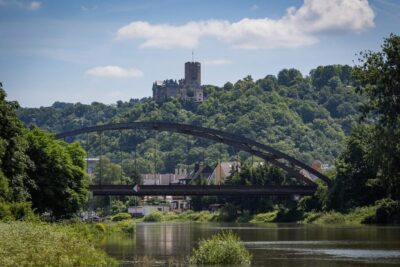 ★ 4.4Koblenz: Rhine Valley Castles and Palaces Boat TourFrom $211,824 reviews
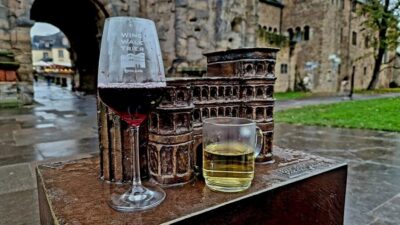 ★ 4.8Trier: Guided City Walk with Wine TastingFrom $43979 reviews
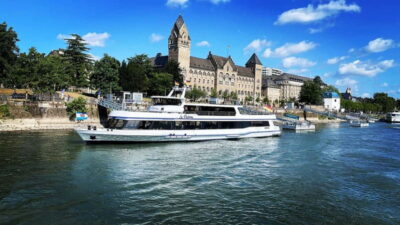 ★ 4.6Koblenz: 2-Hour Sightseeing Cruise on the RhineFrom $20839 reviews
 ★ 4.7Trier: Guided Old Town Highlights and History Walking TourFrom $16687 reviews
 ★ 4.5Koblenz: Old Town Sightseeing Cruise along the RhineFrom $16305 reviews
 ★ 4.4Koblenz: Panoramic Cruise on Moselle River to WinningenFrom $22283 reviews
 ★ 4.7Trier: Discovery Tour – Germany’s Oldest Wine CellarFrom $20218 reviews
 ★ 4.6Trier: City Walking TourFrom $17118 reviews
Other lists this tour is on