
REVIEW · HISTORICAL TOURS
Berlin Protest History Tour: Rebels, Resistance, and Revolution
Protests map Berlin in ways you can feel. This tour connects major turning points across the city, using outdoor “timeline” art and on-the-street memorials to make the past readable fast. I also like the small, focused pace, which keeps the stories clear, and you’ll walk away with a sharper sense of how power, dissent, and ordinary people tangled together. One consideration: it is an outdoor walking tour in good-weather conditions, so plan for cold or rain.
Here’s the big value for me. You get an expert guide in English, and the stops are all practical to reach while still covering big themes like resistance under Nazism and the East German road to 1989. My only caution is that the history is intense, so if you want something light and purely sightseeing, this may feel heavy.
Key moments across Berlin’s protest history, explained clearly. You’ll hear the stories behind statues, memorials, and even the shapes of landmark buildings, without needing a history degree. And yes, you end at a clock that pulls you out of the past and back into the present, right at Alexanderplatz.
In This Review
- Key Highlights You Should Care About
- A 2-Hour Protest Trail That Reads Like a City Map
- Meeting Point at Rotes Rathaus, and Why That Matters
- Nikolaiviertel: When Socialist Memory Gets Built Into a Neighborhood
- Gasthaus Mutter Hoppe and the East German “Timeline” Problem
- Marx-Engels-Forum: Public Ideas and Public Argument
- Humboldt Forum: From Palace to Protests, Including 1848
- Rosenstraße: The Courage of Civil Disobedience in Winter 1943
- St. Mary’s Church and a Different Kind of Protest
- The Television Tower: A Communist Landmark With a Message
- Brunnen der Völkerfreundschaft: 1989, T-Shirts, and the Fall of the Wall
- Weltzeituhr at Alexanderplatz: Time Zones, Then and Now
- Value and Who This Tour Fits Best
- The Guides and the Style That Make It Work
- Quick Practical Notes Before You Go
- Should You Book This Berlin Rebels, Resistance, and Revolution Tour?
- FAQ
- How long is the Berlin Protest History Tour?
- Is the tour offered in English?
- What is the group size limit?
- Where do I meet and where does the tour end?
- What is included in the price?
- Do the stops require paid admission?
- Is the tour weather dependent?
- Can I cancel for a full refund?
Key Highlights You Should Care About
- Terracotta history timelines at Rotes Rathaus and the socialist counterpart timeline south of the center
- Rosenstraße, 1943 civil disobedience, including what is known about the synagogue foundations nearby
- 1989 Peaceful Revolution sites, tied to the Wall’s fall story and a famous T-shirt protest
- The “debated” Marx and Engels statue, a reminder that politics and public art never fully settle
- Protest after protest, from 1848 through the later 1960s and beyond, in a tight walking route
More history walks in Berlin
- Berlin: Natural History Museum Entrance Ticket★ 4.6 · 3,382 reviews
- Berlin: World Heritage Cruise to Potsdam★ 4.5 · 1,435 reviews
- Berlin Historical Highlights Walking Tour★ 4.9 · 657 reviews
- Berlin Private Complete History All Day Walking Tour★ 5.0 · 474 reviews
A 2-Hour Protest Trail That Reads Like a City Map
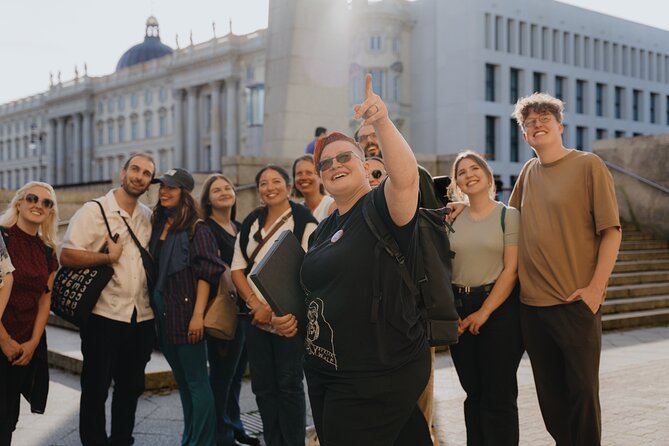
If Berlin can feel complicated, this tour helps you get your bearings. In two hours or so, you’ll move through a chain of places that each point to a specific kind of protest, from early uprisings to Nazi-era resistance and the 1989 revolution that toppled the Wall.
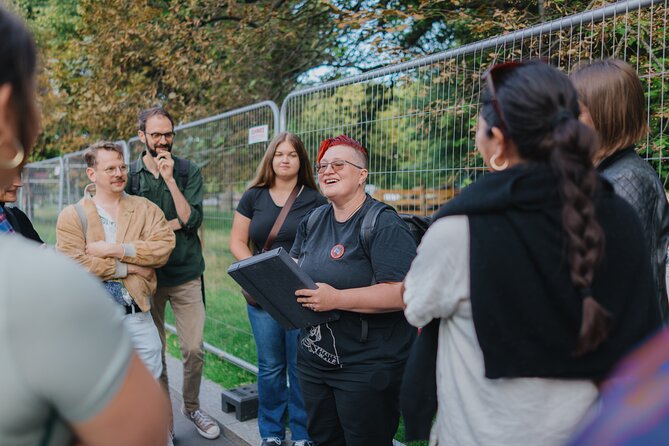
The group stays small, capped at 15 people. That matters because the guide can pace questions, explain details at the street level, and keep you from feeling lost among the city’s constant motion.
You also get a simple win on planning. The tour uses a mobile ticket and runs in English, with the guide doing the heavy lifting of connecting the dots.
Meeting Point at Rotes Rathaus, and Why That Matters
You start at the Aufbauhelferin sculpture by Fritz Cremer, right by Rotes Rathaus. Starting here is smart because Berlin’s protest story begins to show itself immediately, not as a textbook but as public space.
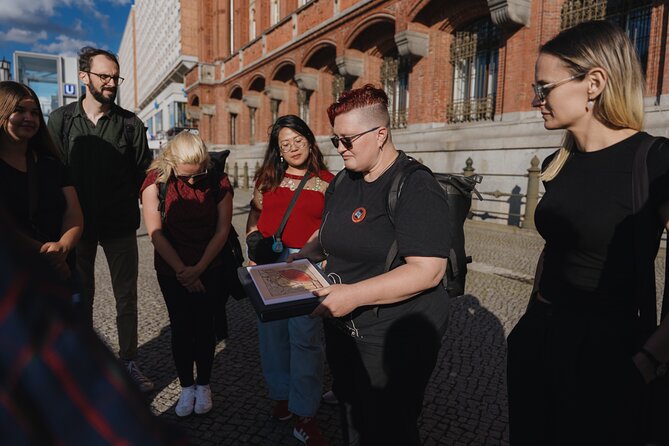
From the outside of the town hall, you’ll look at the terracotta timeline that wraps around the building. It’s a rare way to learn, because you can physically “read” history in the order the city wants you to notice it, and then hear the uprising stories attached to those carved moments.
I love this approach because it’s not just dates. It turns architecture into interpretation, so even if you only catch part of a scene, the guide can fill in what you need to understand the big shifts.
Nikolaiviertel: When Socialist Memory Gets Built Into a Neighborhood
Next you’ll head into Nikolaiviertel, where you can see how a socialist-era project shaped the look of memory. The area is known for a “kitsch” feel that was designed for the 750th anniversary of Berlin, and it also preserves what remains of the Palace of the Republic.
That matters because the Palace of the Republic wasn’t just a building. It was tied to the East German parliament, and it also functioned as a major entertainment hub. In other words, power and culture sat in the same rooms.
This stop also sets you up to think about how regimes try to control narratives. You’ll notice how the guide frames what’s missing, what remains, and how public design can influence what people believe their past was.
Gasthaus Mutter Hoppe and the East German “Timeline” Problem
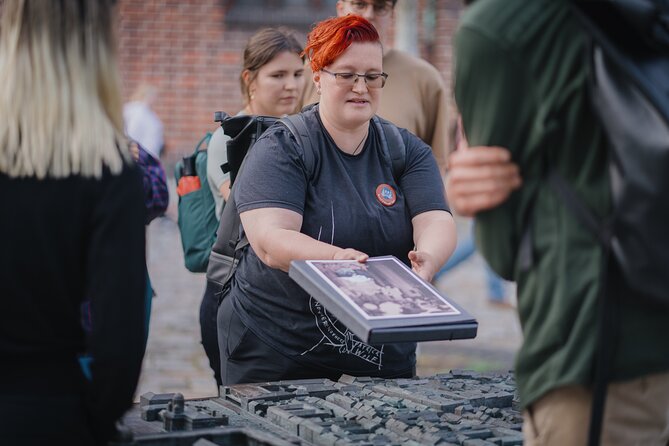
From there, you’ll get the East German answer to the terracotta timeline at Gasthaus Mutter Hoppe. The message here is subtle but important: the timeline highlights major moments in socialist history, and it notably leaves out the Berlin Wall.
That absence is the point. The guide helps you connect why certain events get highlighted in official memory while others get quietly removed from public display.
For me, this is one of the most useful moments in the entire walk. It trains your eye. After that, you’ll start noticing how monuments and facades do political work, even when they look like they’re just “decorating” a street.
Marx-Engels-Forum: Public Ideas and Public Argument
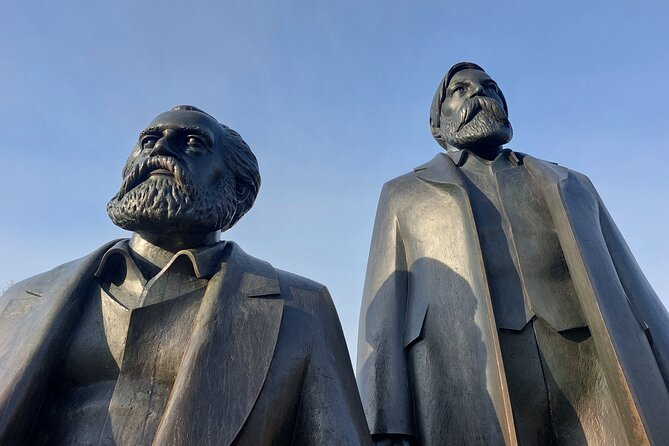
At Marx-Engels-Forum, you’ll meet Karl Marx and Friedrich Engels in statue form. The guide explains that the statue has been debated for years, and you’ll see how Berlin treats political iconography as something that keeps evolving.
I like this stop because it makes a practical argument about public art. Statues are not neutral. They can be a celebration, a warning, or a target, depending on who sees them and when.
If you have any curiosity about why Berlin’s political landscape still influences its streetscape, this is where it starts to click.
Humboldt Forum: From Palace to Protests, Including 1848
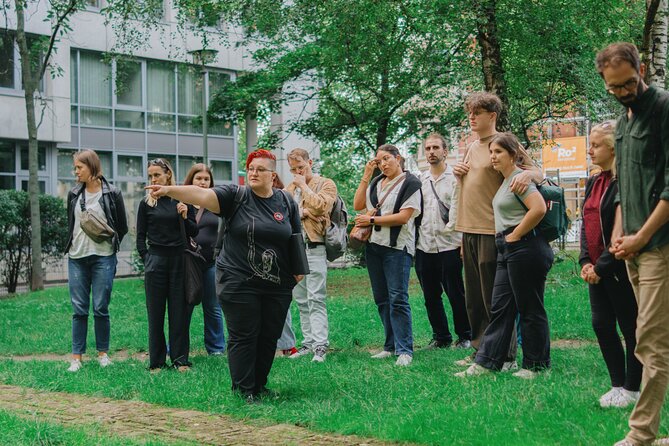
Next comes Humboldt Forum, tied to the reconstructed Berlin Palace. The guide connects the palace site to protests and revolutions, especially the March Revolution of 1848, which is described as sowing seeds of democracy in Germany.
What I like here is that the focus stays human-scale. Yes, it’s a landmark site, but the guide frames it as a witness to people pressuring power.
You’ll also get a sense of how Berlin’s “center” has repeatedly been a stage for dissent. The message is that protests do not belong only to one era, they’re a recurring pattern that reshapes institutions over time.
Rosenstraße: The Courage of Civil Disobedience in Winter 1943
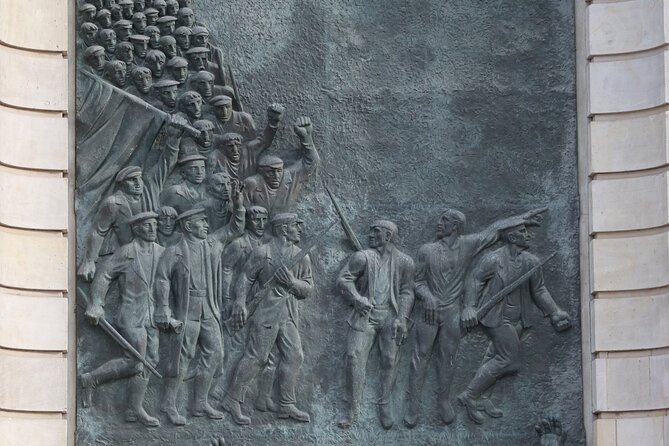
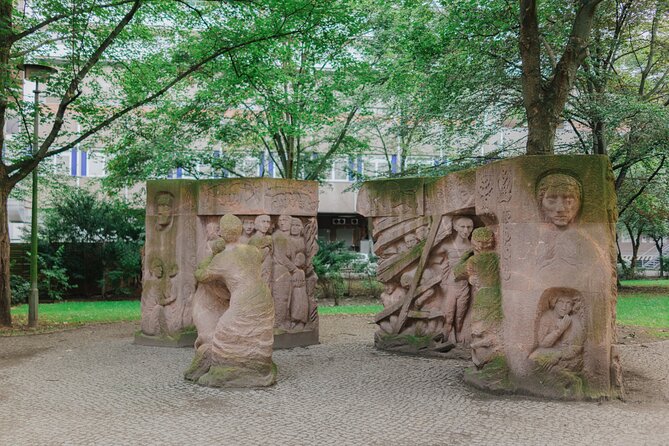
If you only remember one stop, make it Rosenstraße. Here you’ll see the monument connected to women who staged civil disobedience in winter 1943, described as the only protest by Germans against the Final Solution.
The guide also ties this to Jewish life under Nazi rule and points you toward what are said to be the foundations of the oldest synagogue in Berlin in the area. Even without going inside, you’ll understand why the memorial is so emotionally charged.
This is heavy, but it’s also crucial. The story shifts you from “history as events” to “history as decisions people made under threat.”
I appreciate that the guide doesn’t make it vague. You leave with a clear picture of what the act meant, why it was unusual, and how courage can appear in public even when the system tries to erase it.
St. Mary’s Church and a Different Kind of Protest
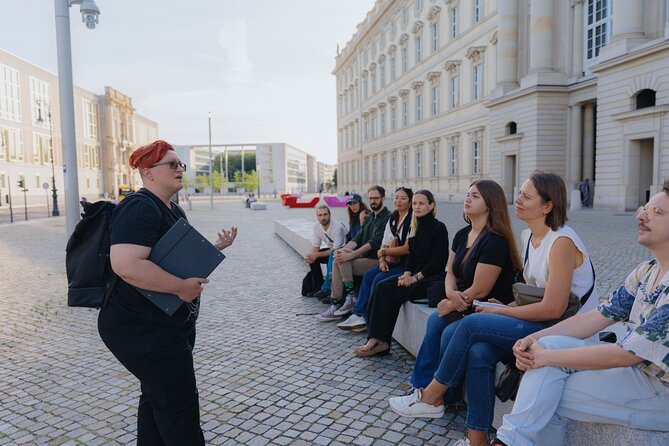
At St. Mary’s Church, you’ll hear how Martin Luther King Jr. delivered a sermon to a huge crowd in 1964. This stop broadens the tour beyond strictly Berlin-based resistance.
It’s a reminder that protest movements and civil rights ideas traveled and connected across borders. In Berlin, that global thread matters because the city kept becoming a meeting ground for ideologies, media, and public speech.
If you’re thinking of Berlin as only a Cold War story, this moment helps balance it.
The Television Tower: A Communist Landmark With a Message
You’ll also catch sight of Berlin’s Television Tower, presented here as a landmark of the city and a symbol of communist power.
Even from a distance, the guide’s framing helps you see it as more than a view point. It’s a statement in the skyline, and the story links it to how East Berlin displayed authority.
This works well if you like learning to “read” landmarks. You start looking at buildings as arguments, not just backdrops.
Brunnen der Völkerfreundschaft: 1989, T-Shirts, and the Fall of the Wall
Then the tour turns firmly toward the Peaceful Revolution of 1989 at Brunnen der Völkerfreundschaft. The guide traces events that led to the Fall of the Wall, keeping the timeline grounded in people, not just politics.
One of the standout details is the story of young East German oppositionists who staged a T-shirt protest by the fountain in autumn 1989. It’s a small image with huge impact, and it makes sense why the guide uses this stop as a turning point.
This section is where the tour often feels most immediate. You can almost feel the speed of change. The guide helps you connect street-level acts to national outcomes.
Weltzeituhr at Alexanderplatz: Time Zones, Then and Now
You end at the World Time Clock (Weltzeituhr) at Alexanderplatz. The clock is described as a rotating design showing time in 148 cities, and it’s also noted as the most popular meeting spot in East Berlin.
I love the symbolism here. The tour begins with history pinned to stone and ends with a mechanism that constantly updates. It’s a clean way to make the point that Berlin keeps changing, even when you try to freeze it into a single narrative.
If you want a last photo with context, this is it. You can stand near a landmark that once served East Berliners as a social node, then look around and see modern Alexanderplatz living alongside the past.
Value and Who This Tour Fits Best
At $30.04 per person for about two hours, this tour is priced like a solid neighborhood experience, not a premium museum day. You also get a real guide, and the major stops along the route are described as free to enter.
That combination tends to work well in Berlin, where paid museums can eat your schedule and budget. Here, you get a guided “street museum” format that focuses on meaning, not ticket lines.
This is a great match if you:
- Like walking tours that teach you how to interpret buildings and monuments
- Want a guided path through protests, not just World War II landmarks
- Are interested in East German memory, resistance stories, and 1989
It can be a less perfect match if you:
- Want a purely light sightseeing outing
- Hate walking in cold or damp weather, since the experience requires good weather
- Prefer only one era of history, because this is intentionally multi-era
The Guides and the Style That Make It Work
Beyond and Beneath Tours put effort into the kind of details that change how you see a street. In the reviews that I found especially convincing, guides like Martina and Simone are credited for explaining the small stories built into facades and corners you’d otherwise skip.
You can feel this in the way the stops connect. Instead of a list of famous sites, the guide points out what the city is quietly saying, what it chose to keep, and what it chose to leave out.
Even better, the walking pace is short enough that the route stays manageable. One helpful detail to plan around is that the route is described as a small walk, around 2 km, which makes it easier to stay comfortable without burning your whole day.
Quick Practical Notes Before You Go
The tour runs in English and uses a mobile ticket. It’s offered with good weather required, and the meeting and ending points are easy to relate to on a map since you start near Rotes Rathaus and finish at Alexanderplatz.
It’s also designed for most participants, and service animals are allowed. If you use public transit, you should have an easier time reaching the start area because it is noted as being near public transportation.
Should You Book This Berlin Rebels, Resistance, and Revolution Tour?
I’d book it if you want a guided walk that treats Berlin like an argument you can follow. The route links uprising stories, Nazi-era resistance, Cold War memory, and 1989 revolution scenes without requiring extra museum tickets.
For first-time Berliners, it gives you a framework that makes later self-guided wandering easier. For repeat visitors, it can still feel fresh because the guide’s focus is often on the specific details you miss when you move fast.
Just go in with the right mindset: this is history with emotion. If you can handle that, you’ll come away with clearer context, sharper eyes, and a tour that feels both practical and meaningful in the streets of Berlin.
FAQ
How long is the Berlin Protest History Tour?
The tour runs for approximately 2 hours.
Is the tour offered in English?
Yes, the tour is offered in English.
What is the group size limit?
The tour has a maximum of 15 travelers.
Where do I meet and where does the tour end?
You start at the Sculpture Aufbauhelferin – Fritz Cremer at Rotes Rathaus (Jüdenstraße, 10178 Berlin). You end at the World Time Clock (Weltzeituhr) at Alexanderplatz (Alexanderpl. 1, 10178 Berlin).
What is included in the price?
The price includes an expert guide and a mobile ticket.
Do the stops require paid admission?
The stops listed are marked as free admission tickets.
Is the tour weather dependent?
Yes. The experience requires good weather. If it’s canceled due to poor weather, you’ll be offered a different date or a full refund.
Can I cancel for a full refund?
Yes, you can cancel up to 24 hours in advance for a full refund. If you cancel less than 24 hours before the start time, the amount you paid will not be refunded.
The Longer History of Berlin
Everything else we filed on Berlin
- Private Photo Tour in Kreuzberg
★ 5.0 · 3 reviews - Kreuzberg Private Walking Tour: Immigrants, Artists & Hipsters
★ 5.0 · 3 reviews - Berlin’s Jewish Heritage: Private Tour of the Vibrant Jewish District
★ 5.0 · 3 reviews - Individual city tour Berlin for max. 8 persons
★ 5.0 · 3 reviews - Berlin & The Third Reich Private Guided Tour
★ 5.0 · 3 reviews - Private Analogue Photography Experience in Berlin
★ 5.0 · 3 reviews
Historical Tours, side by side.
 ★ 4.7Leipzig: City History Canal Sightseeing Tour on a MotorboatFrom $186,232 reviews
 ★ 4.6Berlin: Natural History Museum Entrance TicketFrom $123,382 reviews
 ★ 4.7Leipzig: 1.5-Hour Historical Walking Tour in GermanFrom $172,217 reviews
 ★ 4.5Berlin: World Heritage Cruise to PotsdamFrom $251,435 reviews
 ★ 4.7Heidelberg: Night Watchman Historic Adventure TourFrom $3051,186 reviews
 ★ 5.0The Local Tour of Hamburg Historic CentreFrom $31,058 reviews
 ★ 4.8Elbfloren: Historical city tourFrom $15819 reviews
 ★ 4.6Bamberg: Guided Beer History Tour with Optional TastingFrom $21772 reviews
Other lists this tour is on