
REVIEW · HISTORICAL TOURS
Historic center of Berlin – Tour in Italian
Berlin’s most painful story is walkable.
This Italian-speaking small-group tour strings together the city’s major turning points in about 3.5 hours, starting at Potsdamer Platz and ending near the Pergamon Museum. I like that it’s structured, not rushed, and you get a real guide who can explain what you are seeing as you move.
I love the emphasis on meaning, not just photos. The route hits places like the Holocaust Memorial and the Museum Island area, where you learn why Berlin remembers what it remembers.
One possible drawback: this is a walking route through heavily charged sites, so it can feel emotionally intense, and you’ll want good shoes for a long stretch outdoors.
In This Review
- Key things to know before you go
- How this Italian historic center tour helps you understand Berlin
- Where you meet: Potsdamer Platz and the tour’s easy start
- Potsdamer Platz to Sony Center: modern Berlin built over older damage
- Topography of Terror: the place where the Nazi state operated
- Cold War intensity at Checkpoint Charlie
- The Aviation Ministry building and the Fuhrerbunker: power across regimes
- Holocaust Memorial: a moment for reflection, not speed
- Reichstag, Brandenburg Gate, and Unter den Linden: from politics to symbolism
- Bebelplatz book burning memorial and Humboldt University context
- Neue Wache and Berliner Dom: war refusal and religious grandeur
- Museum Island finish near Pergamon: what to do next
- Price and practical value: what $27.91 buys you here
- Who this tour suits best
- A note on the guides (and why it matters)
- Should you book this Italian Historic Center tour?
- FAQ
- Is the tour offered in Italian?
- How long is the walking tour?
- Where does the tour start and end?
- Does the tour run in bad weather?
- Is food or drinks included?
- What is the cancellation policy?
- What kind of ticket do I get?
Key things to know before you go
- Italian commentary on core landmarks: you get context for the Brandenburg Gate, Checkpoint Charlie, and Berlin’s memorial landscape.
- A smooth route across Mitte: it starts at Potsdamer Platz and ends at Pergamon Museum, so you can keep moving the same day.
- Memorial stops are treated with care: Topography of Terror, the Holocaust Memorial, and Bebelplatz get clear, human explanations.
- Most stops are viewpoint-style: the listed stops are free at each stop, so you’re not juggling extra entry lines.
- Outside-only for one big highlight: you view the Reichstag from outside, while the guide explains how to add the dome visit later.
- Small group size: maximum 28 travelers, which helps when you want questions answered on the move.
More history walks in Berlin
- Berlin: Natural History Museum Entrance Ticket★ 4.6 · 3,382 reviews
- Berlin: World Heritage Cruise to Potsdam★ 4.5 · 1,435 reviews
- Berlin Historical Highlights Walking Tour★ 4.9 · 657 reviews
- Berlin Private Complete History All Day Walking Tour★ 5.0 · 474 reviews
How this Italian historic center tour helps you understand Berlin
Berlin is not a city that stays still in your mind. It keeps changing roles, governments, borders, and names, sometimes block by block. That’s exactly why an Italian-speaking walking tour makes sense here: you get a guided thread connecting the modern city you see today with the brutal events that shaped it.
What I like about this setup is the mix of scale. You’ll stand at famous landmarks like the Brandenburg Gate, but you’ll also pause at places where Berlin talks about guilt, persecution, and propaganda. The guide’s job is to help you translate what you’re looking at, so it doesn’t feel like a checklist.
This is also good value for your time. At $27.91 per person for a 3-hour 30-minute guided walk, you are paying for expert narration and a clear route across the center, while the scheduled stops are listed as free at each point. Food and drinks are not included, so budget for a snack break on your own.
Where you meet: Potsdamer Platz and the tour’s easy start
The tour starts at Potsdamer Platz 10, by the meeting point of Vive Berlin Tours. Look for a blue bicycle with the company logo, marked clearly near the transit hub around Potsdamer Platz.
Why I think this matters: Potsdamer Platz is one of the easiest places in Berlin to orient yourself. Even if you arrive a bit early, you can take a quick scan of the square, figure out which metro lines you might use later, and then begin the walk without stress.
The tour begins at 10:00 am, so it works well if you want to use the morning for a structured overview. Berlin gets busy, and starting early gives you the best chance to move calmly between sites.
Potsdamer Platz to Sony Center: modern Berlin built over older damage
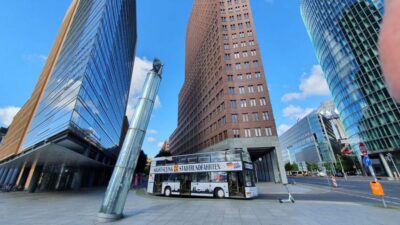
The route opens at Potsdamer Platz, a place that is known for being modern, but which also tells the story of destruction and rebuilding. You’ll hear how this area became a symbol of major shifts in Berlin’s life, and why a square that looks contemporary today still carries heavy history.
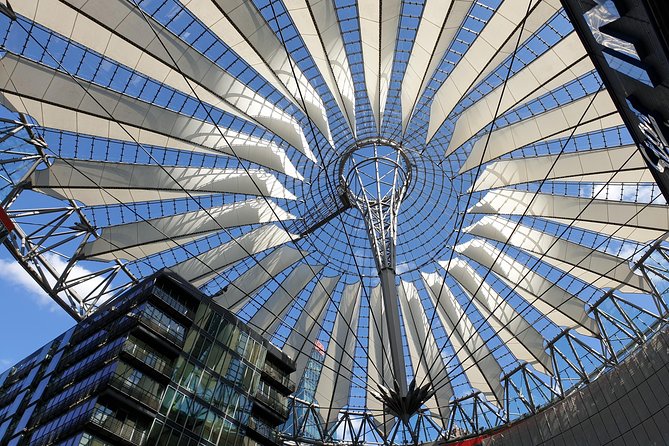
Next is the Sony Center. The main “wow” here is how it combines sleek contemporary architecture with preserved remnants from the older square destroyed during World War II. It’s a reminder that Berlin doesn’t erase its past. It edits it, stacks it, and sometimes keeps pieces in plain view.
A useful mindset for this part: don’t just look for landmarks. Pay attention to how the city blends eras. The guide’s commentary helps you read the layers.
Topography of Terror: the place where the Nazi state operated
One of the most important stops is Topography of Terror. Here, the focus is on remembering the Nazi dictatorship in the exact area connected with the Gestapo and SS headquarters.
This stop also connects you visually to surrounding sites, since from the area you can see other buildings associated with the Nazi era and later cultural life. The route mentions buildings including the former Nazi aviation ministry area and Martin Gropius Bau, a museum building you may recognize later if you decide to add time.
Why this stop is a high point for understanding: it’s not just about dates. It’s about geography. When you know where power was located, Berlin’s other Cold War and postwar stories start to click into place.
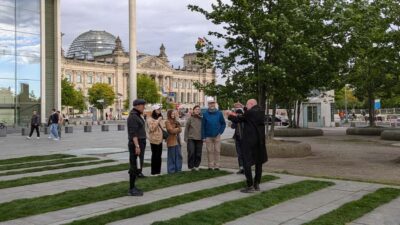
Cold War intensity at Checkpoint Charlie
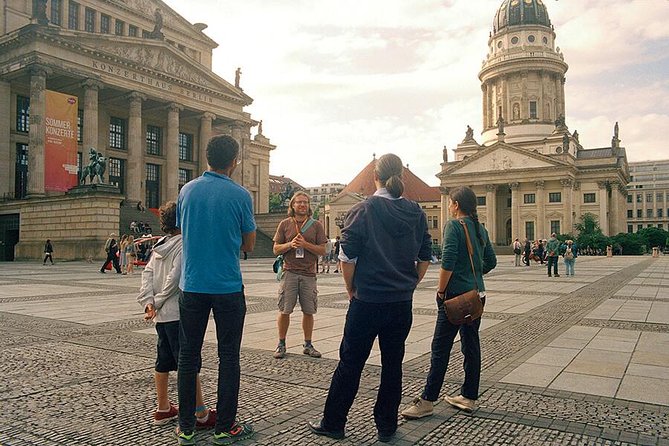
Next comes Checkpoint Charlie, described as one of the hottest Cold War spots for its role in dividing Berlin. The guide explains how the Berlin Wall and the city’s division shaped daily life and the tension between East and West.
This is where I recommend you slow down mentally. It’s easy to treat Checkpoint Charlie as a theme park symbol, but with the guide’s framing, you can see it as a real checkpoint in a real conflict system. The point is how borders were enforced, and how Berlin lived inside that pressure.
The Aviation Ministry building and the Fuhrerbunker: power across regimes
The tour then moves to the Aviation Ministry of Berlin. This huge structure was built by the Nazi dictatorship to house offices connected with the Ministry of Aviation led by Goering. Later, the building served as a “home of the ministries” for the Communist dictatorship during the Cold War. Today, it is used by a ministry of the Federal Republic of Germany.
That layering is the whole Berlin lesson in one building. You’re looking at architecture that served different ideologies, while the stones stayed the same.
Then you reach the Fuhrerbunker area, where the bunker stood and where Hitler spent his last days. The guide explains the meaning of the place and why it exists as it does today.
Practical note: this is another emotionally heavy stop. If you feel overwhelmed, take a minute to stand back, breathe, and let the guide’s words settle before you move on.
Holocaust Memorial: a moment for reflection, not speed
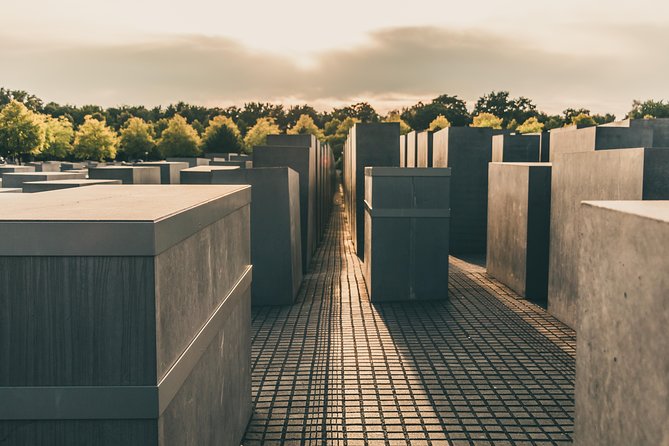
After the bunker area, the route reaches the Holocaust Memorial, the Memorial to the Murdered Jews of Europe. The guide shares stories meant to make the site’s purpose feel personal and specific, not abstract.
This is one of those stops where you should give the time it deserves. The route keeps it brief, but you can use it well if you pick one or two parts of the memorial to focus on, and let the guide’s explanation do the work of connecting the site to what it represents.
Reichstag, Brandenburg Gate, and Unter den Linden: from politics to symbolism
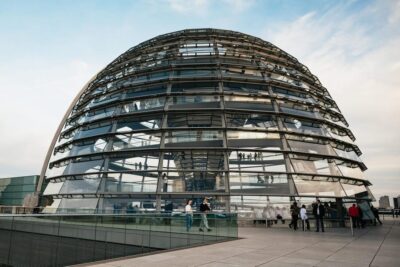
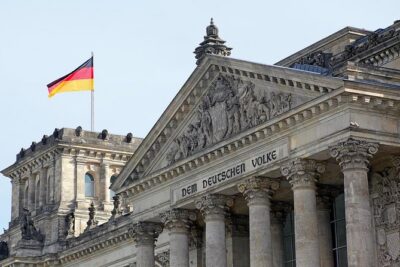
You’ll then pass the Reichstag Building, the seat of the German Parliament. The tour includes time outside only, and the guide explains how to book a visit to the dome if you want to add it later.
This matters because the Reichstag is one of those places where visitors often assume a quick stop means you’ll go inside. Here, you get a clear alternative plan: see it from outside during the walk, then decide if you want the dome experience separately.
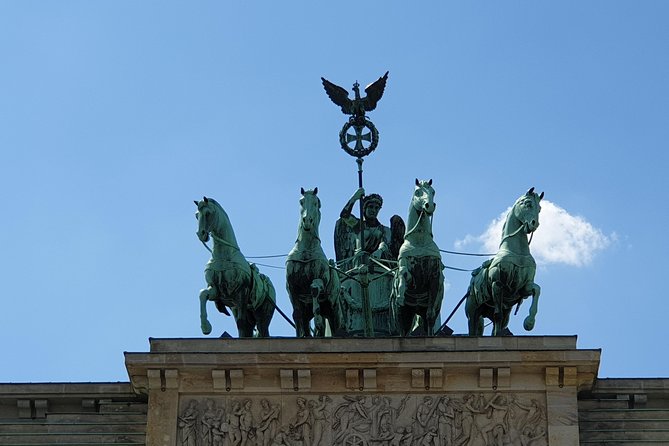
Next is Brandenburg Gate, probably the most photographed landmark on this route. The guide connects its story from a symbol of a king’s strength to a Cold War icon, and finally to one of the symbols of German reunification.
Then you walk along Unter den Linden, an avenue that was once the access road to the emperor’s palace. The guide helps you recognize different periods of construction and the war scars still visible in the urban fabric.
For me, this section is where the tour becomes extra satisfying: you go from the mechanisms of dictatorship and division to the broader idea of national identity, shown through buildings and street design.
Bebelplatz book burning memorial and Humboldt University context
The route reaches Bebelplatz, known for the Nazi-era burning of books, and also for the presence of Humboldt University and a Catholic cathedral nearby.
A key stop here is the Book Burning Memorial at Bebelplatz. The guide’s narration helps you understand how propaganda actions are remembered today, including how the memorial marks what was done in public.
Then you spend time at Humboldt University, where the guide shares its history and points out notable students connected to it. Even if you don’t plan to go inside, it’s helpful because it anchors Berlin’s intellectual story next to the political one you’ve just heard.
Neue Wache and Berliner Dom: war refusal and religious grandeur
Next comes Neue Wache, a memorial focused on rejection of war and its horrors. The site is described as featuring a mother crying for her son, representing a soldier who fell in battle.
This stop works well right after Bebelplatz because the themes connect. You go from cultural repression to the human cost of conflict.
Then you reach Berliner Dom. The tour frames it historically in terms of imperial ambition, describing it as built by the emperor and intended as a Lutheran equivalent to St. Peter’s. It’s a reminder that Berlin’s “center” is also about ceremony, power, and visual scale.
Museum Island finish near Pergamon: what to do next
The walk ends on Museum Island, a UNESCO World Heritage Site. The tour finishes in the area near the Pergamon Museum at Bodestraße 1-3.
This ending is a smart move for your day because you’re not left stranded at a random point. If you want to keep exploring, the guide provides directions for how to visit the museums in a way that makes sense for your time.
Even if you don’t go into Pergamon itself, Museum Island is a natural “hub” for more walking. After 3.5 hours of serious history, it’s a good place to transition into art, artifacts, and the longer arc of human culture.
Price and practical value: what $27.91 buys you here
At $27.91 per person, you’re essentially paying for:
- a local guide (included),
- guided interpretation across major sites,
- and a structured route that saves you time figuring out connections between scattered locations.
The itinerary is also marked with admission ticket free for each listed stop, which helps keep the day simpler. You’ll still need to budget for food and drinks since those are not included, but you’re not stacking paid entries on top of the walking time.
The group size is capped at 28 travelers, which is important. If the group were larger, you’d spend more time watching and less time learning. Here, the format is set up so the guide can keep moving at a pace that feels manageable.
Who this tour suits best
I’d point this tour toward you if you want:
- an overview of Berlin’s modern history in one walk,
- Italian guidance that explains meaning as you see it,
- and a route that blends famous landmarks with memorial spaces.
You’ll also like it if you enjoy structured city walks, and if you like having someone else handle the “what to notice” part while you focus on looking.
It may be less ideal if you:
- prefer a light, entertainment-heavy sightseeing day,
- or you are sensitive to emotionally intense memorial topics.
A note on the guides (and why it matters)
From the guide names shared in feedback you can recognize a theme: the experience is praised for clear communication and preparation. Guides such as Paolo, Giulia, Fabio, Chiara, Elena, and Daniele show up in the kind of feedback you want from a history tour, including being attentive and adjusting to the group.
I like that this suggests consistency in how the tour is taught, not just which stops are visited.
Should you book this Italian Historic Center tour?
Book it if you want a 3.5-hour Italian-guided orientation to Berlin’s most important places, with narration that ties the Berlin Wall, Cold War checkpoints, Nazi-era memory, and major landmarks into one route. It’s good value for the time, and the end point near Museum Island is convenient if you plan to keep exploring.
Skip it if you already know Berlin history deeply and want a more specialized theme, or if you need a lighter day that avoids heavy memorial stops.
If you do book, pack walking-comfort shoes, bring water, and mentally plan for a mix of stunning sights and serious reflection. That mix is the point of Berlin, and this tour guides you through it efficiently.
FAQ
Is the tour offered in Italian?
Yes. The tour is guided by an Italian-speaking guide.
How long is the walking tour?
It lasts about 3 hours 30 minutes.
Where does the tour start and end?
It starts at Potsdamer Platz 10, 10785 Berlin (look for the Vive Berlin Tours meeting point). It ends at Pergamon Museum, Bodestraße 1-3, 10178 Berlin.
Does the tour run in bad weather?
Yes. It operates in all weather conditions, so you should dress appropriately.
Is food or drinks included?
No. Food and drinks are not included.
What is the cancellation policy?
You can cancel for a full refund up to 24 hours before the start time. If you cancel less than 24 hours in advance, the amount paid is not refunded.
What kind of ticket do I get?
You receive a mobile ticket.
The Longer History of Berlin
Everything else we filed on Berlin
- East Berlin: City of Shadows Walking Tour
★ 5.0 · 11 reviews - Berlin: Die Stachelschweine – Frank Lüdecke – Träumt Weiter
★ 4.7 · 11 reviews - Potsdam Day Trip from Berlin with a Local: Private & Personalized
★ 4.0 · 11 reviews - An Introduction to Berlin Walking Tour
★ 5.0 · 11 reviews - DJ for a Day: Learn to Mix Like a Pro in Berlin
★ 5.0 · 11 reviews - 2-H Segway Sightseeing Tour Berlin
★ 4.5 · 11 reviews
Historical Tours, side by side.
 ★ 4.7Leipzig: City History Canal Sightseeing Tour on a MotorboatFrom $186,232 reviews
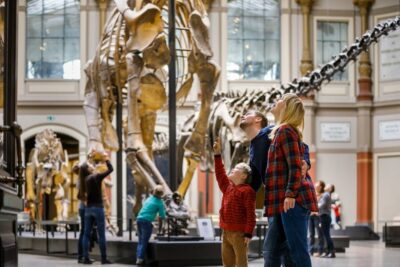 ★ 4.6Berlin: Natural History Museum Entrance TicketFrom $123,382 reviews
 ★ 4.7Leipzig: 1.5-Hour Historical Walking Tour in GermanFrom $172,217 reviews
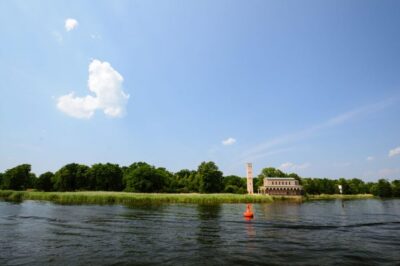 ★ 4.5Berlin: World Heritage Cruise to PotsdamFrom $251,435 reviews
 ★ 4.7Heidelberg: Night Watchman Historic Adventure TourFrom $3051,186 reviews
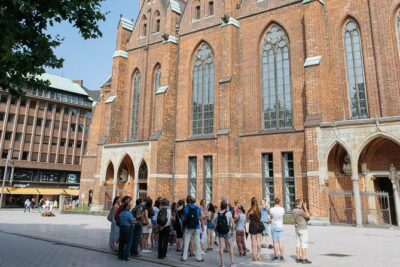 ★ 5.0The Local Tour of Hamburg Historic CentreFrom $31,058 reviews
 ★ 4.8Elbfloren: Historical city tourFrom $15819 reviews
 ★ 4.6Bamberg: Guided Beer History Tour with Optional TastingFrom $21772 reviews
Other lists this tour is on