
REVIEW · HISTORICAL TOURS
Private Taxi Tour City East & West History and Architecture 3-4h
Berlin has two personalities, in one ride. This private East and West Berlin tour uses a taxi to stitch together big architecture moments and street-level history, from church portals to government buildings. I like how the stops feel planned, not rushed, and you get enough pauses to look up close instead of only seeing things through a window.
Two things I really value here: the comfort of car time (air-conditioned, WiFi on board, plus reviewers noted it is great in winter when you are not sitting outside), and the way the guide turns landmarks into stories you can actually remember. One small consideration, though, is that it is a highlights route with short viewing stops, so if you want long museum time beyond what is included, you will likely need extra independent time.
In This Review
- Key takeaways before you book
- What this taxi tour really does for you
- Price and what you get for it
- Meet the guide, then use the route like a local
- West Berlin highlights: churches, KaDeWe, Ku’damm, and the Memorial Church glow
- Kaiser Wilhelm Memorial Church, the preserved scar
- Berlin Zoo: history you can spot from the gates
- Theater des Westens: the West Berlin postcard feel
- Kurfürstendamm (Ku’damm): Paris-style boulevard, modern shopping reality
- Breitscheidplatz and the new Kaiser Wilhelm Memorial Church interior
- European Center and the city’s mall obsession
- KaDeWe (Kaufhaus des Westens): luxury floor, plus a practical reason to go
- Charlottenburg and the science-and-city-plan angle: Urania and transport memory
- Zoologischer Garten station area: a switchboard of Berlin transit
- Urania: science made for ordinary people
- East Berlin and reunification landmarks: Unter den Linden, Gendarmenmarkt, and the Humboldt Forum
- Friedrichstraße: where East and West contact was controlled
- Synagogue stop: Moorish-style architecture and heavy security reality
- Gendarmenmarkt: cathedrals that are not cathedrals
- German Historical Museum area: war implements and the Nazi memory layer
- Humboldt Forum: the interior highlight tied to modern Berlin identity
- Government and Cold War power centers: Reichstag, government buildings, and the Tiergarten style drive
- Reichstag: how modern parliament works
- Chancellor and German government buildings: size and function
- The Holocaust and Cold War memory stops: Topography of Terror and the Checkpoint Charlie area
- Topography of Terror: layered history in one site
- Checkpoint Charlie area: the photo stop that still teaches
- Small Berlin pleasures that fit in: gardens, embassies, and quick windows
- Tiergarten corners and gardens
- Embassy and government drives: architecture as political geography
- How the guide keeps the experience moving (without feeling rushed)
- Tips to get the most from the 3 to 4 hour format
- Should you book this East and West Berlin taxi tour?
- FAQ
- FAQ
- How long is the private taxi tour?
- Is pickup included?
- What language is the tour offered in?
- Is this a private experience?
- Are any tickets or entry fees included?
- What about children and car seats?
- Can I cancel for a full refund?
Key takeaways before you book
- Private taxi pickup inside the S-Bahn ring: your ride starts from your location in the city, not a faraway meeting point.
- Gunter Bauer runs the show, and he is hands-on: he is friendly, responsible behind the wheel, and responsive before you start.
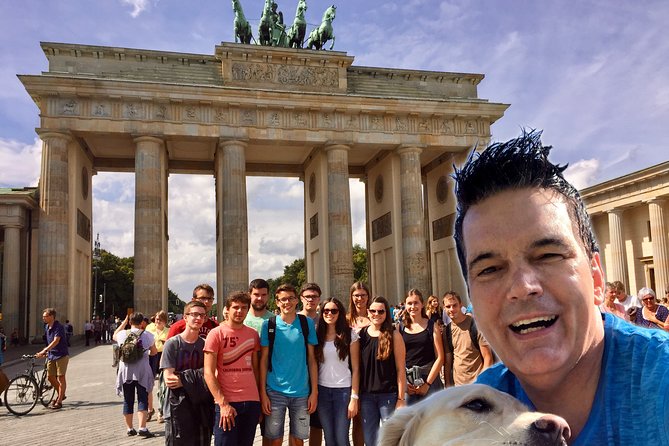
- Photo-friendly stops at iconic viewpoints: Brandenburg Gate and the Humboldt Forum area are part of the plan, and he takes photos for you.
- East and West in one continuous route: you get a Berlin “then and now” contrast without figuring out transport changes.
- Built for short sightseeing windows: the itinerary mixes quick exterior moments with a major interior highlight at Humboldt Forum.
- Most stops do not require additional entry spending: Humboldt Forum entry is included, and many other stops are free.
The wider Berlin sightseeing pile
- Berlin: 1-Hour City Tour by Boat with Guaranteed Seating★ 4.3 · 16,993 reviews
- Berlin: City Sightseeing Hop-On Hop-Off Bus Tour★ 4.1 · 4,233 reviews
- Berlin: 1-Hour City Sightseeing Cruise★ 4.4 · 2,210 reviews
- Berlin City Hop-on Hop-off Tour with Optional Cruise★ 3.5 · 1,155 reviews
What this taxi tour really does for you
A taxi tour can go two ways. It can be simple transport that never turns into a story. Or it can be a guided, stop-and-look route where the car is just the tool that gets you from one meaningful place to the next.
This experience leans hard into the second option. In about 3 to 4 hours, you cover an impressive set of Berlin icons, with the guide explaining why they were built, what changed after the war, and how the city’s politics shaped what you see today. It is also private, so you can ask questions as you go instead of waiting for a group schedule.
And yes, the practical side matters. Reviews highlight that the heated taxi keeps things comfortable, and you do not spend your energy figuring out stations, lines, and transfers.
Price and what you get for it
The listed price is $150.18 per person for 3 to 4 hours. On paper, that can sound steep compared with a basic bus tour. In real life, the value comes from two things you are paying for at the same time:
First, you are buying convenience. Pickup is included within the S-Bahn ring, and the taxi covers the movement between East and West sights without you juggling Berlin’s public transit maze.
Second, you are buying interpretation. The guide is not just naming buildings. He connects them to worker politics, Prussian monarchy choices, wartime damage, Cold War rules, and reunification-era changes. That kind of context is what makes the photos later feel meaningful, not random.
If your plan is mostly “see the highlights quickly,” it can be a good deal. If your plan is “wander for hours inside multiple museums,” you will probably want to pair this with add-on time.
Meet the guide, then use the route like a local
This tour is operated by Gunter Bauer (GAT-Productions). From the reviews you can tell he communicates ahead of time, and he adjusts based on interests. One review even noted rescheduling when someone was delayed, which is reassuring when travel days get messy.
I recommend you do two things before you meet:
1) Tell him what you care about most, history or architecture, or specific periods like Kaiser-era Berlin, World War II, or the Cold War.
2) Bring a small bottle of water. Even with short stops, Berlin walking and photo time adds up.
Once you are in the car, you can treat the day like a guided “best of” that also gives you context for what you will want to revisit later on foot.
West Berlin highlights: churches, KaDeWe, Ku’damm, and the Memorial Church glow
Your route begins by moving through West Berlin’s identity, where the city flexed its wealth, prestige, and cultural ambition before reunification.
More history walks in Berlin
Kaiser Wilhelm Memorial Church, the preserved scar
You start with the Kaiser Wilhelm Memorial Church area. The key idea here is not just “a church.” It is a deliberate decision to preserve part of a damaged place rather than erase everything. The preserved tower and west portal keep the wartime story visible, and the newer building around it creates a sharp contrast between old impact and postwar design.
What I like about this stop is the logic behind the faces in the preserved portal, which echo Prussian rulers through the sculptural program. It helps you see how monuments mix religion, monarchy, and political memory.
Berlin Zoo: history you can spot from the gates
From church to animals is a clever shift. Berlin Zoo is described as one of Germany’s oldest, with about 16,000 animals and roughly 1,600 species. You also get a sense of how the zoo was built using architectural styles connected to where animals came from, which still makes the grounds fun to look at despite wartime damage.
This stop is also a reminder: Berlin’s “culture” is not only museums. Sometimes it is conservation, design, and public life.
Theater des Westens: the West Berlin postcard feel
Next comes Theater des Westens. It sits in the early 20th-century idea of moving life away from the overpacked Mitte and into the greener west. Today it is used as a musical theater, but the imperial box and elegant interior concept are part of why the building still gives that old-West splendor vibe.
Kurfürstendamm (Ku’damm): Paris-style boulevard, modern shopping reality
You then pan along Kantstraße and reach Kurfürstendamm, Berlin’s famous Ku’damm. The guide connects it to the broader boulevard model, including Bismarck’s fascination with Paris after victory over France. It is not “villas and cafés forever” anymore. The boulevard has shifted into a shopping corridor with big fashion names and modern flagships, and at night it can feel quieter than you might expect.
If you love watching cities change, Ku’damm is a great place to get that snapshot.
Breitscheidplatz and the new Kaiser Wilhelm Memorial Church interior
Later, you visit the Memorial Church again from a different angle and get the interior experience. One highlight is the way the church uses many glass stones made in France to create a blue light atmosphere. You also get an unexpected fact: it is surprisingly quiet inside despite the busy square outside, thanks to a double wall with an air gap for soundproofing.
One thing to keep in mind is that scaffolding can be part of the scene. The newer concrete structure is described as fragile due to exposure to traffic emissions.
European Center and the city’s mall obsession
Just behind that church area is the European Center and an older shopping center vibe. You also get context for how Berlin became mall-heavy, with more than 70 malls and additional projects mentioned. It is not everyone’s idea of romance, but it helps you understand what “West Berlin daily life” looks like now.
KaDeWe (Kaufhaus des Westens): luxury floor, plus a practical reason to go
You stop at KaDeWe, the famous department store on Tauentzien. A standout is the sheer size and the gourmet floor concept, including items like champagne, oysters, and an impressive mix of chocolate, bread, and cheese.
Even if you do not buy anything, it is a useful stop if you want to understand West Berlin’s consumer culture. The store is also a strong rainy-day or cold-day fallback, because you can wander inside at your own pace.
Charlottenburg and the science-and-city-plan angle: Urania and transport memory
As the taxi moves, you pick up a different layer of West Berlin: civic institutions and old city planning ideas.
Zoologischer Garten station area: a switchboard of Berlin transit
You pass through the Zoo station area. It is described as Europe’s largest crossing station by a self-published claim, with massive traffic and multiple levels. You also learn why Bahnhof Zoo matters historically, including the shift where long-distance service patterns changed and required routing adjustments for parts of the city.
This is one of those “you feel it” moments. Even from a taxi window, you can tell this is where Berlin’s rail arteries meet.
Urania: science made for ordinary people
The Urania stop adds a social layer. Urania started with a goal to bring science to a broad audience in the late 19th century, with public talks and slide presentations continuing in spirit. You also see a French gift connected to Berlin’s 750th anniversary, and it ties nicely into the idea that Berlin’s identity was always shaped by international attention.
East Berlin and reunification landmarks: Unter den Linden, Gendarmenmarkt, and the Humboldt Forum
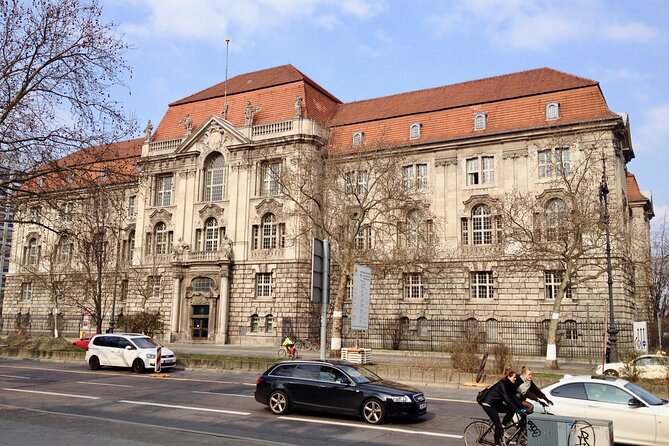
Then your route moves into East Berlin territory, where the emphasis shifts toward monarchy-to-modern government themes, and toward rebuilding after political rupture.
Friedrichstraße: where East and West contact was controlled
You pass along Friedrichstraße, one of Berlin’s most famous north-south corridors. The guide frames it through the Wall period, when it was one of the few points enabling onward movement between East and West Berlin under strict control.
This is where Berlin’s politics becomes physical. The checkpoints, barriers, and Stasi observation presence are part of the story, and it gives you a more grounded sense of what border control meant day to day.
Synagogue stop: Moorish-style architecture and heavy security reality
You also reach a synagogue stop that blends Moorish-style details with a golden dome. The church was destroyed in the war, and the front portal was partly rebuilt in Eastern times. Today the exhibition on Jewish life in Berlin is housed there, and you are warned to expect airport-like security measures at the entrance.
Even if you do not go in, seeing this contrast between proud cultural presentation and wartime loss sticks with you. It is architecture serving as memory.
Gendarmenmarkt: cathedrals that are not cathedrals
The tour reaches Gendarmenmarkt, often described as one of Berlin’s most beautiful squares. You get German and French church meetinghouses with cathedral-like towers, plus museum use in one case and Reformed services in French in the other. It also connects to Huguenot refugee history, including the museum context behind the French cathedral.
If you like symmetry, it is satisfying without being sterile. The square works as a living public room.
German Historical Museum area: war implements and the Nazi memory layer
You stop near the German Historical Museum housed in a former armory. The guide explains how it evolved from war implements into a broader German history story, including frescoes linked to death masks of dying warriors.
It is an intense stop. It helps you understand how Berlin chooses to represent conflict, not only as events, but as visual propaganda and public memory.
Humboldt Forum: the interior highlight tied to modern Berlin identity
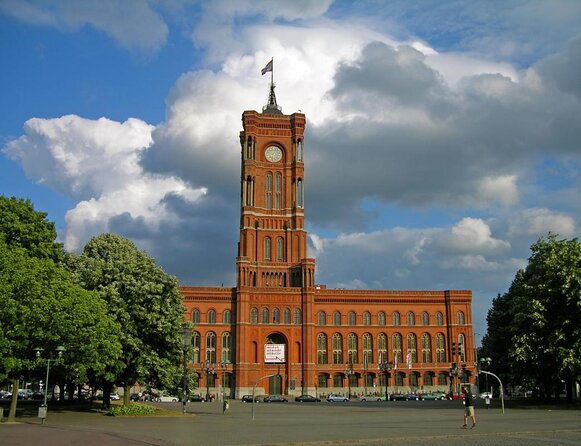
One of the biggest “why this tour is worth it” moments is the stop at Humboldt Forum. The area was empty and used for years as a parking lot, but the former palace stood there for centuries and was burned out in the war. The big story is the reconstruction choice, documented before demolition, and the rebuilding of the Schlüter inner courtyard concept.
If you want a major interior payoff on a short timeline, this is it. The ticket for Humboldt Forum is included, and the guide explains that the modern concrete structure will also host non-European art collections and Humboldt University-related collections.
Government and Cold War power centers: Reichstag, government buildings, and the Tiergarten style drive
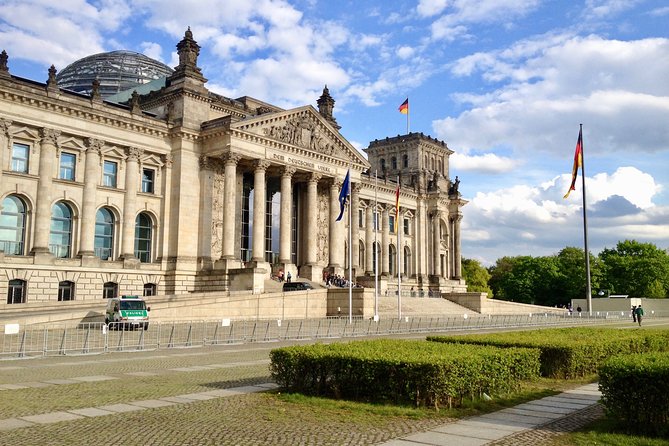
Another core strength of the route is that it includes Berlin’s governing structures, not just memorials.
Reichstag: how modern parliament works
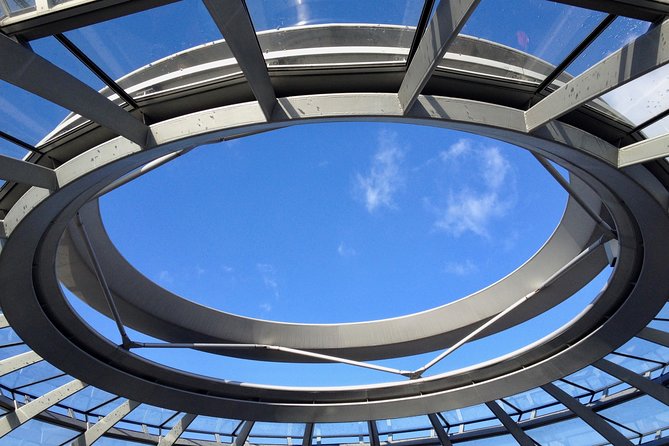
You reach the Reichstag building and the “engine of parliament” idea. The guide explains that committee work happens in bulges along a long building, while speeches are held in the main chambers. It is also described as a glass parliament from the outside, with even more restricted committee seats not fully visible.
This gives you a useful mental model. You will see it differently later if you return.
Chancellor and German government buildings: size and function
You also pass the large government office building described as the “chancellor’s” hub, with a huge scale and a rotunda featuring an official apartment. Nearby, you see a modern building with a central large window that reflects the journalists’ blue backdrop mentioned in the tour description.
Again, this is not just architecture. It is daily governance made visible.
The Holocaust and Cold War memory stops: Topography of Terror and the Checkpoint Charlie area
If you want Berlin’s darker chapters, this route includes major touchpoints.
Topography of Terror: layered history in one site
At Topography of Terror, you get a “four levels of history” feel in one stop, from Imperial and Prussian structures through Nazi-era buildings and the later Cold War era documentation. The open-air exhibition includes uncovered torture cell remains, and the documentation center continues the story into the reunification period.
It is short within the taxi format, but it sets you up with enough context to explore further later if you want.
Checkpoint Charlie area: the photo stop that still teaches
You also reach the Checkpoint Charlie area for a small photo stop and mini tour. The replica is acknowledged as a replica, not the exact original site, and the famous sign seen in photos is described as a recreated element. Still, it points you toward the bigger story: the hottest Cold War confrontation tied to October 1961.
This stop works well because it is honest about what you are seeing, and it gives you direction for what matters.
Small Berlin pleasures that fit in: gardens, embassies, and quick windows
The itinerary also includes parts that feel more like strolling through Berlin’s “status neighborhoods.”
Tiergarten corners and gardens
You get a look at a secluded park corner designed by Peter Lenné, with lakes that absorb and bundle water before it drains into canals. The stop also mentions beer garden life in Berlin, plus activities like pedal boats and boat rentals.
This matters because it balances heavy sites with the city’s everyday leisure side.
Embassy and government drives: architecture as political geography
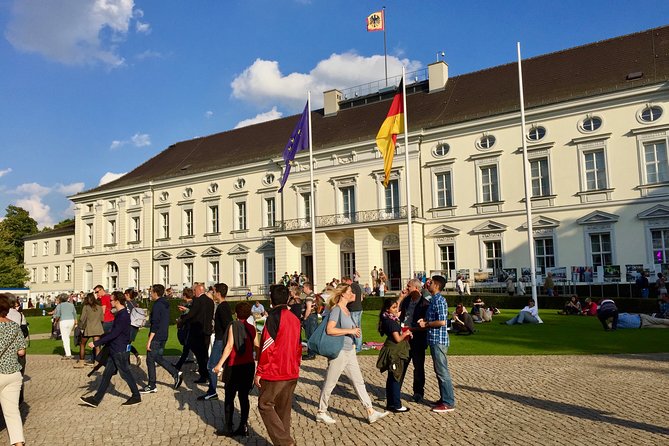
You see embassies and diplomatic buildings along key corridors, with detailed descriptions of what kinds of countries and design cues appear in the area. There is even mention of an Interconti-style high-rise with security standards and links to presidents.
If you like reading a city like a map, this section is a good use of car time.
How the guide keeps the experience moving (without feeling rushed)
One of the reasons reviews rate this tour so high is that the pacing works. Stops are frequent enough to break up driving, and the tour format supports different comfort levels for different ages.
A reviewer also noted that the guide took many photos and later sent them, which is a nice practical add-on. Another review mentioned helpful assistance with a train ticket after the tour, which shows the guide is not only “on” during the drive.
If you bring your questions, you will get answers. If you bring your camera, you will likely leave with better shots because the guide positions you at the right viewing points.
Tips to get the most from the 3 to 4 hour format
- Ask for the stories behind what you are seeing, not just dates. That is where Berlin starts to click.
- Bring water, especially if you plan to stand outside briefly for photos.
- If weather is bad, take it as a win. The taxi time keeps you comfortable, and many stops are short and visual.
- If you care about a specific period, say so early. The guide can shape emphasis around your interests.
Should you book this East and West Berlin taxi tour?
Book it if:
- you want an easy, private way to cover both East and West Berlin in a single half-day
- you care about history tied to architecture, not only facts on a sign
- you prefer short, planned viewing stops over long museum marathons
- you like the idea of a guide like Gunter Bauer who communicates ahead and follows up with photos
Skip it if:
- you want lots of interior time at multiple major museums beyond what is included at Humboldt Forum
- your travel style is mostly slow strolling with minimal car time
FAQ
FAQ
How long is the private taxi tour?
It runs for about 3 to 4 hours.
Is pickup included?
Pickup within the S-Bahn ring is included. Pickup outside the S-Bahn ring or from BER airport is available for an extra charge.
What language is the tour offered in?
The tour is offered in English.
Is this a private experience?
Yes. It is a private tour/activity, so only your group participates.
Are any tickets or entry fees included?
Humboldt Forum admission is included. Many other stops listed are marked as admission ticket free.
What about children and car seats?
A child seat is available for toddlers from six months to three years, plus a booster seat for older children. A baby seat can be brought on request (MaxiCosy).
Can I cancel for a full refund?
Yes, you can cancel up to 24 hours in advance for a full refund.
The Longer History of Berlin
Seeing Berlin in One Go
Everything else we filed on Berlin
- East Berlin: City of Shadows Walking Tour
★ 5.0 · 11 reviews - Berlin: Die Stachelschweine – Frank Lüdecke – Träumt Weiter
★ 4.7 · 11 reviews - Potsdam Day Trip from Berlin with a Local: Private & Personalized
★ 4.0 · 11 reviews - An Introduction to Berlin Walking Tour
★ 5.0 · 11 reviews - DJ for a Day: Learn to Mix Like a Pro in Berlin
★ 5.0 · 11 reviews - 2-H Segway Sightseeing Tour Berlin
★ 4.5 · 11 reviews
Historical Tours, side by side.
 ★ 4.7Leipzig: City History Canal Sightseeing Tour on a MotorboatFrom $186,232 reviews
 ★ 4.6Berlin: Natural History Museum Entrance TicketFrom $123,382 reviews
 ★ 4.7Leipzig: 1.5-Hour Historical Walking Tour in GermanFrom $172,217 reviews
 ★ 4.5Berlin: World Heritage Cruise to PotsdamFrom $251,435 reviews
 ★ 4.7Heidelberg: Night Watchman Historic Adventure TourFrom $3051,186 reviews
 ★ 5.0The Local Tour of Hamburg Historic CentreFrom $31,058 reviews
 ★ 4.8Elbfloren: Historical city tourFrom $15819 reviews
 ★ 4.6Bamberg: Guided Beer History Tour with Optional TastingFrom $21772 reviews
Other lists this tour is on