
REVIEW · PRIVATE
Private Berlin: Iconic Sights and Hidden Gems Walking Tour
Berlin hits hard, fast, and in full color. This is a private Berlin walking tour that links the big icons with the quieter, more unsettling pieces of the city’s story, and it is customized to your interests. I like the way the guide keeps the day practical, with hotel meet-and-greet so you do not waste time hunting for a meeting point.
My other favorite part is the personal attention. You can ask questions as you walk, and you are not stuck following a rigid script if your group wants more context on the Nazis, the Cold War, or Berlin’s role in reunification. One thing to consider: the route covers heavy topics, including Hitler and the Third Reich, so set your expectations for a serious day, not a casual stroll.
In This Review
- Private Berlin by Foot: What You Really Get in 3 to 4 Hours
- Picking Your Tour Length: 3 Hours for the Highlights, 4 for the Connections
- From the Brandenburg Gate to Pariser Platz: Reunification Told in Stone
- Berlin Wall Memorial on Bernauer Strasse: Where Escape Stories Get Real
- Checkpoint Charlie: The Cold War in One Famous Corner
- Gendarmenmarkt: A Beautiful Reset Before the Hard Parts
- Führerbunker: The Quiet, Chilling Reality Under the Ground
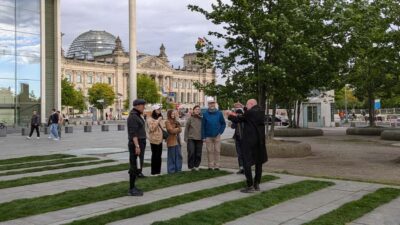
- Reichstag Building and the Glass Dome: From Turmoil to Transparent Power
- East Side Gallery: Turning a Wall Into Wall-to-Wall Art
- Museum Island, Berliner Dom, and the Spree Views: Berlin Looks Like a Postcard
- Bebelplatz and the Empty Library: When Censorship Gets a Physical Memorial
- Die Hackeschen Höfe: Finishing in a Courtyard Complex with Local Energy
- Customization That Actually Changes the Route, Not Just the Pitch
- Price and Value: Is $192.97 Worth It for a Berlin Walking Tour?
- Should You Book This Private Berlin Walk?
- FAQ
- How long is the Private Berlin Iconic Sights and Hidden Gems walking tour?
- Is this tour private or shared?
- Do I get hotel pickup and drop-off?
- What language is the tour offered in?
- Are food and drinks included?
- Do I need to pay for entry at the stops?
- Can I cancel for a full refund?
- Is the tour suitable for most people and are service animals allowed?
Private Berlin by Foot: What You Really Get in 3 to 4 Hours
This is the kind of tour that works especially well on day one, when you want to get your bearings quickly and understand why each neighborhood looks the way it does. You start in a central hotel lobby with a guide, then choose between a 3-hour or 4-hour version. The shorter option is a strong highlights run; the longer one gives you more time to connect the dots.
You also get hotel pickup and drop-off, which is a big deal in a city where landmarks can be close on a map but annoying on foot. With this setup, you can focus on the walk, the stories, and the views, instead of checking transit routes and timing.
On the “private” side, you are only with your group, so the pace can flex. Some guides in the past have tailored routes for different needs, including limited walking ability. That is the key advantage here: you are not just buying sights, you are buying a day shaped around your questions.
Other walking routes through Berlin
- Berlin: Third Reich and Cold War 2 Hour Walking Tour★ 4.9 · 6,830 reviews
- Berlin: Discover Berlin Walking Tour★ 4.9 · 5,998 reviews
- Berlin’s Best: 2 Hour Walking Tour Third Reich and the Cold War★ 5.0 · 5,486 reviews
- Berlin: Hidden Backyards Guided Walking Tour★ 4.8 · 5,360 reviews
Picking Your Tour Length: 3 Hours for the Highlights, 4 for the Connections
The tour runs about 3 to 4 hours, depending on the option you choose. In practice, this means you will have time for quick photo stops and short visits, but you will not feel like you are in a marathon of museums.
If you have limited time in Berlin, the 3-hour option still covers the main emotional spine of the city: Cold War division, reunification symbols, and the places tied to Nazi Germany and its aftermath. If you want a slower rhythm, or you know you want more context around the major WWII and Cold War sites, the 4-hour option is the better fit.
One practical note: many stops are free to enter, and the tour is structured around walking time. That makes the day feel efficient, but it also means your comfort matters. Wear real walking shoes, and if you have mobility concerns, ask your guide to adjust the pace early.
From the Brandenburg Gate to Pariser Platz: Reunification Told in Stone
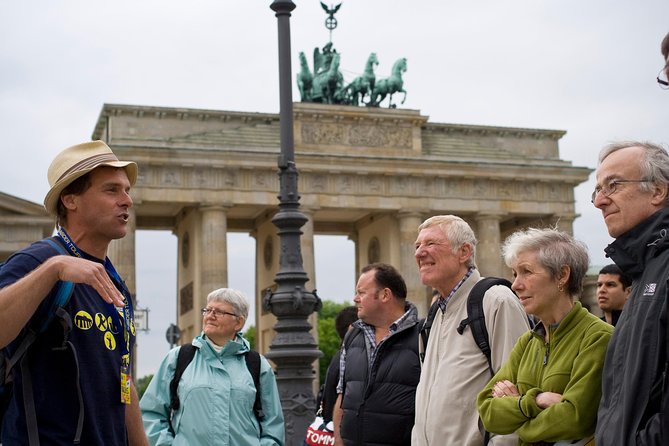
You start at Brandenburg Gate, near Pariser Platz, where the neoclassical arch and its famous Quadriga (the chariot sculpture) instantly signal a “Berlin moment.” You get around 10 minutes here, enough time to see the monument clearly and grab photos from the surrounding plaza.
The story your guide frames is the point. This is not just a pretty backdrop. It is a symbol that changed meaning over time, moving from Cold War division imagery to a national emblem tied to peace and unity. What I like about starting here is that the day gives you a narrative anchor. After you see the Gate, the later stops hit harder, because you understand what the city was trying to become.
Berlin Wall Memorial on Bernauer Strasse: Where Escape Stories Get Real
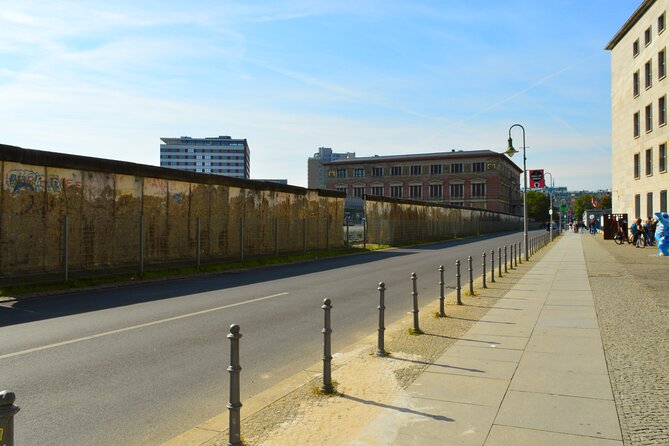
Next comes the Berlin Wall Memorial along Bernauer Strasse. You typically spend about 30 minutes, and it is the most emotionally direct stop on the route. The memorial includes preserved sections of the Wall and a visitor center with context, photos, and personal stories about the lives lived in its shadow and the attempts to flee.
This is the place where “history” stops being abstract. You can walk along the memorial and understand the Wall not just as a barrier, but as an instrument that shaped everyday fear, family decisions, and the brutal risks of trying to leave.
The Wall memorial is free to enter based on the tour info, so you can focus on the human scale of the site without ticket pressure. If you want to photograph, bring a steady hand and be ready for pauses, because the exhibits and preserved Wall sections naturally pull you into longer looks than you might expect.
Checkpoint Charlie: The Cold War in One Famous Corner
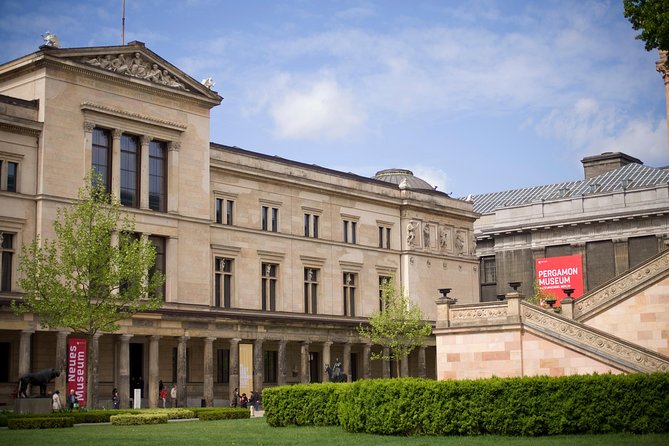
At Checkpoint Charlie (about 15 minutes), you get another fast, high-impact stop. It is one of the best-known crossing points between East and West Berlin during the Cold War, and your guide uses it to explain how division worked on a daily level.
You will see the historic border post today with museum elements, including the famous booth-style structure. It is one of those places where the visuals do most of the work, and your guide adds the missing layer, the political climate and the escape attempts behind the legend.
This is a free stop on the tour, so the value comes from the context you get while standing right where the tension was concentrated. It is also an easy place to ask questions, because your guide can point out what feels obvious from the street and what you would miss without background.
Gendarmenmarkt: A Beautiful Reset Before the Hard Parts
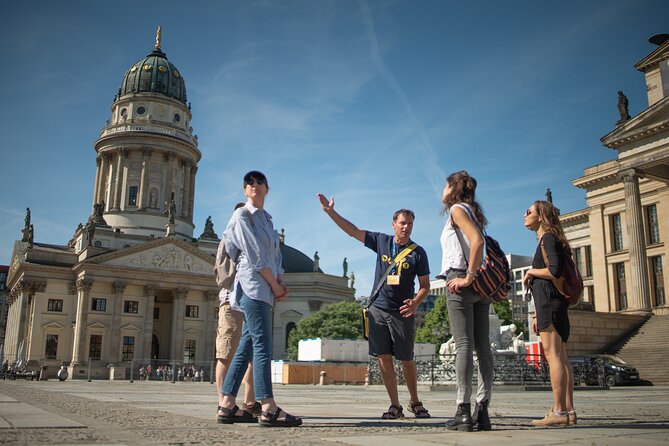
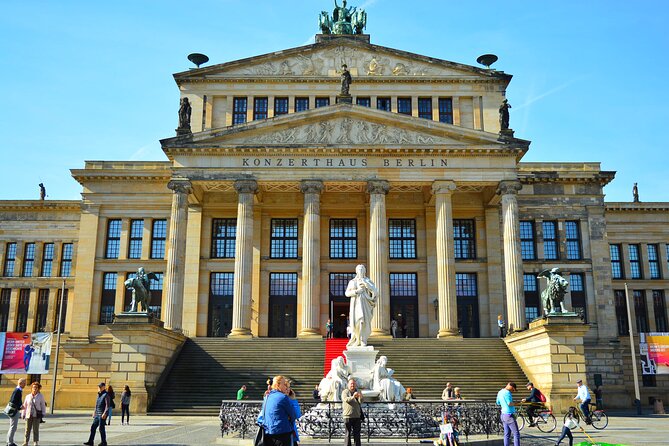
After the Cold War sites, the tour steps into Gendarmenmarkt, a stunning square with the French Cathedral (Französischer Dom) and German Cathedral (Deutscher Dom) flanking the Konzerthaus concert hall. You usually spend around 10 minutes here.
This stop can feel like a breather, and I think that matters. The day is heavy, and Berlin balances that weight with places that look orderly, symmetrical, and elegant. Even if you are not into architecture, the square gives you a sense of Berlin as a real, lived-in city, not just a history lesson.
If you catch the area with cafes active or the lighting right, you will get great photos without the “museum mood.” The tour info also notes that the square hosts events and markets, so if your timing lines up, you might see an extra layer of local life.
Führerbunker: The Quiet, Chilling Reality Under the Ground
One of the most sobering stops is Führerbunker, the underground bunker beneath the Reich Chancellery gardens. You get about 9 minutes, and for many people it is the most uncomfortable stop, because it is tied to Hitler’s final days.
Your guide frames how it was used, why it mattered strategically, and what it meant as the Allies closed in. It also helps to know what you are looking at, because the site today is largely unmarked, with only a small plaque indicating its significance. With a guide, that lack of visible “attraction” turns from confusing to meaningful.
This is not a stop you rush. Even though the tour gives you a short window, your guide will likely encourage a slower pace and careful attention. If your group wants to focus less on WWII’s darkest moments, speak up when customizing. The tour can still give you the broader story, but you should be honest about what you can handle.
Reichstag Building and the Glass Dome: From Turmoil to Transparent Power
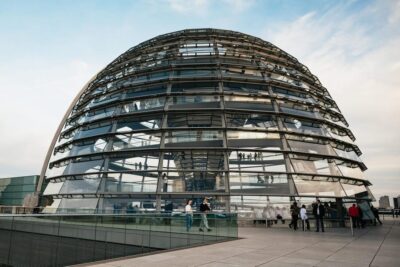
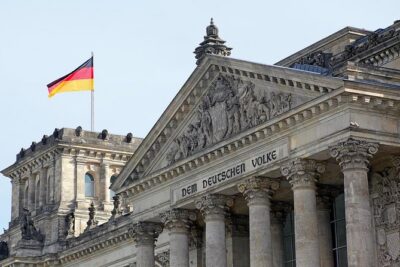
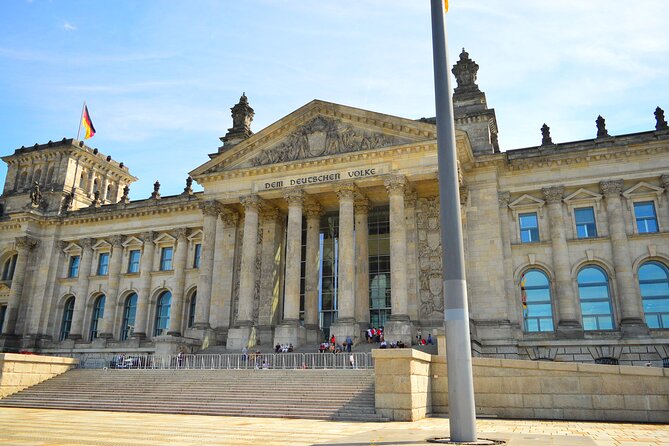
At Reichstag Building (around 10 minutes), you see Germany’s parliament building and a symbol of dramatic political change. Completed in 1894, it links to early parliamentary life, the 1933 fire that marked the rise of the Nazi regime, and the postwar restoration that led to the Bundestag seat in 1999.
The big visual here is the glass dome, designed by Norman Foster. It represents transparency in government, and it also gives a sense of architecture acting like a message. Your guide typically connects the dome to the idea that citizens should be able to see and understand power, which contrasts sharply with the secrecy and propaganda of the 1930s.
Depending on your pace, the stop can feel almost too short, because the Reichstag is the kind of place where your brain starts spinning, but it works well inside a walking tour. You get the meaning, the key architecture, and the panoramic angle outside, then you move on with context sharpened.
East Side Gallery: Turning a Wall Into Wall-to-Wall Art
Next is the East Side Gallery, a stretch of remaining Berlin Wall turned into an open-air gallery. You usually spend about 20 minutes, and it is where Berlin’s story shifts from concrete division to human creativity.
The site runs about 1.3 kilometers and features over 100 murals painted after the fall of the Wall in 1989. Your guide points out themes across the murals, including hope, unity, and the struggle for freedom. The tour info highlights one famous piece often discussed on-site, the Fraternal Kiss mural showing a kiss between Leonid Brezhnev and Erich Honecker.
What I like here is that it changes how you feel about the Wall. Instead of only seeing barrier and tragedy, you see reinterpretation. It is not that the hardship disappears. It is that Berlin chooses to talk about survival and change through public art.
Museum Island, Berliner Dom, and the Spree Views: Berlin Looks Like a Postcard
The tour adds a couple of “big view” stops around central landmarks, including Museum Island and Berliner Dom. Museum Island is about 15 minutes and is positioned for photos of museum facades, the Spree River, and the island gardens.
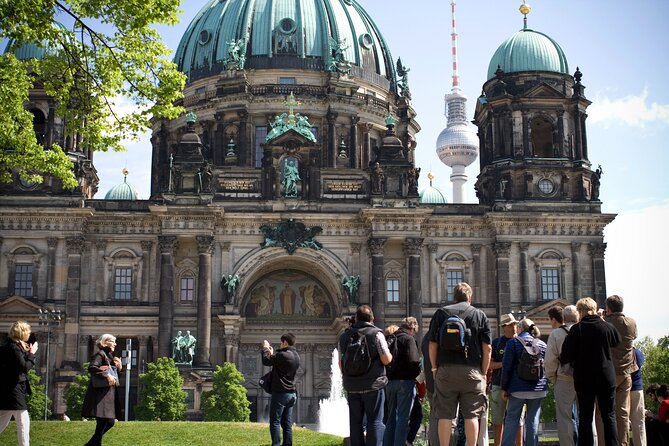
Then comes Berliner Dom, the Berlin Cathedral, where you get around 10 minutes. The Baroque design and dome dominate the skyline. The cathedral’s interior includes mosaics, altar pieces, and a major organ, and the tour mentions you can climb the dome for panoramic views.
These stops work as a needed contrast. After heavy memorials, you get sightlines, architectural grandeur, and the sense that modern Berlin is thriving. If your goal is to understand the city in one day, these are the places that make the walk feel like Berlin, not just Germany’s past.
Bebelplatz and the Empty Library: When Censorship Gets a Physical Memorial
At Bebelplatz, about 12 minutes, you step into one of the most symbolic cultural scars in the route. This square ties to the Nazi book burnings on May 10, 1933, when students and supporters burned more than 20,000 books considered un-German.
The tour info also describes the “Empty Library” memorial by Micha Ullman, an underground room of empty bookshelves visible through a glass panel. It is a striking contrast to the nearby architecture and academic institutions, and your guide typically explains why it matters that this act of censorship became a lasting public marker.
I like this stop because it broadens the story beyond politics and borders. It reminds you that control can show up as what people are allowed to read, learn, and think. It is also a reminder that Germany’s public memory includes not only memorializing victims, but confronting the machinery behind the damage.
Die Hackeschen Höfe: Finishing in a Courtyard Complex with Local Energy
The tour often ends with Die Hackeschen Höfe, about 20 minutes. This is a series of interconnected courtyards near Hackescher Markt, known for art nouveau style and ornate details. The complex dates to 1906 and includes eight interconnected courtyards.
This is the “life after history” moment. You see how Berlin’s center mixes independent shops, restaurants, and cultural venues. The tour info calls out Kino Central, one of Berlin’s oldest cinemas, and the Chamäleon Theater as possible highlights.
It is a smart place to end a walking tour because it feels easy to wander on your own afterward. Even if you do not go inside a venue, the courtyards give you a Berlin texture that does not look like a museum district.
Customization That Actually Changes the Route, Not Just the Pitch
This tour is built around customization, which matters because Berlin has multiple layers of focus. If you are into WWII and the Third Reich, your guide can emphasize the Hitler-linked sites and the Nazi-era cultural controls. If you prefer Cold War division and reunification, you can lean into Wall-related stops and crossing points.
The tour info also notes that your route could include places like Unter den Linden, the Kaiser Wilhelm Memorial Church, and areas connected to East German government life. That flexibility is a real value add, because otherwise you get the same fixed checklist no matter what you care about.
In past guide pairings, I also like what the reviews reveal about style and adaptability. Ariel gets praised for making explanations clear and using helpful visuals. Tina is called out for passion and friendliness, especially when the tour is done early in the visit. Ronja is noted for tailoring the tour to limited walking ability. Will is praised for relating history with humor, which helps when the topics get heavy. Ruben is mentioned for assisting with navigation around marathon routes, which shows the guide pays attention to practical movement, not just facts.
Your guide might use photos and visual aids, answer questions on the spot, and keep the pacing comfortable for your group. That is the difference between a tour that lists sites and a tour that helps you understand what you are seeing.
Price and Value: Is $192.97 Worth It for a Berlin Walking Tour?
At $192.97 per person, the price is not “cheap,” but it is also not priced like a full-day private car tour. What you are paying for is private guiding plus hotel pickup and drop-off, plus a route that hits multiple major sites in a limited time window.
For first-time visitors, this can be a good value because it saves you decision fatigue. Berlin’s landmarks are spread across different areas, and without context you can easily see a monument and miss the meaning. With this tour, you get guided interpretation at the most important points, including Brandenburg Gate, Wall memorials, Cold War crossing context, and key sites tied to WWII and Nazi Germany.
You also get “private” time to ask questions, which can make one stop worth more than it looks. If your group includes two or more people and you care about history context, the per-person cost can feel more reasonable because you are sharing the guiding attention.
If you already know the history well or you prefer to wander independently for long stretches, you might question the cost. This tour is best when you want both structure and explanation.
Should You Book This Private Berlin Walk?
Book it if you want an efficient introduction to Berlin that includes both the iconic landmarks and the harder, real places tied to Nazi rule and Cold War division. It is especially smart if you have only a short stay, because the route clusters major sites you would otherwise stitch together on separate days.
Also book it if you like the idea of a private guide who can adjust the pace and tailor the focus. The strong guide performance you see in past experiences, including examples like Ariel, Tina, Ronja, and Will, points to a tour that does not treat history as a lecture.
Skip it or rethink it if you want a light, non-emotional walking day. The content includes Hitler and Nazi-era topics, and you will also visit memorials that ask you to slow down and reflect.
If you want Berlin to make sense fast, this tour is a solid start, and it leaves you with a map of meaning, not just a list of stops.
FAQ
How long is the Private Berlin Iconic Sights and Hidden Gems walking tour?
It runs about 3 to 4 hours, depending on whether you pick the 3-hour or 4-hour option.
Is this tour private or shared?
It is a private tour, meaning only your group participates.
Do I get hotel pickup and drop-off?
Yes. Hotel pickup and hotel drop-off are included.
What language is the tour offered in?
The tour is offered in English.
Are food and drinks included?
No. Food and drinks are not included.
Do I need to pay for entry at the stops?
The provided stop details list admission ticket free for the sites included in the tour.
Can I cancel for a full refund?
Yes, you can cancel for a full refund if you cancel at least 24 hours before the experience starts.
Is the tour suitable for most people and are service animals allowed?
The additional info says most travelers can participate, and service animals are allowed.
Pavements of Berlin
Everything else we filed on Berlin
- East Berlin: City of Shadows Walking Tour
★ 5.0 · 11 reviews - Berlin: Die Stachelschweine – Frank Lüdecke – Träumt Weiter
★ 4.7 · 11 reviews - Potsdam Day Trip from Berlin with a Local: Private & Personalized
★ 4.0 · 11 reviews - An Introduction to Berlin Walking Tour
★ 5.0 · 11 reviews - DJ for a Day: Learn to Mix Like a Pro in Berlin
★ 5.0 · 11 reviews - 2-H Segway Sightseeing Tour Berlin
★ 4.5 · 11 reviews
Private, side by side.
 ★ 4.8Berlin: Private Reichstag and Glass Dome TourFrom $2882,226 reviews
 ★ 5.0Berlin Private Complete History All Day Walking TourFrom $253474 reviews
 ★ 5.0Munich Private Tour with a Local – Highlights & Hidden GemsFrom $112469 reviews
 ★ 5.0Private Walking Tour Berlin Third Reich Hitler and World War IIFrom $192360 reviews
 ★ 5.0Your private 3-hour Hamburg driving tour with a former policemanFrom $337304 reviews
 ★ 4.8Nuremberg: 1.5-Hour Private Tour through Historical Old TownFrom $140283 reviews
 ★ 5.0Berlin Private Half-Day Walking Tour: Discover the German Capital’s HistoryFrom $180244 reviews
 ★ 5.0Private Walking Tour: World War 2 and Cold War Sites in BerlinFrom $192230 reviews