
REVIEW · WARTIME HISTORY
Berlin Third Reich Sites: Half-Day Walking Tour
Hit Berlin’s darkest history in one smart loop.
This 4-hour walking tour strings together the Nazi takeover, the machinery of terror, and the human cost, using real locations you can stand on and make sense of. I like that it includes both the infamous power centers and the memorials that help you process what happened. The efficient route helps you cover a lot on foot without wasting your day in transit. You’ll also get a guide who can answer the messy questions, from how the regime worked to why specific groups were targeted.
Two things I really like: the focus on context (not just a list of plaques), and the chance to ask questions while you’re still looking at the sites. One drawback to consider: the subject matter is heavy, and the pacing stays firmly anchored in the Third Reich story, so if you’re hoping for more on everyday Berlin life outside this era, you may want a separate day for that.
In This Review
- Key highlights at a glance
- Why this half-day Berlin walk is worth your time
- Starting at Neue Promenade near Hackescher Markt
- Stop by stop: what you’ll see and why it matters
- Museum Blindenwerkstatt Otto Weidt
- Stiftung Neue Synagoge Berlin – Centrum Judaicum
- Anhalter Bahnhof ruins: deportations you can’t ignore
- Topography of Terror: where the regime explained itself
- Former Aviation Ministry headquarters: who paid, and how
- Johann Georg Elser Sculpture: the attempt on Hitler’s life
- The Holocaust Memorial: where you slow down
- Monument to Homosexuals Persecuted Under National Socialist Regime
- Soviet Memorial Tiergarten: the war’s aftermath in the same city
- Reichstag area: the Nazi story lands at the seat of power
- What makes the guide approach so effective
- Price and value: how $21.77 becomes a smart deal
- Who this tour suits best (and who should think twice)
- Making the most of your walk: small prep that pays off
- Should you book this Berlin Third Reich Sites walk?
- FAQ
- What time does the tour start and how long is it?
- Where do I meet the guide?
- Is the tour in English?
- How much are tickets and what is included?
- Do I need a public transport ticket?
- Does the tour run in bad weather?
- How large is the group?
- Is the cancellation policy flexible?
- Are service animals allowed?
- Where does the tour end?
Key highlights at a glance
- Historian-guided context so you understand how the Nazi system functioned
- A tight 4-hour route that covers multiple high-impact locations on foot
- Memorial stops for victims and persecuted groups, not just authoritarian landmarks
- Free entry at every stop listed on the route
- Small group size up to 25 people, which makes questions easier
- Topography of Terror area plus major government buildings in one walk
Further wartime history walks we have written up
- Berlin: Third Reich and Cold War 2 Hour Walking Tour★ 4.9 · 6,830 reviews
- Berlin’s Best: 2 Hour Walking Tour Third Reich and the Cold War★ 5.0 · 5,486 reviews
- Third Reich Berlin: Hitler and WWII Walking Tour★ 5.0 · 3,301 reviews
- Berlin: Third Reich, Hitler, and WWII Walking Tour★ 4.9 · 1,133 reviews
Why this half-day Berlin walk is worth your time
Berlin can feel like a museum built out of neighborhoods. The catch is that it is easy to wander around and still miss the “how it all connects” part. This tour is designed to solve that problem. You get a guided route that links the early Nazi rise to power, the institutions of control, the deportation story, and the aftermath you still see in the city today.
The tour also works well if you only have a short window. Four hours is long enough to get oriented, but short enough to keep the rest of your day open for your own Berlin rhythm, whether that means museums, cafés, or just walking the streets you want to linger in.
And yes, the guides matter. The guide names you’ll hear again and again include Peter, Glen, Giles, Tom, and Hannah. People praise them for being easy to follow, asking and answering questions, and handling the subject with care. That matters here, because you’re not just learning facts. You’re learning how to stand in the right mental frame while you look at real places.
Starting at Neue Promenade near Hackescher Markt
You meet at Neue Promenade 3 (10178 Berlin), in the area of Hackescher Markt S-Bahn, with the tour starting at 10:00 am. This is a practical choice: it’s a central meeting area, and it puts you on the right side of the city for the early walking segment.
Plan a little buffer. Even if you’re prompt, you’ll want a minute to settle the group before you head out. Also note that the tour runs in all weather. That means you’ll likely want layers, a hat or umbrella depending on the day, and shoes that can handle wet sidewalks.
Stop by stop: what you’ll see and why it matters
Museum Blindenwerkstatt Otto Weidt
The tour begins at Museum Blindenwerkstatt Otto Weidt, where the guide explains the history of the site (about 5 minutes, and admission is free on the listed circuit).
This stop is a good “entry point” into a dark theme without starting with the most brutal architecture. Otto Weidt’s story is about survival and small acts of defiance, tied to people who were vulnerable in Nazi Berlin. It sets a human scale for the day, so the later institutional sites land harder, not just bigger.
Practical tip: treat this as a warm-up. Listen closely to how the guide frames the people behind the history, because you’ll carry that mindset into the next stops.
Other walking routes through Berlin
Stiftung Neue Synagoge Berlin – Centrum Judaicum
Next is Stiftung Neue Synagoge Berlin – Centrum Judaicum (about 5 minutes, free entry). The guide explains the history of the synagogue site.
This matters because Nazi persecution was not random. It targeted communities with deliberate intent. Standing near the remnants and memory of a Jewish communal center helps you understand why the Nazi regime’s violence included cultural and religious erasure, not only physical harm.
If you’re the type who likes to understand Berlin’s geography, use this time to get your bearings. Once you start moving through the central Nazi-era corridor of sites, the city layout will make more sense.
Anhalter Bahnhof ruins: deportations you can’t ignore
Then you reach Anhalter Bahnhof, where the tour focuses on the history of the area (about 5 minutes, free). This is one of those places where the modern surroundings can feel too normal.
That’s the point. The Nazi system used transport, paperwork, and bureaucracy to move people to concentration camps. A guide helps you connect what you see today to what was happening to Berlin’s Jewish residents during the years of persecution.
Consider this a “be present” stop. Even if you have a strong stomach for history, let the emotional weight register. The rest of the tour builds on this reality, including the institutions behind the scenes.
Topography of Terror: where the regime explained itself
The walking stretch ends at the area of Topography of Terror (about 15 minutes, free). Your guide connects this site to the former SS and Gestapo headquarters on Prinz-Albrecht-Strasse, now associated with the museum.
This is one of the tour’s core learning stops. You’ll get the regime’s inner logic explained in plain language: how terror was organized, how power was enforced, and what roles these institutions played in everyday life under dictatorship.
What I like about this stop is that it’s not just about villains. It’s about systems. Once you understand the system, you see why the impact lasted far beyond 1945.
Former Aviation Ministry headquarters: who paid, and how
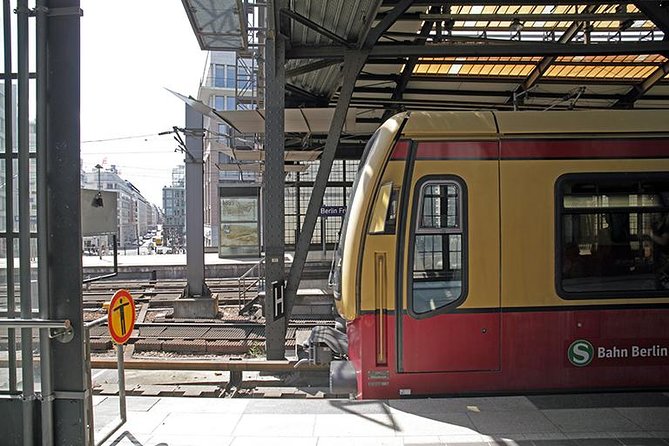
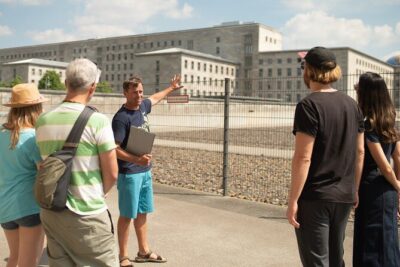
From there, you visit the former Aviation Ministery of Berlin (about 10 minutes, free). The guide discusses the site as part of the former German Luftwaffe air force headquarters and the consequences of Nazi rule for Jewish people and for Sinti and Roma communities.
This stop helps you widen the story. Nazi policies were not only directed at one target group. A good guide makes the pattern clear: persecution was built into policy, labor, and state priorities. It’s especially useful here because it moves the story beyond the most famous Jewish deportation narrative into a broader picture of who suffered and why.
If you’re interested in how Nazi institutions overlapped with war planning, this is your moment. You’ll likely start making connections between government structures and how persecution was carried out.
Johann Georg Elser Sculpture: the attempt on Hitler’s life
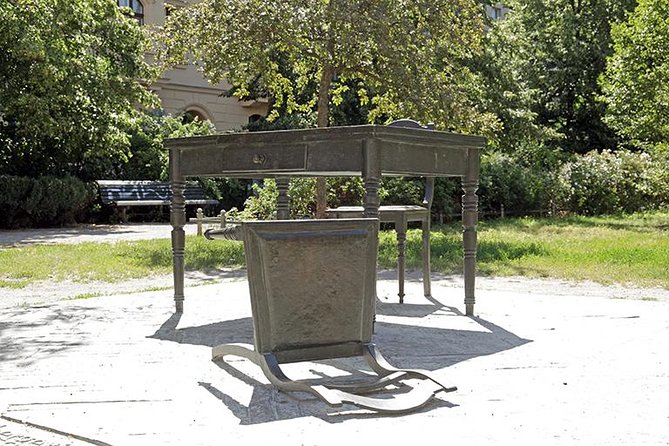
Next is the Johann Georg Elser Sculpture (about 5 minutes, free). The guide explains the history of the attempt on Hitler’s life.
This stop changes the tone in a necessary way. It reminds you that there were people trying to stop Hitler, even when the danger was extreme. Elser’s story is a reminder that history is not only about control. It’s also about resistance attempts, imperfect and difficult, in a brutal context.
The Holocaust Memorial: where you slow down
The tour then reaches Memorial to the Murdered Jews of Europe (about 10 minutes, free). The guide explains the history of the site.
This is not a “run through it” kind of stop. Even with the guide keeping you moving, you’ll need a few minutes to feel what the memorial asks of you. It’s designed for reflection. A guide’s framing helps avoid it becoming just a photo stop.
Tip for your photos: get one shot if you want, but keep most of your time for standing, reading, and letting your thoughts connect back to what you learned about deportation and state violence.
Monument to Homosexuals Persecuted Under National Socialist Regime
After that is the Monument to Homosexuals Persecuted Under National Socialist Regime (about 10 minutes, free). The guide explains the history of the site.
This is a powerful stop because it expands the story of persecution into the LGBTQ dimension. Under Nazi rule, homosexuality was criminalized and punished with the same cold logic used across the dictatorship. The monument gives you a place to recognize that harm was not limited to one victim group.
I also like that it prevents the tour from turning into a single-note tragedy. It keeps the full scope in view.
Soviet Memorial Tiergarten: the war’s aftermath in the same city
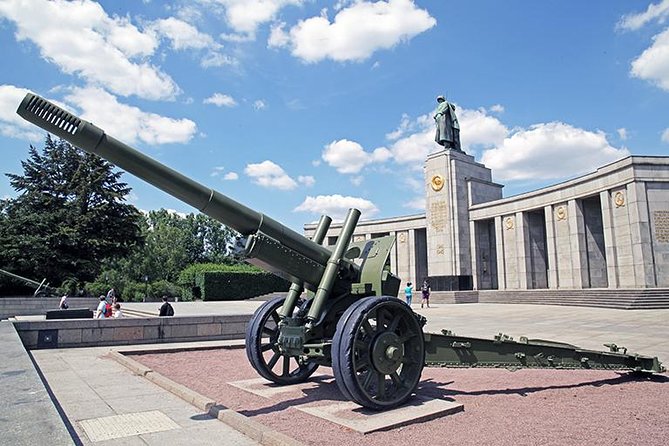
Then you visit the Soviet Memorial Tiergarten (about 10 minutes, free). The guide explains the site’s history.
This matters because the end of the Third Reich wasn’t the end of suffering. Berlin’s final days and the post-war reality shaped everything that followed. Seeing this memorial within the same day as Nazi power sites helps you understand how layered the city’s memory is.
If your brain likes timelines, this is a useful anchor. You’ll be able to place 1945 and the immediate aftermath into the broader narrative the guide started earlier.
Reichstag area: the Nazi story lands at the seat of power
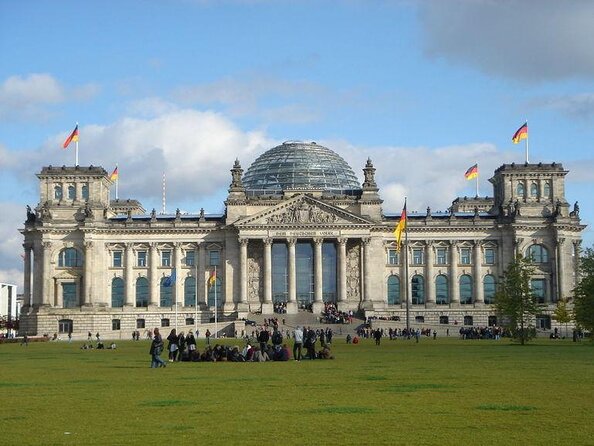
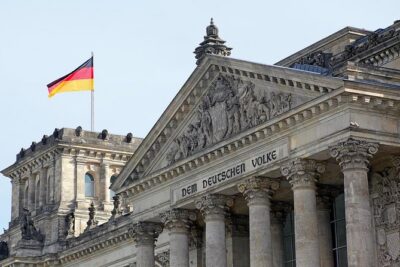
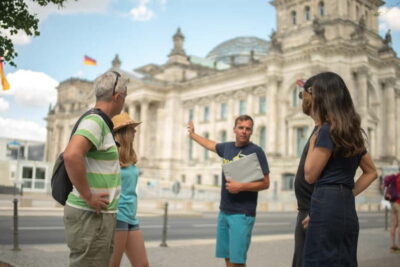
Finally, the tour ends outside the Reichstag building (about 10 minutes, free). The guide explains the history of the location, including how the Nazis came to power in 1933 and what happened in the final days of World War II in 1945.
This finish makes sense. Early Nazi rise. Central institutions of power. Then the physical climax of the war. You’re not finishing with a random landmark. You’re ending where political power was contested and where the story of the era reaches its visible conclusion.
The tour’s end point is Platz d. Republik 1 (11011 Berlin), and from there you can easily continue on your own.
What makes the guide approach so effective
A lot of walking tours list stops. This one emphasizes meaning while you’re still in front of the places.
Two specific guiding styles show up in the best feedback: guides who are easy to hear and understand, and guides who stay open to questions. People often mention guides like Steve, Tom, Giles, Gregor, and Benjamin for that combination of clarity and respectful sensitivity. If you love learning, you’ll appreciate that the guide doesn’t treat your questions as a disruption. They use them to connect dots.
Another underrated strength is the pacing. The stops are short, but the guide gives you enough context to prevent “place spotting.” You end the day with a mental map of how the regime operated, rather than just a checklist of sites.
Price and value: how $21.77 becomes a smart deal
The price is $21.77 per person for an approximately 4-hour guided walk. That sounds reasonable on its own, but the value improves when you think about what’s included.
You’re getting:
- a professional English-speaking guide
- a guided route that covers multiple major sites
- free entry at every listed stop
- a structure that keeps your time efficient
Also, you’re not spending your day figuring out routes between scattered memorials and institutional sites. You’re using your limited time in Berlin on meaning, not logistics.
One note for budgeting: transport is not included. You’ll want an AB Zone transport ticket, listed as about €3.80. This is a small add-on, but it’s worth planning for so you don’t lose time on the day.
Who this tour suits best (and who should think twice)
This tour is a great fit if you:
- want an efficient introduction to key Third Reich sites
- like learning from a guide at the actual locations
- want the memorial dimension too, including Jewish, Roma and Sinti, LGBTQ persecution, and Soviet remembrance
- can handle heavy subject matter with respect
It may be less ideal if you:
- prefer a lighter, more general Berlin overview in one hit
- want extra time inside museums rather than short stop explanations
- need more balance between Nazi-era themes and non-Nazi Berlin topics
One more practical consideration: the tour is built for walking. People mention that comfortable shoes help, especially in bad weather.
Making the most of your walk: small prep that pays off
If you do one thing, do this: go in with curiosity and a willingness to ask questions. The best guides on this route create space for you to clarify things in real time.
Also, pack for real Berlin weather. The tour runs in all conditions, so bring what you need to stay comfortable. And keep your expectations focused. This is not an all-of-Berlin political tour. It is a guided route through a specific chapter, and the guide sticks to that arc.
If you have teens or you’re traveling across generations, this can work well. Many guides mentioned in feedback made the story understandable and engaging for different ages, without turning it into a watered-down version.
Should you book this Berlin Third Reich Sites walk?
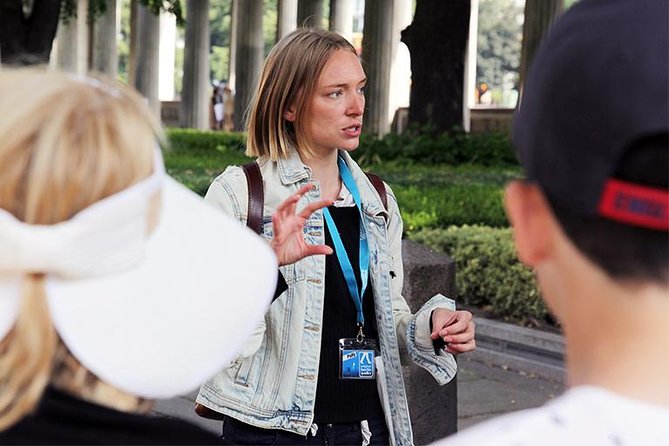
If your goal is to understand the Nazi rise, the machinery of terror, and the memorial landscape in one half-day, this is a strong choice. The 4.8 rating and the high recommendation rate reflect how often people leave with clearer connections, not just a list of stops. And the guides singled out, like Peter, Glen, Giles, Tom, Hannah, and Gregor, are consistently praised for clarity, sensitivity, and answering questions.
Book it if you want an efficient, guided orientation and you’re ready for a serious, emotionally weighty route. Skip it if you only want a casual overview, or if you want a tour that spends significant time on other eras of Berlin in the same day.
FAQ
What time does the tour start and how long is it?
The tour starts at 10:00 am and runs for about 4 hours.
Where do I meet the guide?
You meet at Neue Promenade 3, 10178 Berlin.
Is the tour in English?
Yes. The tour is offered in English, and the guide speaks perfect English.
How much are tickets and what is included?
The price is $21.77 per person. It includes the professional guide and the 4-hour walking tour. The listed stops have free admission tickets.
Do I need a public transport ticket?
Yes. You need an AB Zone transport ticket, estimated at about €3.80, and it is available at the meeting point.
Does the tour run in bad weather?
It operates in all weather conditions, so dress appropriately.
How large is the group?
The tour has a maximum of 25 travelers.
Is the cancellation policy flexible?
Yes. You can cancel for a full refund if you cancel up to 24 hours in advance of the experience start time.
Are service animals allowed?
Yes. Service animals are allowed.
Where does the tour end?
The tour ends at Platz d. Republik 1, 11011 Berlin.
Pavements of Berlin
Wartime History Walks We Have Reviewed
Everything else we filed on Berlin
- East Berlin: City of Shadows Walking Tour
★ 5.0 · 11 reviews - Berlin: Die Stachelschweine – Frank Lüdecke – Träumt Weiter
★ 4.7 · 11 reviews - Potsdam Day Trip from Berlin with a Local: Private & Personalized
★ 4.0 · 11 reviews - An Introduction to Berlin Walking Tour
★ 5.0 · 11 reviews - DJ for a Day: Learn to Mix Like a Pro in Berlin
★ 5.0 · 11 reviews - 2-H Segway Sightseeing Tour Berlin
★ 4.5 · 11 reviews
Third Reich and Wartime History Tours, side by side.
 ★ 4.9Berlin: Third Reich and Cold War 2 Hour Walking TourFrom $236,830 reviews
 ★ 4.6Munich: Third Reich & WWII Walking TourFrom $316,181 reviews
 ★ 5.0Berlin’s Best: 2 Hour Walking Tour Third Reich and the Cold WarFrom $245,486 reviews
 ★ 4.5Third Reich Walking Tour MunichFrom $454,291 reviews
 ★ 5.0Third Reich Berlin: Hitler and WWII Walking TourFrom $243,301 reviews
 ★ 4.7Nuremberg: Walking Tour of Former Nazi Party Rally GroundsFrom $151,665 reviews
 ★ 4.9Berlin: Third Reich, Hitler, and WWII Walking TourFrom $201,133 reviews
 ★ 4.8Nuremberg: Historischer Kunstbunker WWII Art Bunker TourFrom $14921 reviews
Other lists this tour is on