
REVIEW · JEWISH HERITAGE
Path of Resistance: Berlin’s Hidden Holocaust Stories
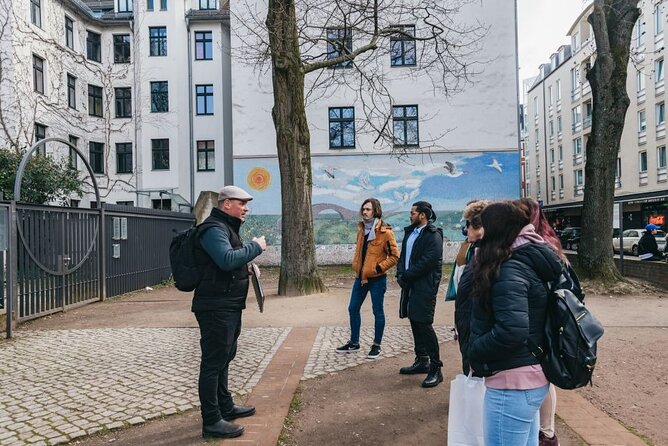
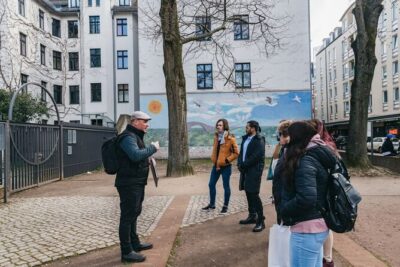
Courage has a street address in Berlin. This 2.5-hour walk through the Jewish quarter connects World War II resistance to real places, not just dates. I especially like the small group size and the World War II specialist guides who bring stories to life with care and steady pacing, including guides like Tom and Hannah.
One drawback to plan for: this is an emotionally heavy route, and it runs outdoors in all weather. So bring comfortable shoes and whatever weather gear you need, and remember there’s no food stop built into the schedule.
In This Review
- Key points that make this tour worth your time
- A Berlin walk where resistance gets real names
- Price and time: what $56 gets you in Berlin
- Meeting the route: Former Imperial Post Office, blue umbrella, then straight into history
- New Synagogue Berlin and the Moses Mendelssohn school site
- The cemetery stop: Grosse Hamburger Strasse as a lesson in memory
- Otto Weidt’s Workshop: where protection became a daily risk
- Rosenstraße, the women’s protest, and resistance in public view
- Museum Island and Neue Wache: history in the open air
- Bebelplatz 1933 book burning: when Nazis targeted ideas
- Trains to Life, Trains to Death: what happens to families
- Then and Now photos, Q and A, and how to get more out of 2.5 hours
- Respect, weather, and basic “come prepared” stuff
- Should you book this Berlin Holocaust resistance tour?
- FAQ
- How long is the tour?
- What is the meeting point for the tour?
- When should I arrive?
- Where does the tour end?
- Is this tour in English?
- How big is the group?
- Do I need public transport tickets?
- What is included in the price?
- What should I bring?
- Is the tour wheelchair accessible and does it run in bad weather?
Key points that make this tour worth your time
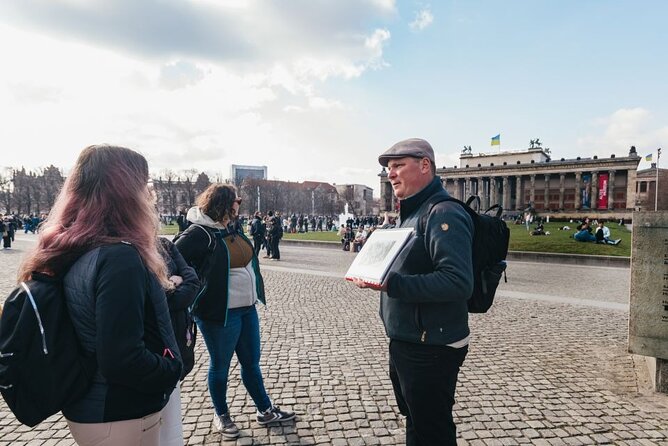
- Small-group, historian-led storytelling that keeps the pace human and the questions welcome
- Otto Weidt’s workshop shown as a practical example of protection and risk
- Rosenstraße Protest explained as a rare form of public resistance in Nazi Germany
- Bebelplatz 1933 book burning tied to the Nazi attack on free thought
- Then and Now photos plus maps help you match today’s streets to vanished lives
More Jewish heritage walks and memorial visits
- Nazi Berlin and the Jewish Community Tour★ 4.8 · 55 reviews
- Path of Resistance: Berlin’s Hidden Holocaust Stories★ 5.0 · 33 reviews
- Private Tour: Jewish Heritage Walking Tour of Berlin★ 5.0 · 29 reviews
- Jewish Berlin: Walking tour The Old Jewish Quarter (private 3 Hours tour)★ 5.0 · 27 reviews
A Berlin walk where resistance gets real names
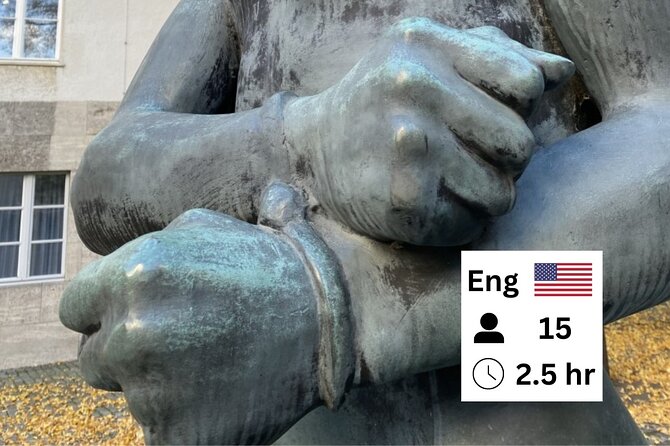
Berlin can feel like a museum. That’s true, but it’s not the whole story. On this tour, you walk where resistance happened, where people hid, argued, forged documents, protested, or simply refused to look away. You’re also taken to sites that show how Nazis tried to control not just bodies, but ideas.
The focus is on ordinary people facing impossible choices. You learn what the Nazi system claimed about “Aryan” superiority and how it organized society into invented categories of “sub-races.” That mindset mattered because it powered law, policing, deportation, and mass murder.
I like that the tone stays grounded. You’re not just handed tragedy. You’re shown how resistance took many forms, from quiet bravery to public defiance, and how hope could exist even when survival was far from guaranteed.
Price and time: what $56 gets you in Berlin
At $56 per person for about 2.5 hours, this tour sits in the mid-range for Berlin walking tours. The value comes from the guide focus and the stop mix. You get an expert local historian, museum and memorial entry included, plus Then and Now photographs and historical maps that make the route easier to understand.
Also, the group stays small, limited to 10 participants. That matters on a route like this. When you can ask questions without yelling, you get better context and fewer gaps in what you’re seeing.
If you only have an hour, you might feel rushed. But at 2.5 hours, you have time to absorb each place before you move on, which helps with a topic this heavy.
Meeting the route: Former Imperial Post Office, blue umbrella, then straight into history
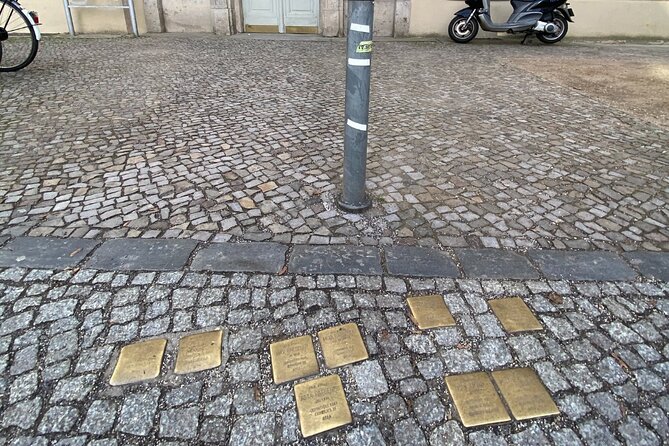
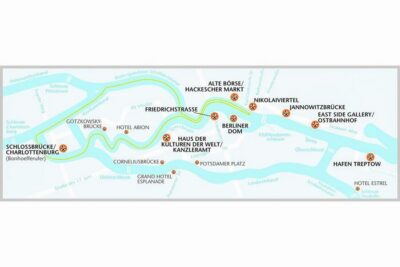
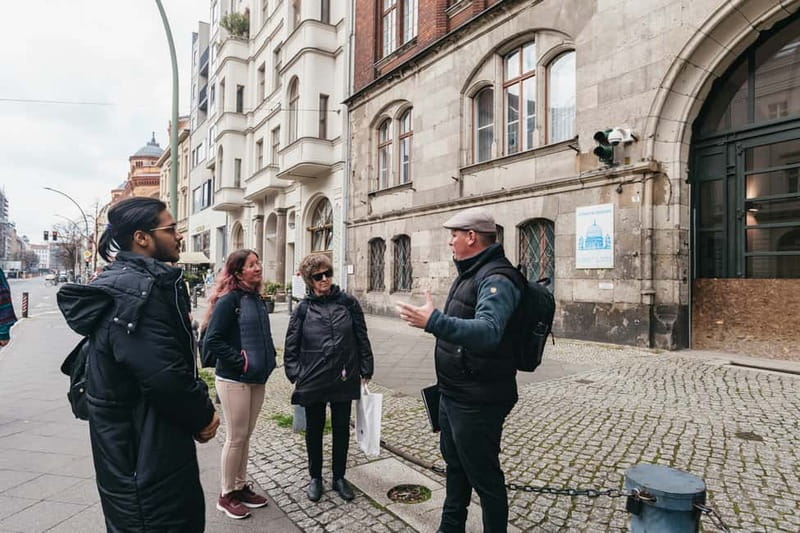
You start at the Former Imperial Post Office. The guide meets you at the main entrance holding a blue umbrella, so you can spot the group quickly. Arrive about 10 minutes early to get your bearings.
From the first minutes, the walk sets the “why” behind the “what.” Berlin’s Jewish quarter locations here are not random stops. They connect community life to Nazi targeting, and they show how quickly the city’s normal routines turned into persecution.
You’ll walk at a comfortable pace for a city tour, with short guided segments at each site. If you want to see Berlin efficiently and still feel like you understand what you’re looking at, this works well.
New Synagogue Berlin and the Moses Mendelssohn school site
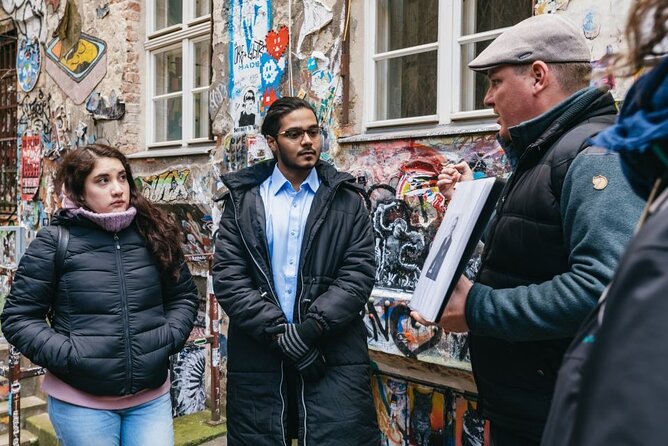
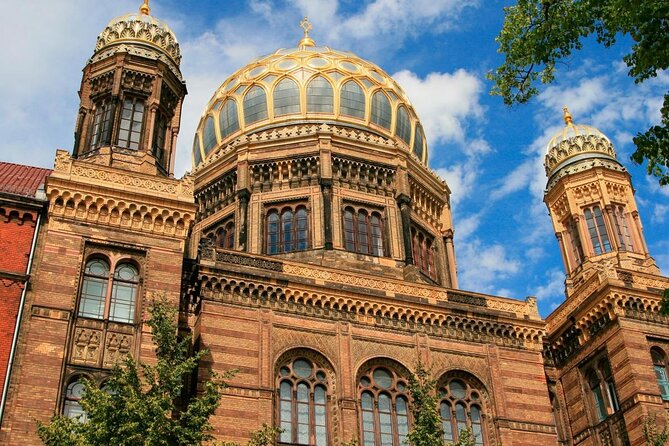
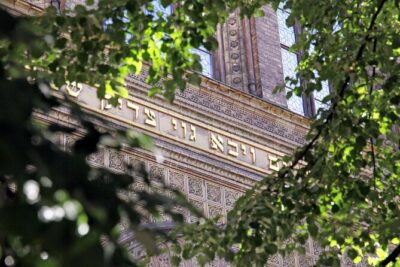
One of the first big anchors is the New Synagogue Berlin Jewish Centre area. From there, you move toward the Jüdisches Gymnasium Moses Mendelssohn. Even when you’re not inside every building, the guide helps you read what’s around you.
This is where the tour starts teaching you how Nazi ideology worked at ground level. The system didn’t only attack people in one dramatic moment. It chipped away at daily life through discrimination, exclusion, and increasing control. Seeing these locations early gives you a baseline for what was being targeted.
You also get short guided viewing windows that help you slow down. That sounds simple, but on a city like Berlin, most people speed past plaques and doorways. Here, you’re guided into seeing what the site is really saying.
The cemetery stop: Grosse Hamburger Strasse as a lesson in memory
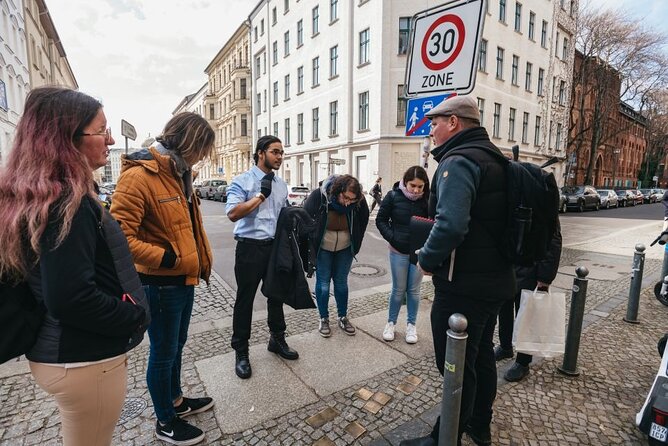
Next you visit the Grosse Hamburger Strasse Cemetery. Cemeteries can be quiet places, and this one is treated that way. The guide frames what you’re seeing as more than a list of names. You’re meant to understand that Jewish life in Berlin had deep roots and that these roots were not just erased, they were attacked.
A cemetery stop also changes your brain’s tempo. If you feel that shift, that’s normal. It’s part of how the tour keeps the story human.
Otto Weidt’s Workshop: where protection became a daily risk
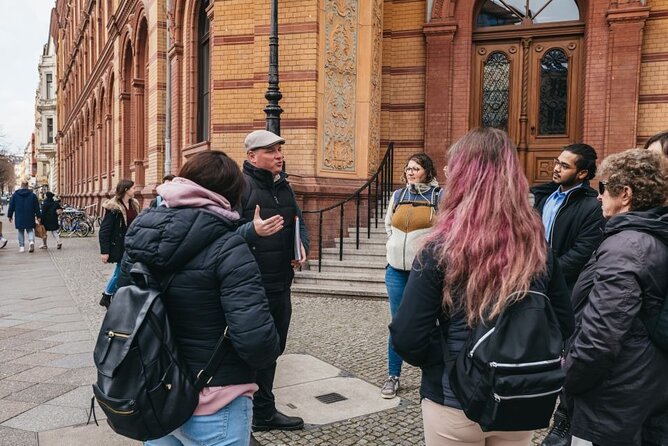
After the quieter cemetery moment, the tour moves into a more direct story of resistance. Otto Weidt’s Workshop for the Blind is one of the most memorable stops on the route.
This is where you see resistance as action, not just belief. Weidt protected blind and deaf Jewish workers from persecution, using the workshop as a place where people could work and stay under a roof when the Nazi system was closing in. The guide makes clear that protection always came with danger, because everyone around the Nazis had to decide what they could do and what they might be punished for.
If you like history that explains how people actually survived day to day, this is a highlight.
Rosenstraße, the women’s protest, and resistance in public view
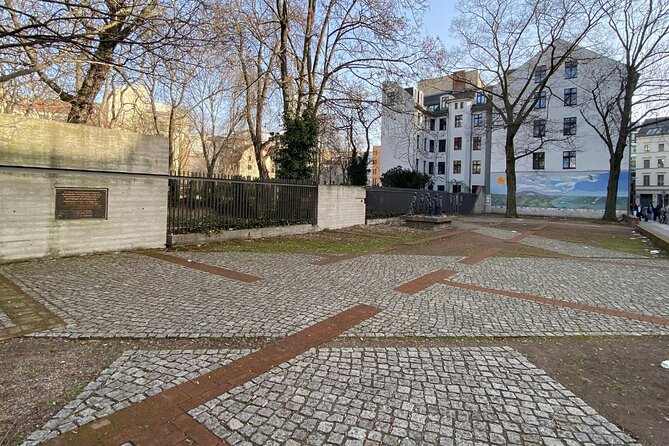
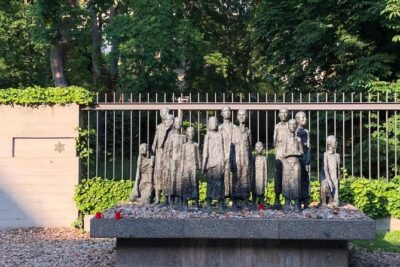
Then you reach the Block of Women, tied to the Rosenstraße protest. This part of the story is especially important because it shows a rare kind of collective action.
You hear how German women stood up to demand the release of their Jewish husbands. This wasn’t a Hollywood-style battle scene. It was risk, pressure, and public visibility in a system designed to silence dissent. The guide connects the emotional impact of that protest to the broader pattern of Nazi control and the limits of what people could resist.
You’ll likely notice how the tone changes here. You go from learning how people hid to learning how people confronted power in the open.
Museum Island and Neue Wache: history in the open air
The route continues toward Museum Island and then Neue Wache. These are different kinds of places than the Jewish quarter sites. Instead of focusing only on Jewish life and Nazi persecution, you widen your view to how Berlin remembers, frames, and debates memory.
Museum Island is also a reminder that Berlin is a city of institutions. That matters because the Nazi campaign didn’t only target communities. It targeted scholarship, intellectual freedom, and cultural independence too.
Neue Wache gives you another moment to reflect in a setting that’s more symbolic. The guide uses these stops to help you understand how public monuments and memorial spaces shape what future generations think history is for.
Bebelplatz 1933 book burning: when Nazis targeted ideas
One of the most famous stops is the Memorial to May 10, 1933 Nazi Book Burning. You stand in the area linked to the infamous book burning at Bebelplatz, and you hear how the Nazi campaign signaled an attack on free thought and intellectual freedom.
It’s easy to think of persecution as only a physical threat. This stop argues for the “control the mind” side of Nazi ideology. If you can control what people read, what they discuss, and what they’re allowed to imagine, you weaken resistance before it even organizes.
This is a great moment to ask questions if you want more context. A small group helps you do that without losing the group flow.
Trains to Life, Trains to Death: what happens to families
The tour ends with a final leg that focuses on what deportation meant in practice. You visit Trains to Life, Trains to Death, and you also spend time connecting the dots about a former deportation centre area and the impact on families.
This is where several stories click together. The guide doesn’t treat each name as an isolated anecdote. You see how the system moved people from living communities into transport, separation, and destruction.
You’ll also hear about Nicholas Winton, often described as the British Schindler, who helped hundreds of Jewish children escape the Holocaust. That story adds a different kind of resistance, one driven by rescue and urgency rather than local confrontation.
If you want the tour to feel complete, this is the segment that ties it off.
Then and Now photos, Q and A, and how to get more out of 2.5 hours
This isn’t a “silent walk past plaques” type of tour. You get interactive discussion and Q and A, plus Then and Now photographs and historical maps. Those tools are more than nice extras. They help you make sense of how Berlin has changed, which is essential when you’re trying to understand a story that no longer looks like the street you’re walking on.
A small group also helps with pacing. I like tours where you’re not shoved along like a human conveyor belt. Here, the timing supports absorbing details without feeling rushed.
Practical tip: use the Q and A moments. If something doesn’t make sense, ask. On this topic, confusion is common, and a good guide can correct your mental timeline fast.
Respect, weather, and basic “come prepared” stuff
This tour runs in all weather conditions. That means bring an umbrella and plan for temperature shifts. Also bring water, because you’ll be outside for the full 2.5 hours.
Comfort matters. You’ll be walking between multiple stops, and some sites can involve standing and quiet reading time.
The rules are simple: no alcohol and no drugs. You’re dealing with Holocaust history and resistance stories, so the expectation is serious focus and respectful behavior.
Should you book this Berlin Holocaust resistance tour?
Book it if you want Berlin history with named people and a clear moral through-line. The combination of resistance stories like Otto Weidt, Rosenstraße, and the Nazi book burning site gives you a fuller picture than the usual “hit the big monument” approach. Add small-group, historian-led guidance plus memorial and museum entry, and the value at $56 feels fair.
Skip it if you know you can’t handle heavy topics in public spaces, or if you need a tour that’s mostly upbeat. This walk includes deportation themes and the Nazi attack on Jewish life, so it’s emotionally serious.
If you’re visiting Berlin for the first time and want one tour that helps you understand the city’s WWII layers in human terms, this is a strong choice.
FAQ
How long is the tour?
It lasts about 2.5 hours.
What is the meeting point for the tour?
The tour meets at the former Imperial Post Office. The guide stands at the main entrance holding a blue umbrella.
When should I arrive?
Arrive 10 minutes before the activity starts.
Where does the tour end?
The tour finishes at Berlin Friedrichstraße station.
Is this tour in English?
Yes, the live tour guide is English.
How big is the group?
The tour is a small group limited to 10 participants.
Do I need public transport tickets?
No. Public transport tickets are not required for this walking tour.
What is included in the price?
You get an expert local historian guide, entry to museums and memorials, Then and Now photographs and historical maps, interactive discussion and Q&A, plus insider recommendations for further exploration.
What should I bring?
Bring comfortable shoes, an umbrella, and water.
Is the tour wheelchair accessible and does it run in bad weather?
Yes, it is wheelchair accessible, and it runs in all weather conditions. Dress appropriately and bring rain protection or sun coverage if needed.
Jewish Heritage and Memorial Visits
Everything else we filed on Berlin
- East Berlin: City of Shadows Walking Tour
★ 5.0 · 11 reviews - Berlin: Die Stachelschweine – Frank Lüdecke – Träumt Weiter
★ 4.7 · 11 reviews - Potsdam Day Trip from Berlin with a Local: Private & Personalized
★ 4.0 · 11 reviews - An Introduction to Berlin Walking Tour
★ 5.0 · 11 reviews - DJ for a Day: Learn to Mix Like a Pro in Berlin
★ 5.0 · 11 reviews - 2-H Segway Sightseeing Tour Berlin
★ 4.5 · 11 reviews
Jewish Heritage and Holocaust Memorial Tours, side by side.
 ★ 4.5Berlin: Jewish Museum Berlin Entrance TicketFrom $08,393 reviews
 ★ 4.8Nazi Berlin and the Jewish Community TourFrom $2755 reviews
 ★ 5.0Private Tour: Jewish Heritage Walking Tour of BerlinFrom $19129 reviews
 ★ 5.0Jewish Berlin: Walking tour The Old Jewish Quarter (private 3 Hours tour)From $35627 reviews
 ★ 4.5Jewish Life in Berlin – Private Walking TourFrom $35521 reviews
 ★ 5.0Path of Resistance: Berlin’s Hidden Holocaust StoriesFrom $4819 reviews
 ★ 5.0Jewish Berlin Extended (private Walking tour – 5 Hours)From $62418 reviews
 ★ 5.0Berlin: Jewish Museum Highlights TourFrom $717 reviews
Other lists this tour is on