
REVIEW · JEWISH HERITAGE
Jewish Life in Berlin – Private Walking Tour
Berlin hides its Jewish story in plain sight. This private 3-hour walking tour follows the threads of Berlin Jewish life from the 17th century to today, using real street corners and landmark buildings to make the past feel close. You start near Hackescher Markt, then move through neighborhoods and memorial sites that explain what changed over time.
I especially like the mix of big turning points and everyday details, from Moses Mendelssohn and the Jewish education legacy to what daily life looked like before World War II. I also love the strength of the WWII storyline, particularly at the Museum Blindenwerkstatt Otto Weidt, where you see how one workshop owner protected blind and deaf Jewish workers.
One consideration: the pacing is focused on short stops and interpretation on foot, so if you want a long, slow museum-style visit inside every site, this may feel more like an informed route than a deep exhibition day.
In This Review
- Key things you should know before you go
- A 3-hour private walk that connects 17th-century roots to today
- Hackescher Markt to Die Hackeschen Höfe: starting where the story gathers
- Blindenwerkstatt Otto Weidt: wartime rescue you can stand next to
- Scheunenviertel and Sophienstraße: how the neighborhood changed over time
- Grosse Hamburger Straße: cemeteries, schools, and what persecution did
- Sophia Church and the Martin Luther King link: a surprising connection
- Auguststraße and the old community’s footprint in modern Berlin
- The New Synagogue ending at Centrum Judaicum, from 1938 to today
- Price, pacing, and how to get real value from a private guide
- Who this tour suits best
- Should you book this Jewish Life in Berlin private tour?
- FAQ
- How long is the Jewish Life in Berlin private walking tour?
- Where does the tour start and where does it end?
- Is this tour private or a shared group?
- What are the main stops on the route?
- Is the tour in all weather?
- Are admission tickets included for the stops?
- Can I cancel and get a full refund?
Key things you should know before you go
- Private and small-group format up to 15 people, so the guide can tailor explanations and answer questions
- Otto Weidt’s workshop story adds a clear, human wartime perspective to the Holocaust narrative
- Multiple neighborhood stops help you understand how Jewish life shifted across Berlin over centuries
- New Synagogue ending at Centrum Judaicum connects the building’s late 19th-century role to today’s interpretation
- Flat walking, but still a lot of it in around 3 hours, so comfortable shoes matter
- Weather-ready plan since it operates in all conditions
More Jewish heritage walks and memorial visits
- Nazi Berlin and the Jewish Community Tour★ 4.8 · 55 reviews
- Path of Resistance: Berlin’s Hidden Holocaust Stories★ 5.0 · 33 reviews
- Private Tour: Jewish Heritage Walking Tour of Berlin★ 5.0 · 29 reviews
- Jewish Berlin: Walking tour The Old Jewish Quarter (private 3 Hours tour)★ 5.0 · 27 reviews
A 3-hour private walk that connects 17th-century roots to today
This tour is built like a guided timeline you can walk through. You move from the early waves of Jewish immigration into Berlin, through the rise and cultural influence of well-known figures, and then into the brutal rupture of the Holocaust. The goal is not only to name events, but to help you notice how communities formed, moved, and survived across different parts of the city.
Because it is private, you are not stuck watching a guide talk into a sea of heads. The route still works as a structured line, but the experience can flex a bit around your pace and interests. In reviews, guides like Caroline and Carlos stood out for handling sensitive topics well, and for keeping the conversation clear and thoughtful.
Another useful part is that you get both the landmarks people recognize and the less obvious places that explain daily life. The route includes synagogues and cemeteries, but also streets tied to schools, community institutions, and what was lost during Nazi persecution.
Hackescher Markt to Die Hackeschen Höfe: starting where the story gathers
You begin outside Starbucks at Hackescher Markt S-Bahn station. The official start address is Neue Promenade 3, 10178 Berlin, which is a short walk from that transit hub. This is a smart meeting spot because it is easy to reach, and it helps you start oriented in Berlin Mitte without wasting time.
From there, you head to Die Hackeschen Höfe, a site the guide uses as a historical doorway. You learn about the place and why it matters in the broader Berlin Jewish story, including the Memorial of the woman protest. Even in a short stop, your guide’s job is to connect the location to the people and the pressures they faced.
This section works well for two reasons. First, it sets the tone early, so later stops about the Holocaust do not feel like random heavy blocks. Second, it helps you understand the city’s layers, because Berlin does not present one clean era. It stacks.
Blindenwerkstatt Otto Weidt: wartime rescue you can stand next to
One of the strongest stops is Museum Blindenwerkstatt Otto Weidt. Your guide explains Otto Weidt, the resistance around him, and the way he protected his blind and deaf Jewish workers from persecution during the Holocaust.
This is not abstract history. A workshop is a workplace, and the story becomes easier to hold when you are standing in an environment tied to real survival efforts. The “resistance” angle matters because Berlin’s Jewish history can get flattened into tragedy alone. Here, you get a different moral shape, the kind that comes from individual action inside a system designed to crush people.
Timing is also practical. The schedule gives this stop enough attention to build meaning, but not so much that you lose the momentum of the walking route. If you like narrative nonfiction, this stop tends to be the point where the tour feels most grounded.
Scheunenviertel and Sophienstraße: how the neighborhood changed over time
After the Otto Weidt stop, the route moves into neighborhood history, especially the Scheunenviertel. Here, your guide explains the former Jewish Quarter and the history of the Jewish community in old Berlin. This is where the tour shifts from landmark buildings into city geography.
Scheunenviertel is useful because it helps you visualize community life as something spatial. People clustered for reasons tied to economics, safety, institutions, and community support. Then those same factors could make the city’s targeting more severe. The guide’s job is to connect those dots without turning it into a checklist.
Next, you pass through Sophienstraße, a picturesque street in Berlin Mitte named after Queen Sophie. It may sound like a “nice street” stop on paper, but it is a setup for context. You learn how a named street in the modern city connects back to the Jewish presence and community structures that shaped the surrounding area.
If you care about architecture and city layout, you will likely appreciate how these streets become clues. If you prefer big museum moments only, you may find this part less dramatic. Still, it is the groundwork that makes the later sites hit harder.
Other walking routes through Berlin

Grosse Hamburger Straße: cemeteries, schools, and what persecution did
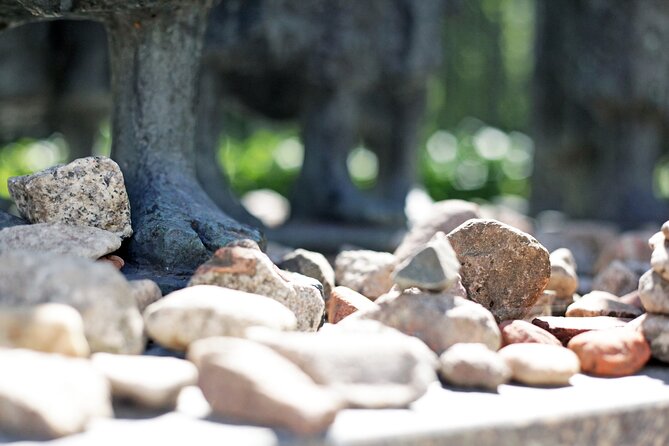
At Grosse Hamburger Straße, the guide focuses on Jewish cemeteries, a Jewish school, and how deportations were carried out during the Nazi era. This is one of those stops that is emotionally heavy, but it is also historically concrete, because cemeteries and schools are places where life leaves a long paper trail.
What I like about including this kind of stop is that it resists vagueness. You are not only hearing about dates. You are getting a sense of what institutions were meant to do: education, mourning, community continuity. Then your guide explains how Nazi policy attacked those foundations.
This is also where a good guide matters. In reviews, guides were praised for handling sensitive situations well, and for answering questions with poise. If your group has emotional reactions, you want an approach that stays respectful and clear, not defensive or rushed. This stop is exactly the kind where that shows.
Sophia Church and the Martin Luther King link: a surprising connection
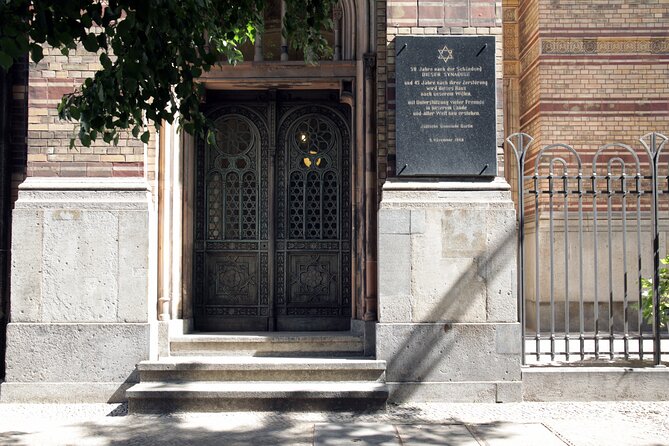
The tour then goes to Sophia Church, where your guide explains the church’s history and the connection to Martin Luther King. That might not sound like a Jewish history stop at first, but Berlin’s history is interwoven. Institutions and public life overlap across communities, even when the main story is different.
This stop can also help you place Berlin’s Jewish history inside a bigger human rights and moral conversation. Your guide’s explanation is the bridge that turns a church into a meaningful part of the overall narrative arc.
One practical note: churches and memorial-focused sites can trigger people to slow down mentally, which is normal. If you pace yourself and stay present, this part often becomes one of the most memorable transitions of the day.
Auguststraße and the old community’s footprint in modern Berlin
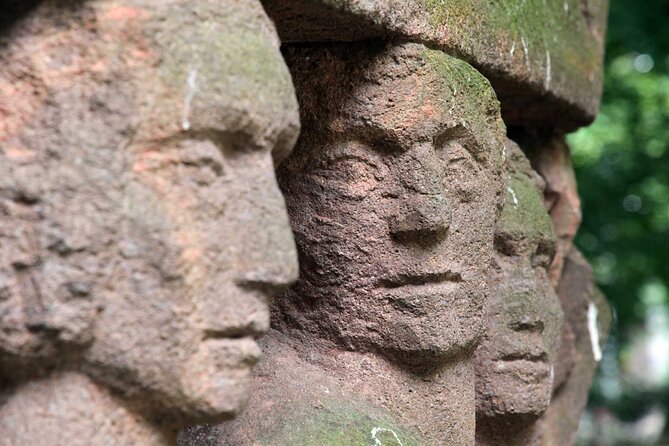
Next you reach Auguststraße, where the guide explains the history of the site known today for art galleries and important buildings of the old Jewish community. This stop works because it shows continuity and change in the same glance.
Berlin often looks like modern life now, but the built environment keeps older stories anchored to it. Your guide uses what remains to explain what used to be there, and how the Jewish community shaped the area in ways that still show up through streets, buildings, and cultural institutions.
If you enjoy “reading the city,” this stop is a good payoff. You start noticing how urban space can carry memory even after people are gone.
The New Synagogue ending at Centrum Judaicum, from 1938 to today
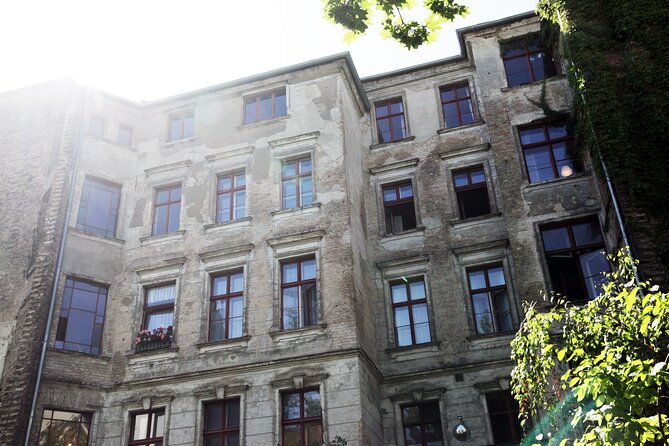
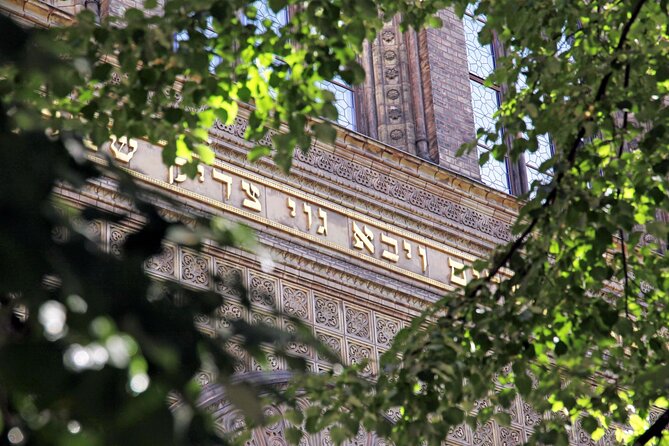
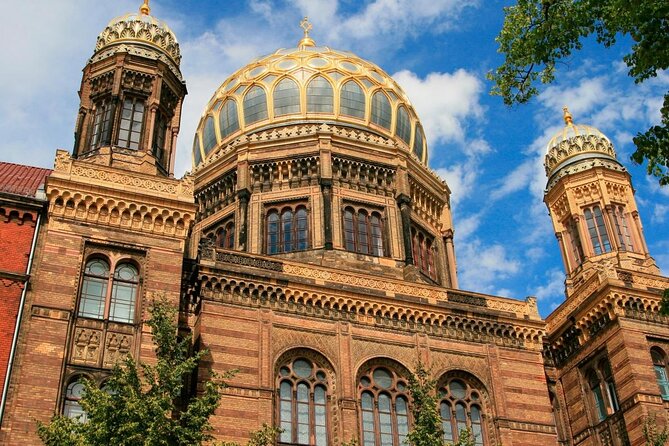
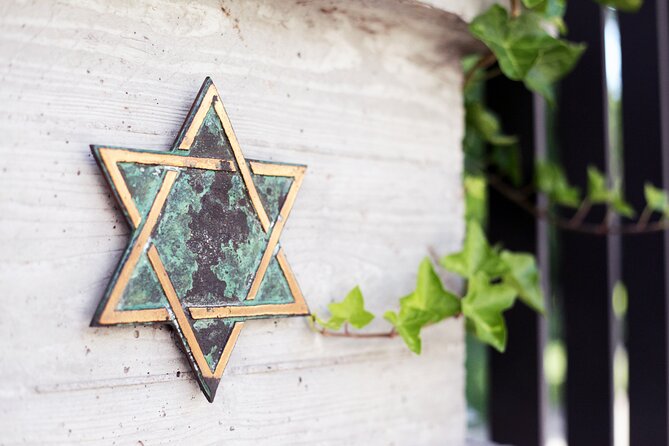
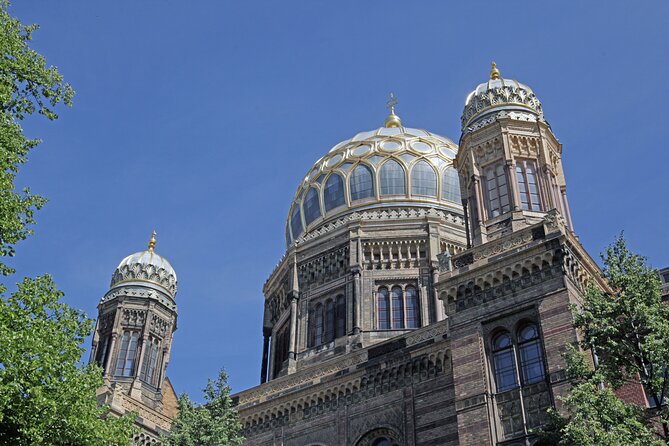
You finish at Stiftung Neue Synagoge Berlin, also known as Centrum Judaicum, located at Oranienburger Str. 28-30, 10117 Berlin. Here, your guide explains the history of the New Jewish Synagogue, including its role as the main synagogue of the Berlin Jewish community and its significance as an architectural monument of late 19th-century Berlin.
The building is important for two time periods at once. It represents Jewish communal life before the catastrophe, and it also becomes part of the present-day effort to interpret and remember. Your guide connects this to the Night of broken glass in 1938, including the people who helped Jewish people during that violent period.
This ending is designed to give you closure without pretending the story ends there. The Centrum Judaicum traces the building’s history and the life associated with it, which means you are not only looking at a landmark. You are being guided toward a framework for understanding how Berlin remembers.
Price, pacing, and how to get real value from a private guide
The price is $355.25 per group, for a private walking tour up to 15 people, and the duration is about 3 hours. That math can work out surprisingly well when the group fills up. At the maximum size, you are roughly in the $24 per person range, and you still get a dedicated guide rather than a generic group tour.
If your group is smaller, the cost per person rises, but you are still paying for the private element: you choose the pace, you can ask questions, and your guide can spend more time on the parts you care about most. If you are traveling with family members of different ages, that private flexibility can be the difference between a frustrating and a satisfying experience.
Pacing is another key value point. Reviews note that there is quite a lot of walking, but it is on flat ground. That is important in Berlin, where some tours feel like hill climbing in disguise. For this one, plan for steady walking rather than steep terrain.
What to wear is straightforward: comfortable shoes for a full 3-hour route, and dress for all-weather conditions. The tour operates in all weather, so bringing a light rain layer is a smart move.
Who this tour suits best
This is a strong fit if you want Jewish history that is grounded in specific places. If you like learning how the city worked, who lived where, and how institutions shaped community life, you will likely enjoy the route.
It also fits well if you care about moral storytelling during WWII, because the Otto Weidt stop gives you a clear resistance thread. And if your group likes asking questions, the private format makes it easier to keep things interactive.
If you only want the most famous Holocaust sites and a heavy concentration on memorials, you might be slightly surprised by the balance. This tour is designed more around Jewish life and community landmarks, then connects that history to the Holocaust through specific locations.
Should you book this Jewish Life in Berlin private tour?
If your goal is to understand Berlin’s Jewish community with real-world context, I think this is a book-worthy option. The private format, the strong Otto Weidt story, and the ending at the New Synagogue and Centrum Judaicum create a complete arc from early Jewish presence to modern remembrance.
Book it if you want facts with empathy, and you are okay spending time on streets and buildings rather than only in big exhibitions. If you are the type who needs long indoor time at every stop, consider using this as the guided backbone, then add extra independent time at whichever site you want to explore longer.
FAQ
How long is the Jewish Life in Berlin private walking tour?
It lasts about 3 hours.
Where does the tour start and where does it end?
You meet outside Starbucks at Hackescher Markt S-Bahn station, and the tour ends at New Synagogue Berlin, Centrum Judaicum on Oranienburger Str. 28-30.
Is this tour private or a shared group?
It is private. Only your group participates, with up to 15 people.
What are the main stops on the route?
The walk includes Hackescher Markt, Die Hackeschen Höfe, Museum Blindenwerkstatt Otto Weidt, Scheunenviertel, Sophienstraße, Grosse Hamburger Straße, Sophia Church, Auguststraße, and the New Synagogue Berlin – Centrum Judaicum.
Is the tour in all weather?
Yes, it operates in all weather conditions, so dress appropriately.
Are admission tickets included for the stops?
The itinerary lists Admission Ticket Free for the stops, which indicates you will not need extra admission for those scheduled visits.
Can I cancel and get a full refund?
Yes. You can cancel for a full refund if you cancel at least 24 hours before the experience starts. Canceling within 24 hours does not receive a refund.
Pavements of Berlin
Jewish Heritage and Memorial Visits
Everything else we filed on Berlin
- East Berlin: City of Shadows Walking Tour
★ 5.0 · 11 reviews - Berlin: Die Stachelschweine – Frank Lüdecke – Träumt Weiter
★ 4.7 · 11 reviews - Potsdam Day Trip from Berlin with a Local: Private & Personalized
★ 4.0 · 11 reviews - An Introduction to Berlin Walking Tour
★ 5.0 · 11 reviews - DJ for a Day: Learn to Mix Like a Pro in Berlin
★ 5.0 · 11 reviews - 2-H Segway Sightseeing Tour Berlin
★ 4.5 · 11 reviews
Jewish Heritage and Holocaust Memorial Tours, side by side.
 ★ 4.5Berlin: Jewish Museum Berlin Entrance TicketFrom $08,393 reviews
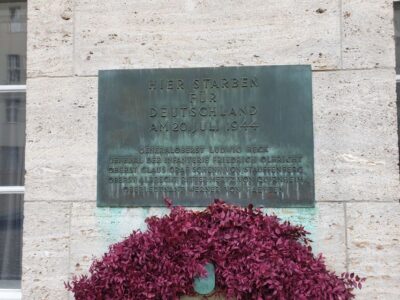 ★ 4.8Nazi Berlin and the Jewish Community TourFrom $2755 reviews
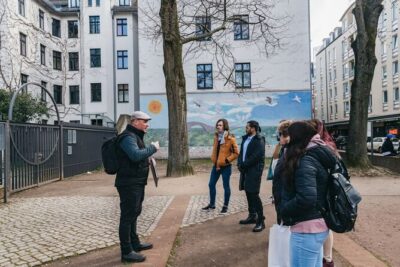 ★ 5.0Path of Resistance: Berlin’s Hidden Holocaust StoriesFrom $5633 reviews
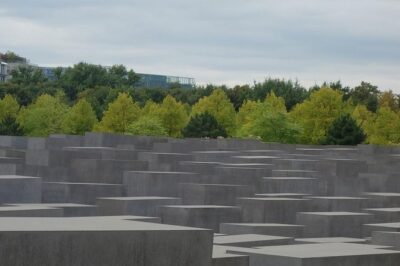 ★ 5.0Private Tour: Jewish Heritage Walking Tour of BerlinFrom $19129 reviews
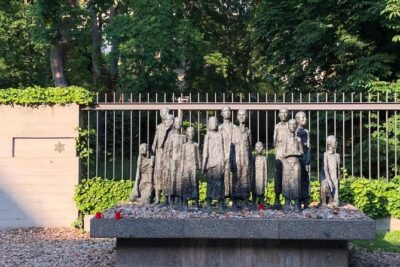 ★ 5.0Jewish Berlin: Walking tour The Old Jewish Quarter (private 3 Hours tour)From $35627 reviews
★ 5.0Path of Resistance: Berlin’s Hidden Holocaust StoriesFrom $4819 reviews
★ 5.0Jewish Berlin: Walking tour The Old Jewish Quarter (private 3 Hours tour)From $35627 reviews
★ 5.0Path of Resistance: Berlin’s Hidden Holocaust StoriesFrom $4819 reviews
 ★ 5.0Jewish Berlin Extended (private Walking tour – 5 Hours)From $62418 reviews
 ★ 5.0Berlin: Jewish Museum Highlights TourFrom $717 reviews
Other lists this tour is on